





If you like our site, mark us as a preferred source on Google — so you’ll see our articles more often in search!
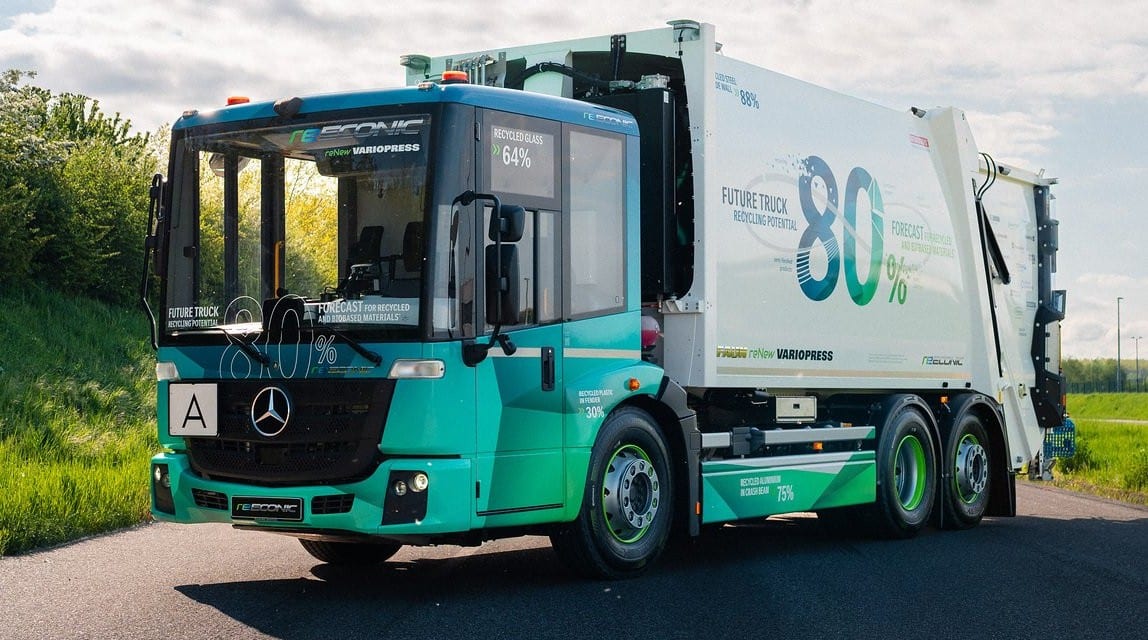
★Mark us as a preferred sourceHow can a holistic circular economy be successfully implemented within the commercial vehicle sector? A sustainability alliance comprising 33 partners—spearheaded by Daimler Truck segment Mercedes-Benz Trucks, waste management body specialist FAUN Umwelttechnik, and the recycling enterprise TSR Group—provides a tangible answer with the “reECONIC” concept vehicle. Debuting on May 4 at the IFAT environmental technology trade fair in Munich, this battery-electric waste collection truck is partially constructed from recycled, natural, and bio-based materials. The vehicle embodies a perfect circular loop: it collects waste intended for recycling processes while being largely built from recycled materials itself. Backed by a TÜV SÜD-certified study, the project demonstrates that through innovative production processes, up to 41 percent of CO₂ equivalents (CO₂e) could theoretically be saved during the manufacturing of such a vehicle.
A 33-Partner Sustainability Alliance
Achieving a circular economy in vehicle manufacturing requires collaboration across the entire supply chain. The reECONIC project is the result of an extensive network of 33 companies, including raw material recyclers, semi-finished product manufacturers, and component producers from the metal, plastic, glass, and woodworking industries.
Built on the foundation of the series-production Mercedes-Benz eEconic and equipped with the new FAUN reNew VARIOPRESS body, the concept vehicle is designed for rigorous real-world application. In the second half of 2026, the reECONIC will undergo comprehensive everyday operational testing by the waste management company REMONDIS. The practical data gathered during this phase is intended to provide crucial insights for the further development of circular vehicle concepts and future serial production.
Certified Metrics: Substituting 5.2 Tons of Raw Materials
The most striking evidence of the project’s success lies in its quantitative data, validated by the independent testing organization TÜV SÜD. In a standard, conventionally produced series eEconic, the four main material groups—steel, aluminum, glass, and plastics—account for a combined 6.5 tons of the total vehicle weight.
Through detailed forecasts and extrapolations, the partner companies have demonstrated that with currently available production methods and materials, theoretically up to 80 percent of these conventional materials could be replaced. This equates to a potential substitution of up to 5.2 tons with recycled, natural, and bio-based alternatives. Consequently, by transitioning to these sustainable resources, up to 41 percent of CO₂e emissions could be eliminated during the vehicle’s manufacturing process compared to a conventional eEconic.
Steel, Aluminum, and Innovative Bio-Plastics in the Chassis
To completely overhaul resource procurement, the consortium focused heavily on major component assemblies across the chassis, body, and interior:
-
Steel: The front axle and the two longitudinal members of the reECONIC are manufactured from CO₂-reduced steel. The flat steel used for the longitudinal members, produced via innovative electric arc furnace (EAF) technology, boasts an average recycling share of 88 percent. For the forged steel in the axle body, the recycling rate reaches an impressive 97 percent.
-
Aluminum: The cab frame and battery crash protection systems are primarily composed of extruded recycled aluminum. These components contain a minimum of 75 percent post-consumer recyclate (material recovered from used products).
-
Plastics and Bio-Materials: Conventional petroleum-based plastics have been widely replaced. The footwell trim utilizes natural-fiber-reinforced polylactic acid (PLA). The seat covers are woven from recycled polyamide sourced from carpet waste and old fishing nets. The fender fillers consist of a recycled duromer plastic, a dimensionally stable material typically used in wind turbine rotor blades and boat building. Furthermore, the display holder is made from a bio-based filler derived from sunflower oil production waste, while the dashboard incorporates lignin-based plastics (lignin being a woody plant byproduct from the pulp and paper industry). The vehicle also rides on retreaded tires, where the use of an existing casing increases the share of recycled and renewable materials to up to 80 percent after just the first retreading.
Glass Recycling and the Return of Wood in Commercial Vehicles
Visibility is paramount in urban waste collection, and the reECONIC’s panoramic windshield and large side windows deliver on this while remaining sustainable. In total, 64 percent of all glass surfaces used in the vehicle consist of recycled material. Only the glass for the mirrors and the display covers was sourced from standard series production, proving that high-quality recycled glass can be integrated into vehicle manufacturing without compromising its structural properties.
Uniquely, the reECONIC marks the first time wood has been utilized in a modern commercial vehicle from Mercedes-Benz Trucks. Beech wood—a renewable resource that binds atmospheric CO₂ during its growth—is featured in the floor elements, wheel arches, and fenders. In a specialized demonstration cab at the trade fair, the seat shell and cabin roof are also constructed entirely from wood.
The FAUN reNew VARIOPRESS: Maximizing Material Recovery
The superstructure provided by FAUN demonstrates equally massive potential for a circular economy. Within the analyzed material groups of the reNew VARIOPRESS body, up to 88 percent of the structure’s weight could theoretically be replaced by recycled materials. This is largely driven by the use of steel with a high recyclate content from CO₂-reduced electric arc furnace production.
The attention to detail in the superstructure is exceptional: the fenders are made of 92 percent recycled plastics, and the control element carriers achieve a near-perfect 99 percent recyclate share. These components are manufactured at the Osterholz-Scharmbeck production site utilizing renewable energy.
Paving the Way for Serial Production and Closed Loops
Achim Puchert, CEO of Mercedes-Benz Trucks, alongside leadership from FAUN and the TSR Group, emphasized that this is not merely a one-off exhibition piece. The partners are actively evaluating how the materials, manufacturing processes, and supply chains established in the reECONIC project can be scaled and integrated into Daimler Truck’s future serial production.
Because not all materials can currently be fully recycled, the consortium systematically analyzes material flows to identify and minimize losses. The ultimate objective is to establish closed material loops that prevent resources from ending up in thermal recovery or landfills. This industrial-scale circular economy model is designed to drastically reduce dependency on global raw material markets, strengthen the resilience of industrial supply chains, and secure long-term sustainability for the commercial transport sector.
Reference and Official Source:
-
Daimler Truck Newsroom: Zweispurig zur Kreislaufwirtschaft: Mercedes-Benz Trucks zeigt den reECONIC…
