




If you like our site, mark us as a preferred source on Google — so you’ll see our articles more often in search!
★Mark us as a preferred sourceRepresentative and analytical research by the SENS eRecycling foundation and the University of Applied Sciences and Arts Northwestern Switzerland (FHNW) has highlighted one of the fastest-growing and most severe problems in Swiss waste management: the improper disposal of single-use e-cigarettes, or vapes. According to quantitative survey data, more than half of Swiss users throw their depleted devices into standard household bins. This practice not only results in the permanent loss of valuable, recyclable raw materials but, according to FHNW’s material flow analysis, also carries severe ecological damage and critical fire safety risks for the national waste management and logistics infrastructure.
Shocking Statistics: Quantifying the Consumer Problem
The study commissioned and published by SENS eRecycling, which is responsible for the collection and recycling of electronic waste in Switzerland, paints an accurate picture of consumer habits. Based on the data, the consumption of e-cigarettes has increased exponentially, and parallel to this, their appearance as waste has reached drastic proportions.
The most important quantified results of the research are as follows:
-
In Switzerland, approximately 5 million e-cigarettes (vapes) end up in traditional household waste (Kehricht) every year.
-
54 percent of surveyed users admitted to simply throwing depleted devices into municipal garbage.
-
Only 17 percent of consumers act correctly and return used vapes to points of sale or official electronic waste collection centers.
FHNW’s Material Flow Analysis: Critical Raw Materials Lost by the Ton
The consumer data is put into even sharper focus by a scientific analysis conducted by the University of Applied Sciences and Arts Northwestern Switzerland (FHNW), which examined the ecological footprint and material composition of disposable e-cigarettes in Switzerland. FHNW researchers performed a precise Material Flow Analysis, proving quantitatively that despite the “disposable” label, these devices are complex alloys of valuable metals and plastics.
The study pointed out that incinerating the 5 million vapes that end up in Swiss household trash annually represents a dramatic loss of raw materials for the national economy, measurable in tons. Based on FHNW’s laboratory teardowns, the vast majority of the devices are manufactured with high-quality aluminum casings, batteries containing cobalt, nickel, and lithium, as well as copper wiring and various persistent plastic components.
The researchers’ model calculations highlighted that the amount of lithium from the e-cigarettes destroyed annually would alone be sufficient to manufacture batteries for tens of thousands of modern smartphones. The university’s analysis also warns that the production of e-cigarettes (which largely takes place in Asia) is extremely energy-intensive. When these metals are lost in incinerators and end up in residual toxic slag, Swiss industry is forced to import primary, mined raw materials, drastically increasing the country’s indirect CO2 emissions and ecological footprint.
Valuable Raw Materials in Incinerators and the Importance of Urban Mining
Disposable vapes are therefore not simple plastic waste, but complex Waste Electrical and Electronic Equipment (WEEE). Through improper disposal, these devices end up in waste incinerators along with household trash. According to the joint position of SENS eRecycling and FHNW, mining these metals is highly environmentally burdensome, making their recovery as secondary raw materials (Urban Mining) crucial for sustainability and European raw material independence.
Fire Hazards in the Logistics Chain
In addition to the loss of raw materials, the greatest direct danger is posed by the lithium-ion batteries found within the devices. When a vape enters municipal waste, the compaction mechanisms of garbage collection vehicles or the massive machinery of sorting plants can easily crush the thin aluminum and plastic casing.
Upon physical damage, the battery cells can short-circuit, leading to what is known as “thermal runaway.” This can cause explosive fires in both garbage trucks and waste management facilities, threatening workers in the sector with serious property damage and safety risks.
Legal Obligations and Educational Deficits
The combined data from SENS and FHNW point to a significant information asymmetry: the majority of consumers are unaware of Swiss legislation. In Switzerland, a strict legal obligation mandates the return of electronic waste. Retailers (including kiosks and online stores) are required to take back any type of electrical device they sell free of charge for disposal—regardless of whether the customer purchased the specific product there. The fact that 54% of users still throw them in the bin indicates severe educational and communication deficits on the part of distributors.
The Industry Solution: The “Vape Recycling Bag”
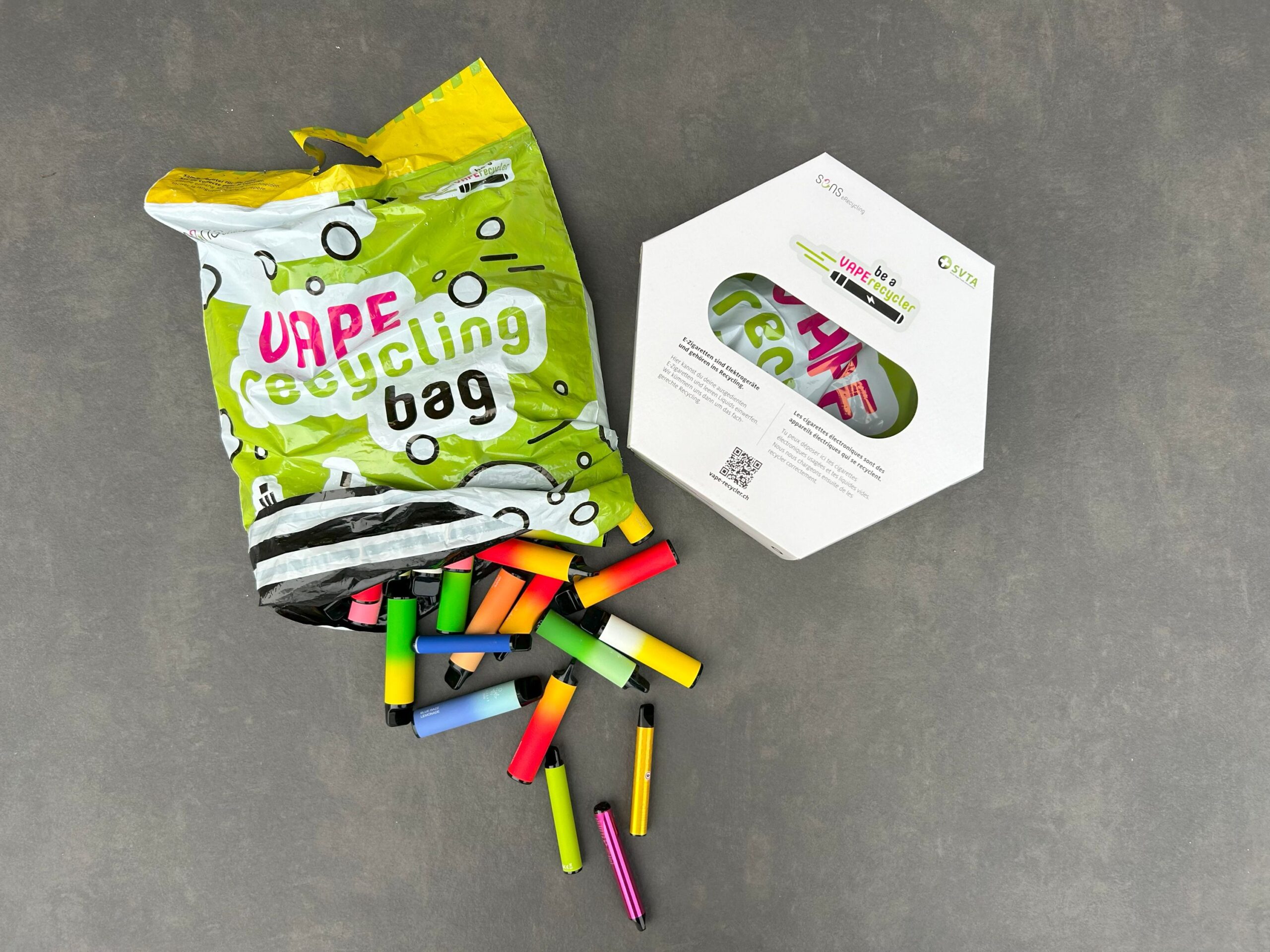
To mitigate the problem, stop the waste of raw materials confirmed by scientific research, and increase the collection rate, SENS eRecycling, involving industry partners, developed an innovative and low-threshold solution: the “Vape Recycling Bag” initiative.
The core of the concept is that consumers can order a specially designed, safe, and pre-paid bag to collect their depleted e-cigarettes in the comfort of their homes. Once the bag is full, it can simply be dropped into any Swiss mailbox, from where it goes directly to professional recycling plants supervised by SENS. During the process, the devices are safely dismantled, the batteries are neutralized, and the recovered aluminum, lithium, and plastics are returned to the industrial cycle, preventing the ecological damage outlined in the FHNW study.
References and Sources:
-
Original Study and Official Press Release (SENS eRecycling): Vapes landen im Kehricht (Swiss e-waste management foundation)
-
Research and Scientific Background: Related material flow analysis and ecological impact assessment by the University of Applied Sciences and Arts Northwestern Switzerland (FHNW).
