


If you like our site, mark us as a preferred source on Google — so you’ll see our articles more often in search!
★Mark us as a preferred sourceOne of the greatest technical challenges in the Waste-to-Energy industry is the unpredictable and highly heterogeneous composition of incoming waste. According to an official announcement by Wasteer, their latest technology powered by Artificial Intelligence (AI) brings a breakthrough to this field. The advanced software and sensor solution enables real-time analysis of the waste’s calorific value and efficient, data-driven bunker management, thereby drastically improving the operational and environmental metrics of power plants.
The Challenges of Heterogeneous Waste in Energy Recovery
A fundamental barrier to the operation of traditional waste incineration plants is that the composition of delivered municipal and industrial solid waste (MSW) is constantly changing. Moisture content, the proportion of plastics, and the presence of organic matter fluctuate continuously, leading to unpredictability in the lower heating value (LHV) of the material entering the boiler.
If the calorific value is too low, the combustion process becomes unstable, and supplemental (fossil) fuels may be required to maintain temperatures. Conversely, if the calorific value unexpectedly spikes—for example, when feeding a waste batch with high plastic content—it can lead to so-called thermal peaks. This damages the boiler grate, increases maintenance costs, and degrades emission statistics. Wasteer’s technology eliminates exactly this uncertainty factor.
Real-Time Calorific Value Analysis with Artificial Intelligence
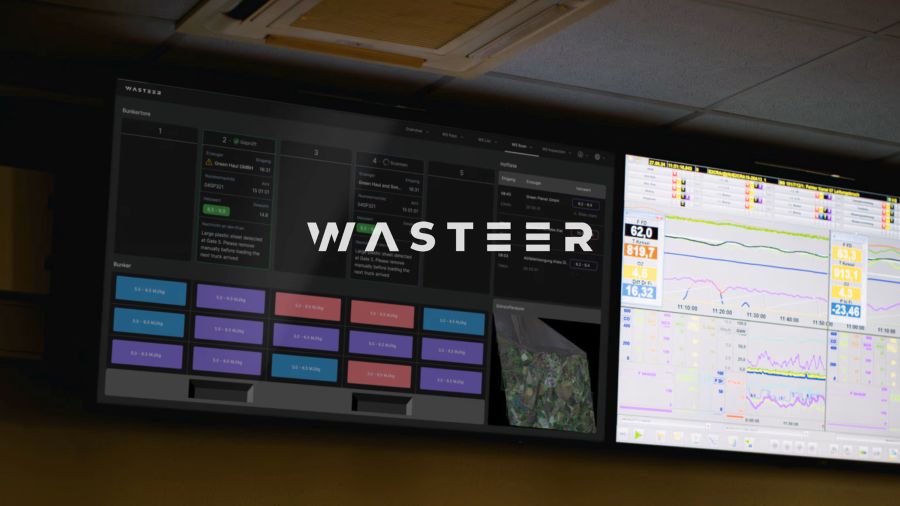
The core of the innovation introduced by Wasteer is a visual and data-driven, AI-controlled analysis system. The technology utilizes advanced camera and sensor systems mounted above the waste bunker and on the bridge cranes.
The AI algorithms scan and analyze the surface of the deposited waste in real time. Computer Vision and Deep Learning models can visually classify different material types and estimate their moisture content and density. By aggregating this data, the software provides a continuous, quantitative estimate of the waste’s calorific value before it even enters the combustion chamber.
Intelligent Bunker Management and 3D Mapping
Knowing the calorific value alone is not enough; the data must be integrated into daily operations. Wasteer’s solution creates a dynamic, three-dimensional (3D) Digital Twin of the waste bunker.
This digital heat map shows crane operators and plant managers exactly which zones of the bunker contain high and low calorific value material flows. The system generates quantitative, data-driven instructions for bunker management:
-
Optimized mixing: The software suggests to crane operators which zones to lift waste from to achieve the perfect, homogeneous blend.
-
Stable feeding: A homogeneous blend ensures that material with a consistent calorific value continuously enters the boiler, eliminating the previously mentioned thermal fluctuations.
Quantitative Benefits: Efficiency Enhancement and Emission Reduction
Based on objective technological analyses, intelligent bunker management brings immediate and measurable benefits to the Waste-to-Energy sector:
-
Stabilizing steam output: A homogeneous fuel ensures more even combustion, stabilizing the power plant’s steam production and thereby increasing the efficiency of electricity and district heating generation.
-
Reducing maintenance costs: By avoiding thermal shocks, the lifespan of boilers, refractory linings, and grates is significantly extended, reducing the number of unplanned downtimes.
-
Environmental compliance (Emissions): Combustion at a consistent temperature is essential for the optimal control of harmful substances—such as dioxins and furans—as well as carbon dioxide (CO2) emissions.
Wasteer’s development proves that artificial intelligence and big data analysis have emerged as critical tools for the circular economy and waste management, enabling precise, data-driven control over previously unmanageable processes.
References and Official Sources:
-
Original Professional Release: Wasteer: Waste management – Wasteer’s AI technology enables calorific value analysis and efficient bunker management


