


If you like our site, mark us as a preferred source on Google — so you’ll see our articles more often in search!
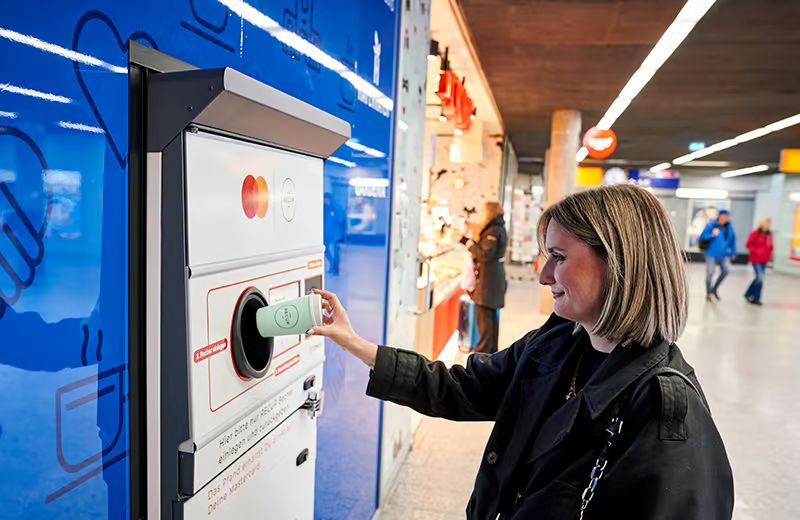
★Mark us as a preferred sourceThe city of Freiburg has once again raised the bar in sustainable urban policy. In a first for Germany, automated cup return machines have been integrated into an existing urban reusable system at Freiburg Central Station. Through the collaboration of TOMRA and RECUP, this project offers consumers a convenient, fast, and cashless solution, elevating eco-conscious waste management and the local reuse culture, which is also incentivized by a packaging tax, to a new level.
Central Location and Technological Integration
Freiburg Central Station (Freiburg Hauptbahnhof) is a crucial hub where crowds of commuters, visitors, and local residents pass through daily, and where on-the-go consumption naturally converges with public mobility. This high-traffic location was precisely chosen for the installation of two TOMRA Reuse return machines.
The machines allow cup returns at any time without requiring personal counter interactions or finding a participating RECUP café. The system automatically recognizes cups from the RECUP network. The process is fast and frictionless, and the deposit refund is immediately credited to the user’s digital payment method.
The Foundation of Success: Sustainability Policy and Packaging Tax
Freiburg has long been at the forefront of sustainable urban policy. The city possesses an established reusable packaging culture, a growing network of RECUP partners, and a packaging tax (Verpackungssteuer) that actively favors reusable solutions over single-use alternatives.
What had been missing until now was automated return infrastructure available at high-traffic locations. TOMRA’s technology is explicitly interoperable: although the machines currently accept RECUP cups, the infrastructure can be configured for other reusable packaging formats in the future. This makes it a flexible asset for any city building out its reuse ecosystem. A critical advantage of automated returns is that cities do not need to build a new system from scratch; the machines enhance and extend the existing network, increase network density, and make the overall system more practical for everyday use.
Expert Opinions: The Significance of Network Expansion
The significance of the project was emphasized by the executives of the participating companies:
-
Phillip Goos, CEO of RECUP: “Freiburg demonstrates how the RECUP network can be expanded with additional return infrastructure where there is high demand. Central stations are busy hubs: people from across the region come together here, travelling into or out of the city. Reusables need to work as simply as possible, even across city borders — and we’ve achieved that.”
-
Sven Hennebach, Senior Manager, TOMRA Reuse: “Reusable solutions work best when returning is just as easy as using. Freiburg shows how automated returns can meaningfully enhance existing reusable systems. For cities, this is a crucial point: promoting reusables or making single-use less attractive isn’t enough. The right infrastructure is needed so consumers can naturally integrate reusables into their daily lives.”
Quantitative Data and International Experience: Results from Aarhus
TOMRA Reuse’s track record in city-wide automated return systems is grounded in scalable results achieved in the city of Aarhus, Denmark. The numbers there clearly prove the efficiency of the technology:
-
More than 30 return machines have been operating in public spaces since January 2024.
-
The system has already processed nearly 2 million return transactions.
-
Over the past 12 months, a 89 percent return rate was achieved, which is among the highest recorded values for any urban reuse system in Europe.
The Role of TOMRA Reuse in the Circular Economy
TOMRA Reuse is a corporate venture of the TOMRA Group, a global leader in circular solutions. The division develops digital, traceable, and efficient systems for reusable to-go packaging, deploying them at major events and in city-wide reusable systems. The TOMRA Group itself operates more than 113,000 installations worldwide in pursuit of a world without waste.
Freiburg is the first city in Germany to successfully integrate automated returns into an existing reusable environment. This step is a clear signal of what is possible when infrastructure ambition matches policy intent.
References
-
Original TOMRA press release: Automated cup returns come to Freiburg (May 26, 2026)
-
Official state/city page on regulation: City of Freiburg – Official information page on packaging tax and reusable strategy (freiburg.de/verpackungssteuer)
Consistent structure, quick answers: every article is built so that both readers and AI search tools can find the key points easily. Our content is produced with the help of AI tools and reviewed by our editor.


