


If you like our site, mark us as a preferred source on Google — so you’ll see our articles more often in search!
★Mark us as a preferred sourceCritical raw materials in households are not an abstract supply-security concept. They are a few kilograms of copper, aluminium, nickel and rare earths behind the back panel of a washing machine, and eighty grams of high-value material in the phone that was replaced two years ago. A 2026 study by Cradle to Cradle NGO, the Cradle to Cradle Electronics Initiative and Boston Consulting Group (“Materialien, Margen, Regulierung”) is the first to quantify how much material wealth is locked into Europe’s household device stock — and why most of it is lost at end of use.
According to the study, electronic products placed on the EU market each year contain around 1.6 million tonnes of critical raw materials, roughly 11% of the total mass of those devices. The sector — large appliances, small appliances and consumer electronics combined — represents a €250 billion EU market and 12–13 million tonnes of material annually.
The average household holds 74 electronic devices
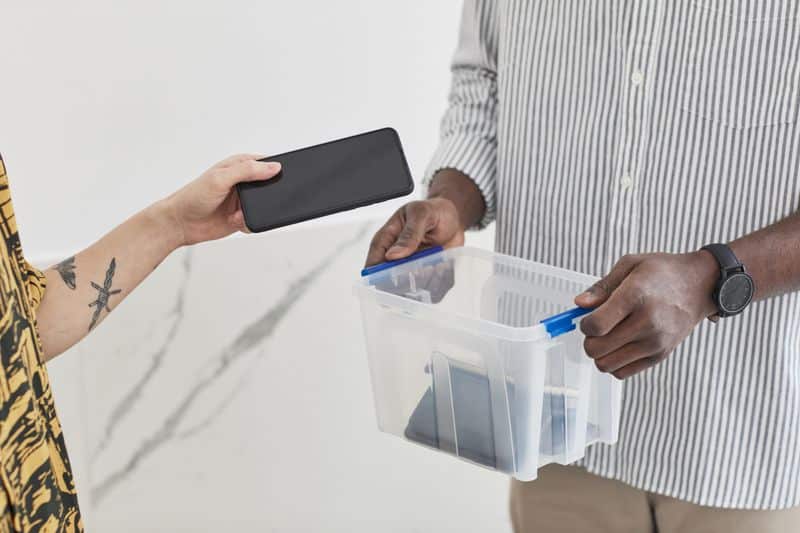
One of the study’s most striking figures comes from the consumer side: an average European household contains 74 electronic devices, 13 of which are kept unused — nine still functional, four broken. This is not just clutter. Those devices are a material stock that never enters the official collection system.
The pattern shows up at macro level too. Europe generated around 13 million tonnes of e-waste in 2022, expected to rise to 16 million tonnes by 2050. Of this, only 43% is formally collected — well short of the EU’s 65% target. The rest is traceable: roughly 13% goes into scrap and metal trading channels, where the focus is on bulk metals, 8% ends up in residual waste, around 5% is exported illegally, and the remainder stays in drawers, garages and basements.
Critical raw materials in households: how much sits in a washing machine and a phone?
A typical front-loading washing machine weighs 65–70 kg. Of that, 4 kg — about 6% — is critical raw material: copper in the motor windings and cabling, aluminium in the motor housing and brackets, nickel in the stainless steel drum and heating element, plus a few grams of neodymium-iron-boron magnets. Small by mass, large by value: those 4 kg are worth €30–35, more than 30% of the machine’s total material value of roughly €100. Meanwhile 39% of the machine’s weight is the concrete counterweight, which is essentially worthless.
For smartphones the ratio inverts, and far more sharply: 40–45% of the device’s mass, around 80 grams, is critical material, and it accounts for 90–95% of material value. Copper sits in the printed circuit board; cobalt, lithium, nickel and graphite in the battery; gold, silver and platinum group metals in the contacts and coatings.
Aggregated across the EU, the installed stock of household appliances and consumer electronics holds more than €65 billion worth of critical materials. Because the EU is a net importer, the annual material value in end-of-use products (around €9 billion) exceeds the annual material demand of European production (around €6 billion).
A tonne of retired phones beats a tonne of gold ore
At today’s gold price, one tonne of end-of-life smartphones carries €25,000–35,000 in raw material value, roughly 70% of it gold. For comparison: copper scrap fetches €7,000–9,000 per tonne, aluminium €1,000–1,800, steel just €300, mixed plastics €0–200. On paper, smartphones are the most valuable urban mining stream in the waste system.
Two figures give the scale: a tonne of phones contains 100 times more gold than a tonne of gold ore, and 15% of annual global gold production is effectively locked in mobile devices that are never recovered. An estimated 50,000 tonnes of critical raw materials sit in European drawers, and the material value in unused EU devices is put at €3.5 billion. The EU collection rate for mobile phones is below 5%, while roughly 700 million devices sit unused in households.
Ten percent of the mass, three quarters of the value
More than 90% of e-waste mass is steel, plastics and other non-critical material. But 75% of the value is in critical materials — in the narrow ten percent that today’s treatment chains preserve least well.
Large appliances — washing machines, ovens, dishwashers, fridges — account for more than 40% of e-waste by weight and are among the better-collected streams, since their size makes home storage impractical. Even so, a significant share flows into informal scrap channels. There the steel is recovered, while refrigerants, plastics and critical materials are typically lost.
So why doesn’t it come back?
The study identifies four reasons using smartphones as the example, but the logic applies to most devices.
First, collection: a device that never enters the system cannot be recovered from. Second, construction: glued, non-modular builds mixing more than 60 elements make disassembly and material separation difficult. Third, selective recovery: integrated smelting recovers gold, silver, palladium and copper at above 95%, but the end-of-use recycling rate for rare earths stays below 1%, and lithium oxidises into the slag. Fourth, unit economics: miniaturised, glued assemblies require slow manual dismantling at €2–7 per device.
For large appliances it looks like this: welded or glued sub-assemblies leave shredding as the only route. Steel, stainless steel, copper and aluminium are downcycled to lower grades, most plastics are incinerated, and the motor’s rare earth magnets are effectively lost. The long 10–20 year service life compounds the problem: a machine bought today returns in the late 2030s — meaning today’s design decisions set the volume and quality of the next decade’s secondary material supply.
The product as a material bank
This is where the Cradle to Cradle approach begins, and it begins at design. When a product is treated and designed as a material bank, it becomes a store of value: healthy, separable materials and components can be recovered at full quality, and critical raw materials return to the technical cycle instead of being lost.
The concept is usually associated with long-lived goods such as buildings, but the study argues it applies equally to electronics. Much of the value concentrates in small, material-rich components — magnets, batteries, circuit boards — so even a compact, short-lived device can be a high-grade material store. The decisive factor is therefore not primarily how long a device lasts, but whether it is designed for circulation: removable and labelled magnets, connectors instead of welds and adhesives, mono-material plastics, modular electronics.
Five business models that unlock the value
The study assesses five archetypes, rating each on resilience and commercial potential.
Material optimisation cuts primary material demand before manufacturing through higher recycled content and more efficient material use. Up to 50% primary material savings per device are achievable, including 1–2 kg of critical raw materials.
Repair services and spare parts — the European household appliance repair market is €1.5–2.0 billion today and could grow to around €3 billion by 2030. Demand is structural: 77% of EU consumers would rather repair a device than replace it. In practice repair fails on cost: once it approaches roughly a third of the new price, most people replace. Among surveyed German specialist retailers, 67% named high spare part prices as the single biggest obstacle, and 62% said many devices are not repairable by design.
Reuse and refurbishment — technically 60–70% of retired large appliances could be reused or refurbished, yet only 1–2% of collected devices are resold. Smartphones are the mature case: around 18% of phones in use in Europe are second-hand, buyers typically save 30–40% against new flagships, and the European refurbished market could reach €8 billion by 2028.
Take-back and recycling — for manufacturers this is less a margin lever than a supply instrument. Washing machines retiring in a single year contain around €0.5 billion of critical raw materials, roughly 70% of the €0.7 billion needed for annual EU production. Since about 75% of large appliances sold in Europe are also made here, closed material loops strengthen European industrial resilience directly.
Pay-per-use and rental models — here the manufacturer sells the service, not the machine, and retains ownership of the asset. That shifts the incentive towards longevity: the more use cycles a machine completes, the more it is worth.
Regulation is narrowing the options
EU regulation is turning circularity into a condition of market access. The Ecodesign for Sustainable Products Regulation (ESPR) introduces binding design requirements on repairability, durability and modularity from 2028 and 2029, with the Digital Product Passport as the central transparency instrument. The Right to Repair Directive requires repair to be offered for up to ten years in certain product categories, well beyond the warranty period. From February 2027, every battery placed on the EU market must carry a battery passport. The Critical Raw Materials Act targets covering at least 25% of annual strategic raw material demand from recycling by 2030, the WEEE Directive sets a 65% collection rate, and a Circular Economy Act has been announced for 2026.
What can a household do?
The study addresses corporate decision-makers, but its household conclusions are simple. A working device kept in a drawer is not a spare — it is a withdrawn resource. Passing on or trading in a few of those nine functional devices helps exactly where the refurbishment chain is tightest: the supply of good-quality used devices. Broken devices belong in official collection rather than mixed scrap, where the odds of recovering magnets and circuit boards are orders of magnitude better.
When buying, repairability, spare part availability and modular construction are no longer aesthetic questions — they decide whether a device serves five years or fifteen. And a refurbished device is not a compromise: the market today is constrained not by demand, but by the shortage of good-condition devices coming in.

Critical Raw Materials in Households — Frequently Asked Questions
What are critical raw materials in households?
They are materials that are economically important to the EU and carry supply risk, built into the devices in our homes: copper, aluminium, nickel, lithium, cobalt, graphite, rare earths, plus gold and silver. Electronic products placed on the EU market each year contain around 1.6 million tonnes of them, roughly 11% of their total mass.
How much critical raw material is in a washing machine?
A 65–70 kg front-loading washing machine contains about 4 kg — 6% of its mass — of critical raw materials: copper in the motor windings and cabling, aluminium in the motor housing, nickel in the drum and heating element, and a few grams of rare earth magnets. That is worth €30–35, more than 30% of the machine’s total material value.
Why is a tonne of retired smartphones worth more than a tonne of gold ore?
Because metal concentrations in phones are far higher: a tonne of devices holds roughly 100 times more gold than a tonne of gold ore. A tonne of end-of-life smartphones carries €25,000–35,000 in raw material value, about 70% of it gold. By comparison, copper scrap fetches €7,000–9,000 and steel just €300 per tonne.
How many unused devices sit in an average household?
The study finds an average European household holds 74 electronic devices, 13 of them unused: nine still functional, four broken. Across Europe roughly 700 million mobile phones sit idle, together holding some 50,000 tonnes of critical raw materials, with an estimated material value of €3.5 billion.
Why are critical raw materials lost during waste treatment?
Four reasons combine: most devices never enter formal collection (only 43% in Europe), glued and non-modular construction makes disassembly difficult, recovery is selective — the rare earth recycling rate is below 1% — and manual dismantling costs €2–7 per device, making the unit economics negative.
What can a household do to keep critical raw materials in circulation?
Pass on or trade in working devices you no longer use: the shortage of good-condition used devices is what limits the refurbishment market. Send broken devices to official collection rather than mixed scrap. When buying, treat repairability, spare part availability and modular construction as the decisive criteria.
About the study: Materialien, Margen, Regulierung: Der Cradle to Cradle Case für Europas Konsumelektronikmarkt (2026), published by Cradle to Cradle NGO, the Cradle to Cradle Electronics Initiative and Boston Consulting Group. The C2C Electronics Initiative is a three-year effort by Cradle to Cradle NGO, Bertelsmann Stiftung and Röchling Stiftung, aiming to make Cradle to Cradle the standard for electronic consumer goods.
Consistent structure, quick answers: every article is built so that both readers and AI search tools can find the key points easily. Our content is produced with the help of AI tools and reviewed by our editor.


