


If you like our site, mark us as a preferred source on Google — so you’ll see our articles more often in search!
★Mark us as a preferred sourceThe UK Fast-Moving Consumer Goods (FMCG) sector has reached a critical turning point. As Extended Producer Responsibility (EPR) regulations tighten and consumer expectations rise, data has become the new currency of sustainability. The strategic partnership between Polytag and Interket UK provides a revolutionary answer to the “blind spots” of waste management through invisible, UV-readable tags.
In traditional waste processing, brands and retailers have historically relied on estimates regarding the recycling rates of their products. This uncertainty represents not only an environmental challenge but a significant financial risk under new EPR frameworks, where companies must provide verifiable data on the lifecycle of their packaging. Polytag’s technological innovation, combined with Interket UK’s printing expertise, offers a direct solution to this transparency gap.
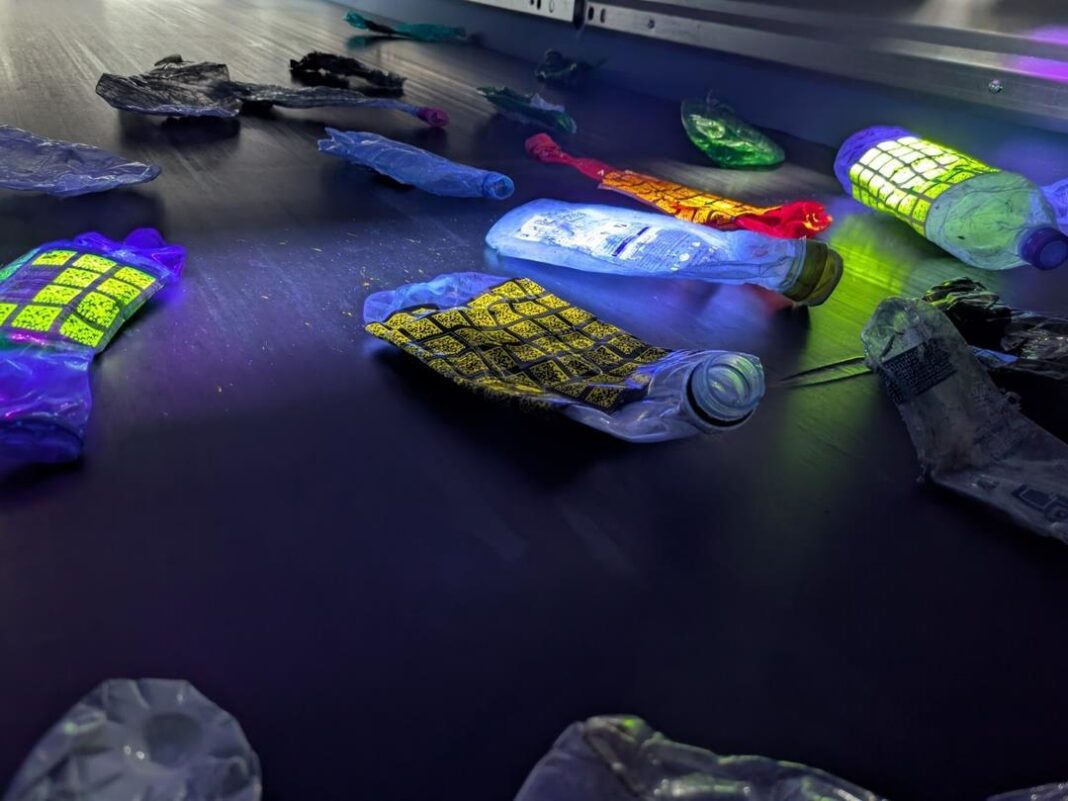
Invisible Codes, Visible Results
The core of the technology is a 2D matrix code printed with UV ink, invisible to the human eye. These “digital fingerprints” are integrated into product labels by Interket UK without compromising high-speed production lines. When the packaging reaches a Material Recovery Facility (MRF), UV-reading units installed by Polytag identify the code and provide real-time data to the system.
According to David Acott, Operations Director at Interket UK, the primary challenge was scaling laboratory success to an industrial level. Harmonizing ink density, various substrates (materials), and sensor reliability was the key to success. The result is a solution that makes goods traceable without altering the original aesthetic of the packaging.
Success in Numbers: From 5 Million to 100 Percent
The effectiveness of the collaboration has already been proven through several large-scale projects. A major early milestone was the trial with Ocado Retail, which saw over 5 million labels equipped with markings printed on Ecoket material, containing at least 30% recycled content.
The quantitative data and validated results are compelling:
-
100% Detection Rate: In independent tests under real-world operating conditions, Polytag’s UV technology identified tagged packaging with maximum precision.
-
83% Identification Rate: At the barcode level, identification stabilized at this high level, providing sufficient data for accurate statistical reporting.
-
146,000 Tonnes of Waste: The system has been deployed across four sorting centers in Wales, enabling the tracking of this massive annual volume of household waste.
-
50% Coverage: Through Polytag’s Ecotrace program, the goal is to cover nearly half of the UK’s waste processing capacity, partnering with industry leaders like Biffa and Re-Gen.
Industry Giants Onboard
This technology is no longer a theoretical concept; major players in the British market are already utilizing it. Marks & Spencer (M&S) implemented UV codes on its popular four-pint milk bottles, contributing to a £100,000 investment to enhance recovery infrastructure. Other retailers, including Aldi, Co-op, and Waitrose, have followed suit, with Waitrose also applying the Interket and Polytag solution to its milk packaging.
The data flows directly to the producers’ and retailers’ dashboards, allowing them to know exactly what percentage of their products actually reach recycling plants.
Financial and Regulatory Advantages
The adoption of this technology is driven by firm economic interests. Under EPR regulations, producers are responsible for the costs of managing packaging waste. Without precise data, companies often pay higher fees based on “worst-case scenario” estimates. UV tags allow for optimized fees and the avoidance of penalties through proven recycling data.
Alice Rackley, CEO of Polytag, emphasized that the goal is for packaging to cease being a static container and instead become a “smart asset” that generates data throughout its entire lifecycle.
Summary: The Future is Already on the Shelves
The partnership between Polytag and Interket UK has demonstrated that the transition to a circular economy does not require radical changes in consumer habits if the technology works invisibly in the background. Scalable and designed for industrial speeds, UV tagging has become a mature solution ready to become the standard across the UK FMCG sector.
References and Sources:
-
GS1 UK Case Study: Ocado Retail & Polytag (Official standards and regulatory reference point)
Consistent structure, quick answers: every article is built so that both readers and AI search tools can find the key points easily. Our content is produced with the help of AI tools and reviewed by our editor.


