



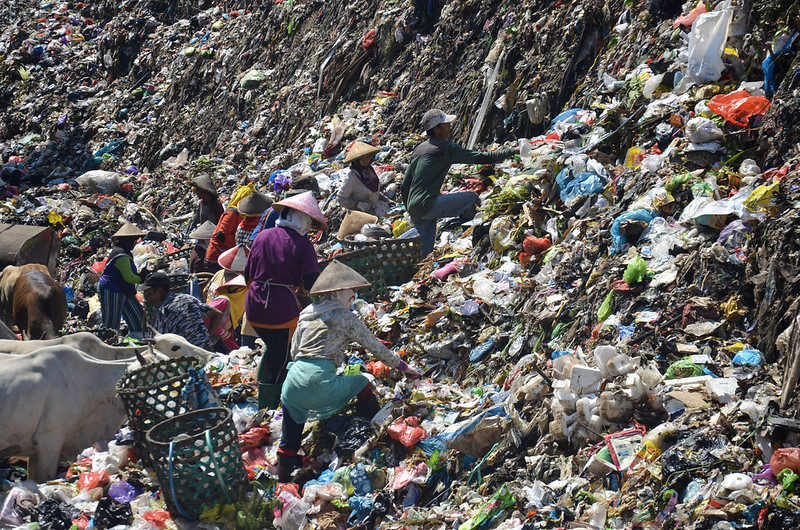
Indonesia is one of the world’s largest plastic polluters, where nearly half of all households continue to dispose of trash by burning it, causing a severe air pollution and public health crisis. According to the latest report from Mongabay, Jakarta’s new pilot project, “Kunang-Kunang” (Fireflies), aims to eliminate this illegal yet systemic practice through decentralized methods and community cooperation. The stakes are immense: Jakarta produces more than 8,000 tons of waste daily, while the city’s main landfill is on the brink of total collapse.
In Indonesia, burning trash in backyards or on the streets is not merely a cultural remnant but a forced consequence of inadequate waste collection infrastructure. Data from the World Bank and local organizations suggest that for a significant portion of the population, burning is the only accessible “solution” to accumulating waste, regardless of its environmental and health costs.
The Silent Killer: Waste Burning Statistics
Data cited by Mongabay highlights the gigantic scale of the problem:
-
48 Percent: According to World Bank data, nearly half of Indonesian households destroy their waste via open-air burning.
-
8,200 Tons: The city of Jakarta produces this much solid waste every single day.
-
PM2.5 Pollution: Waste burning is a primary source of fine particulate matter (PM2.5), making Jakarta one of the world’s most polluted cities in terms of air quality.
-
Bantargebang Crisis: The capital’s main landfill, the 110-hectare Bantargebang, reached its capacity limit as early as 2021 and currently operates only through overloading.
The report emphasizes that dioxins and furans produced during the burning of plastics not only increase respiratory diseases but are also carcinogenic and enter the local food chain.
“Kunang-Kunang”: Community Light in Waste Management
The project named “Kunang-Kunang” (Fireflies) was launched by the DKI Jakarta Environmental Agency in close cooperation with NGOs such as the Nexus3 Foundation. The project’s name refers to the fact that fireflies only thrive in clean environments, making the program’s success a symbol of environmental rehabilitation.
The core of the project is decentralized waste management:
-
Local-Level Sorting: Residents in participating neighborhoods (RWs) are encouraged to sort organic, recyclable, and residual waste at the source.
-
Integration of Waste Banks (Bank Sampah): Recyclables are taken to local “waste banks,” where residents receive credit or cash for their paper, plastic, and metal.
-
Door-to-Door Collection: The project has established a collection system that guarantees sorted waste actually reaches processing centers, removing the incentive for residents to burn it.
Obstacles to a Mindset Shift
While the pilot projects are successful, the report points to systemic obstacles. In Indonesia, burning trash is prohibited on paper and punishable under the 2008 Waste Management Law; however, in practice, authorities rarely impose fines because they cannot offer an alternative to the population.
Experts from the Nexus3 Foundation believe the biggest challenge is organic waste, which accounts for more than 50-60 percent of household trash. If this cannot be composted locally or converted into biogas, residents will continue to choose burning to avoid odors and pests.
Future Vision: Expansion or Collapse?
Jakarta’s environmental authorities aim to use the lessons from the “Kunang-Kunang” project to significantly reduce the volume of waste sent to the Bantargebang landfill by 2030. However, this requires scaling the pilot projects to a city-wide, and eventually national, level.
The Mongabay analysis concludes that Indonesia must shift from a “collect and dump” model toward a circular economy. The “Firefly” project proves that by combining technology (sorting plants) with community will (waste banks), the spread of toxic smoke can be stopped, but this requires stable state funding and a drastic increase in waste collection coverage.
Official Sources and References:
-
Original Mongabay Article (February 12, 2026): Pilot projects aim to break Indonesia’s habit of burning household waste
-
Indonesian Ministry of Environment and Forestry (KLHK): Sistem Informasi Pengelolaan Sampah Nasional (SIPSN)
-
DKI Jakarta Environmental Agency: Dinas Lingkungan Hidup Provinsi DKI Jakarta
Cover image: Flickr