


If you like our site, mark us as a preferred source on Google — so you’ll see our articles more often in search!
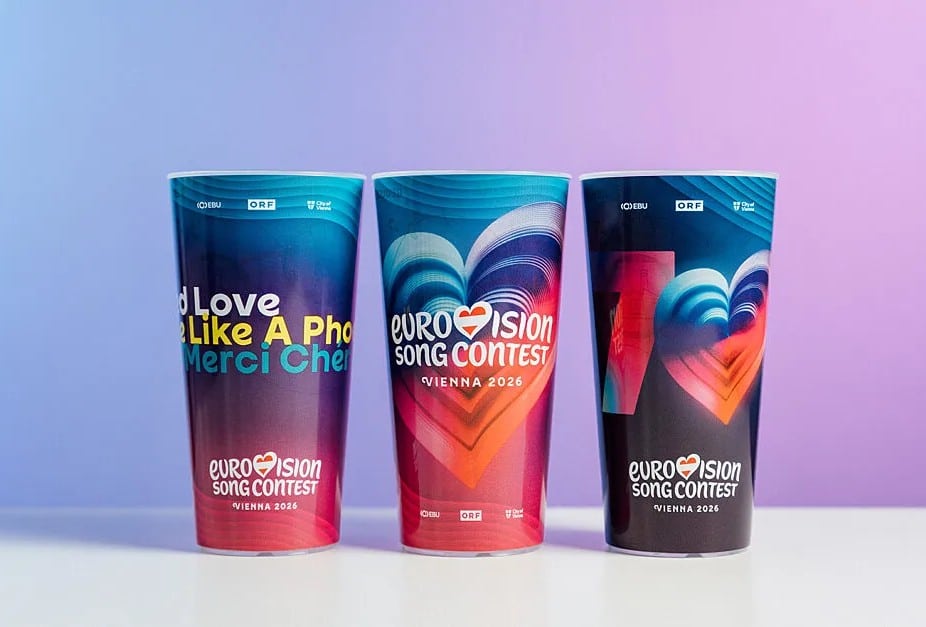
★Mark us as a preferred sourceTo mark its 70th anniversary, the 2026 Eurovision Song Contest (ESC) in Vienna is putting sustainability and the Austrian circular economy squarely in the international spotlight. As the official event supplier, ARA (Altstoff Recycling Austria) and its industry partners are providing 100,000 reusable cups made from 100 percent recycled material for the event in an unprecedented closed-loop project. Manufactured entirely in Austria and featuring a unique QR code communicating in 25 languages, these cups save approximately 5 tons of raw materials and serve as a foundational pillar for the event’s “Green Event” concept.
From the Yellow Bin to a Food-Safe Cup: The Production Process
This environmental initiative, focused on the massive music event, is the result of exemplary teamwork along the entire Austrian value chain. Alongside ARA, the project involves major industrial partners OMV, Borouge International, and Greiner Packaging.
The raw material for the festival cups is sourced exclusively from the Yellow Bin (Gelbe Tonne) and the Yellow Bag (Gelber Sack) used in Austrian households. With over 300,000 Yellow Bins and around 2.2 million households connected to the Yellow Bag collection system, ARA provides the ideal collection infrastructure. The collected waste is first sorted at the high-tech TriPlast sorting plant in Upper Austria.
The technological breakthrough of this process is the UPCYCLE method, patented by ARA, which processes the waste into plastic flakes. Subsequently, in the OMV ReOil® plant, high-quality circular raw material (pyrolysis oil) is produced, which is then used to manufacture circular propylene in OMV’s base chemical plants. In the next step, Borouge International processes this into sustainable plastic granulate that achieves the food-grade quality of primary raw materials. In the final phase, Greiner Packaging manufactures the durable, fully recyclable reusable cups.
This process successfully closes the Austrian recycling loop. The use of plastic packaging from the Yellow Bin and Yellow Bag throughout the chemical recycling and further processing steps is verified using a recognized and externally audited mass balance approach (ISCC PLUS), certified by TÜV SÜD Industrie Service GmbH Munich.
Statements from Industry Leaders: Closed-Loop Austrian Innovation
Project participants emphasized the pioneering nature of this initiative. Harald Hauke, ARA Board Spokesperson, highlighted: “Our reusable cups for the ESC are a best practice of the Austrian circular economy. The UPCYCLE process developed and patented by ARA makes it possible to use plastic sorting residues that are, for example, very small or consist of different chemical substances. Previously, these could only be thermally recycled; today, they receive a second life as reusable cups that are not only made of 100% recycled material but are also absolutely food-safe. With the 100,000 cups made from plastic recyclate, we save around 5 tons of natural raw materials—an important contribution to resource conservation.”
Martijn van Koten, OMV Executive Vice President Fuels & Chemicals, pointed out the significance of industrial-scale sustainability: “At the Eurovision Song Contest, we are showing how innovative circular economy is realized: By converting used plastics into high-quality raw material of primary quality, we avoid the use of conventional resources and thus lower the carbon footprint along the entire value chain.”
Shanila Baseley, Vice President Sales at Borealis (part of Borouge International), praised the key role of closed-loop recycling, explaining that their ‘Borcycle C’ portfolio of chemically recycled plastic waste allows the material to be used again in demanding, everyday food-contact applications like these drinking cups.
Beatrix Praeceptor, CEO of Greiner Packaging, added that the exclusive Limited Edition cups connect a striking exterior design with an interior that visually depicts the Austrian closed-loop process—from the yellow bag to the finished cup—sending a clear signal for waste prevention at a major international event.
DigiDot QR Code: Multilingual Education for Festival-Goers
The exclusive limited edition of 100,000 reusable cups will be used exclusively at the main event and official side events surrounding the Eurovision Song Contest in Vienna. Besides the savings in the production process and through short transport routes, their reusability plays a central role in waste prevention compared to single-use products.
Furthermore, the cups promote awareness among visitors. A QR code printed on the cups leads directly to “DigiDot”, a digital recycling guide initiated by ARA. This platform offers simple orientation in 25 different languages, displays nearby collection points, and supports correct waste separation during the Eurovision Song Contest and beyond.
What Happens to the Cups After Eurovision?
According to Michael Krön, Executive Producer of the Eurovision Song Contest 2026, the event proves that an occasion of this magnitude can be responsibly implemented as a Green Event: “An innovation from Austria, 100% Austrian recycled material, directly from the Yellow Bag into the hands of guests from all over the world.”
Following the event, the cups will take different paths. Many will undoubtedly be taken home by guests as popular collectible souvenirs, keeping the memory of the 2026 Vienna contest alive. Cups that are returned but can no longer be reused due to damage or severe wear will be recycled and fed back into the material loop. Finally, cups that remain in a good, reusable condition will be donated to social institutions for continued use.
Reference and Official Source:
-
Original Austrian press release: ARA: ESC setzt auf Kreislaufwirtschaft aus Österreich


