


If you like our site, mark us as a preferred source on Google — so you’ll see our articles more often in search!
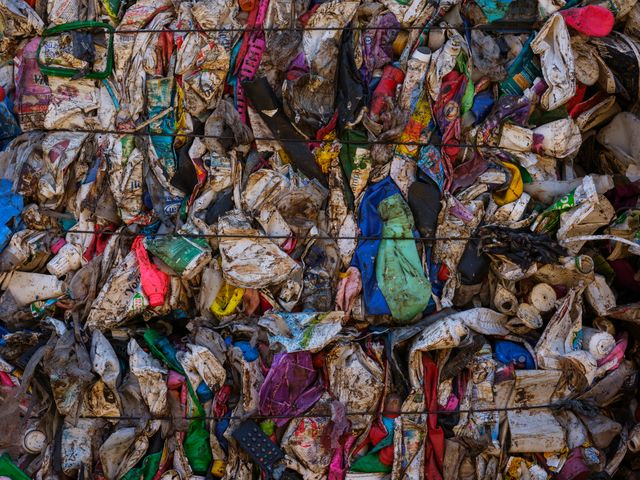
★Mark us as a preferred sourceItaly’s plastic recycling crisis: On 30 July 2026 the Italian recyclers’ association UNIRIMA issued its second warning within a month: collection of baled plastic packaging waste has stalled, storage yards are full, and several southern municipalities have already suspended kerbside plastic collection. The case matters because it is not the failure of a collection scheme — it is the chain reaction of a collapsing secondary raw material market, and every component of it is reproducible in other EU Member States.
What happened in Rome
UNIRIMA — the national association of Italian companies collecting, recovering, recycling and trading recovered paper and other secondary materials — states in its 30 July 2026 release that the situation in the plastic recycling chain has not improved since the previous alarm a month earlier. Baled material is still not being collected from the district sorting centres (Centri Comprensoriali) on schedule, storage areas are saturated, and the risk of a halt in separate collection of plastic packaging is growing.
For the association this is no longer a temporary operational difficulty but a genuine emergency requiring immediate extraordinary measures. The release lists the economic consequences: substantial storage costs borne by companies, continual reorganisation of yard space, slowdown of processing activity and, in several cases, suspension of intake from municipal separate collection. UNIRIMA frames this as a risk to companies’ operational continuity, to employment, and to the stability of the entire plastic packaging management system.
Carmelo Marangi, UNIRIMA vice-president with responsibility for the plastics sector, puts it plainly in the release: for months the association has been reporting a situation that keeps deteriorating. Storage space has reached its capacity limit, and companies are paying ever more to handle material that should be collected on a regular schedule. Without immediate intervention, the concrete risk is a halt in separate collection across many areas of the country.
The association’s two demands deliberately point in different directions. One is a short-term valve: designating temporary plastic storage areas so that bale collection can be increased rapidly and on a continuous basis. The other targets the input side of the system: meaningful action against the growing non-recyclable fraction in separate collection. UNIRIMA explicitly links deteriorating quality of delivered material to the saturation of storage areas at receiving plants.
The mechanism: auctions with no bidders
The release itself does not explain why collection stopped. The missing link comes from the Italian trade press and from parliamentary questions: the material auctions run by COREPLA — the national consortium for plastic packaging — are repeatedly going unsold, sorted material finds no market outlet, and the blockage propagates backwards through the chain. The plant fills up, the plant stops accepting, and the municipality has nowhere to deliver.
From there, interruption of a public service is a single step away. According to the parliamentary question tabled by MP Patty L’Abbate on 5 August 2026, several municipalities in Puglia have already issued formal orders suspending plastic packaging collection after the destination facility notified them that it had reached its authorised maximum storage level. The same submission records that Puglia collected 102,038 tonnes of plastic packaging waste in 2025, a 9 percent increase year on year.
Those two data points side by side are the essence of the crisis. Collection is rising; demand is not. In a system that rewards tonnage but does not guarantee offtake, good collection statistics eventually turn into physical congestion.
The figures that appear to show everything is fine
CONAI’s general report for 2025 sharpens the paradox. In 2025 Italy recycled 77.3 percent of packaging placed on the market — 10.97 million tonnes out of 14.2 million — thereby exceeding not only the aggregate EU target for 2025 but also the one set for 2030. One material stream lags: plastics stand at 50.5 percent, barely half a point above the 2025 target and 4.5 percentage points below the 55 percent required for 2030.
The more self-critical part of the report, however, is its explanation of the volumes. According to CONAI, the quantity of packaging waste delivered into the system rose relative to 2024 not primarily because separate collection improved, but because of unfavourable developments in the secondary raw material market. The collective system is subsidiary to the market: it expands precisely when recycling markets are less competitive. Deliveries into the system grew in double digits across all macro-regions in 2025 — 10.9 percent in the North, 11.7 percent in the Centre, 11.6 percent in the South.
In other words, the system worked exactly as designed: it absorbed, as a shock absorber, the material the market would not take. The problem is that a shock absorber has finite physical volume. When market failure is not a few-month cycle but a multi-year condition, the binding constraint shifts from final reprocessing to intermediate storage capacity — and the imbalance lands in the yards of sorting plants and municipalities.
Not an Italian story: Europe’s capacity loss
The Italian crisis is the national manifestation of a European trend. According to Plastics Recyclers Europe, the European plastics recycling sector lost close to one million tonnes of capacity between 2023 and the end of 2025; 2024 saw the largest contraction ever measured, and preliminary 2025 figures indicated a further 50 percent rise in facility closures. Installed capacity of 13.5 million tonnes in 2024 remains well below the roughly 6 percent annual growth needed to meet PPWR targets. Closures in 2023–2024 hit polyolefin films and PET hardest, each accounting for a quarter of the total.
The association also names the drivers: high production and energy costs, falling demand, and rising volumes of low-priced, unregulated imports from outside the region. Imports of recycled and virgin polymers now exceed 20 percent of EU polymer consumption, while domestic recycling output has fallen by around 5 percent for most polymers.
Plastics Europe describes the same slowdown from the production side: growth in circular plastics output fell from 13.6 percent in 2022 to 1.2 percent in 2024, with production of 8.7 million tonnes representing 15.8 percent of Europe’s total plastics output. Growth in mechanically recycled post-consumer material collapsed from around 40 percent over 2020–2022 to 3.9 percent over 2022–2024, and by 2024 some 12.4 percent of Europe’s plastic waste was being recycled outside Europe.
There has been one temporary reprieve: in the first quarter of 2026, oil prices rose sharply on Middle East geopolitical tensions, making virgin polymers more expensive and briefly improving recyclers’ position. That episode illustrates the sector’s fragility precisely — an industry whose profitability depends on crude prices and on Chinese petrochemical capacity expansion cannot underwrite investment decisions.
Anatomy of the proposals — and where they get uncomfortable
Following the crisis meeting at Italy’s environment ministry (MASE) on 28 July 2026, ANCI (the national association of municipalities) and Utilitalia (the utilities federation) set out proposals on three levels.
Emergency level. Extraordinary storage areas to handle excess volumes; temporary concentration of recycling on streams with established outlets; and — the most sensitive point — a temporary expansion of energy recovery. The two associations also ask that additional costs not fall on municipalities and, through them, on citizens, but be covered by extended producer responsibility (EPR) systems.
Two of their proposals are technically revealing. One asks for European-level recognition that ETS emissions arising from the energy recovery of plastic fractions diverted from recycling for lack of outlets are exceptional in character. The other asks ARERA, the energy and environment regulator, to consider extraordinary measures relating to the R1 macro-indicator, which measures the relationship between the quantity and the quality of packaging sent for recycling.
Both point to the same structural trap: regulation simultaneously mandates delivery to recycling, penalises deviation from it, and makes the alternative costly. If the market will not take the material, the operator loses in all three directions. This is not an administrative failure but a blind spot in the regulatory architecture: it does not specify what happens when the recycling obligation and market absorption capacity diverge for a sustained period.
Medium-term level. Stronger customs controls against low-cost, uncertified and untraced polymers from third countries; full application of the Single-Use Plastics Directive; revision of the plastic tax from an industrial policy perspective; and support instruments for the use of certified recycled plastic.
Industrial level. Value-chain agreements, development of chemical recycling, easier open-loop recycling, acceleration of the national End of Waste regulation, and systemic use of green public procurement (GPP) and minimum environmental criteria (CAM) to stimulate public-sector demand for regenerated materials.
The parliamentary proposals go further. Senator Peppe De Cristofaro argues that plant saturation is a technical and industrial problem that cannot be allowed to become an interruption of public service, nor to unilaterally alter the economic equilibria on which municipalities have built their collection systems. He raises the idea of permanent guarantee instruments: a dedicated fund financed from the CONAI environmental contribution, national strategic storage capacity, and automatic compensation mechanisms in favour of municipalities. L’Abbate calls for a national secondary raw materials market strategy, developed with the regions and the industrial chain, to strengthen the competitiveness of recycling against virgin material and against recyclate imported from abroad.
The timing paradox
The timing of the crisis could hardly be worse. The EU Packaging and Packaging Waste Regulation (PPWR) becomes applicable on 12 August 2026, and its mandatory recycled content shares begin to bite from 2030. Exports of plastic waste from the EU to non-OECD countries will be prohibited from 21 November 2026.
Regulation is therefore building exactly the demand — and the in-region processing requirement — that the sector needs, only not now but within a few years. Meanwhile the capacity that would have to serve that demand is closing today. If capacity loss continues, the 2030 recycled content obligations will either be met with imported recyclate, whose traceability is the most contested question of all, or they will not be met.
It is worth noting that Italy is moving on another track at the same time: during budget debate the Chamber of Deputies approved a motion to phase single-use plastics out of the parliament building, and on 6 August 2026 the government adopted an urgent decree-law on compostability requirements for certain packaging types. But long-term waste prevention and acute market crisis operate on different time horizons — the former is not an answer to the latter.
Why this matters from Hungary
The Italian case is not exotic; it is a leading indicator. It brings four structural questions into focus that remain open in the Hungarian system as well.
1. Storage capacity as a system-critical but unregulated element. The crisis surfaced not at reprocessors but at intermediate storage. In Hungary, authorised storage limits, the capacity of intermediate sites and their emergency flexibility are typically treated as permitting questions rather than security-of-service questions. A sustained offtake disruption would activate the same bottleneck.
2. Who carries the market risk? The core of the Italian dispute is not technological but allocative: does the cost of a collapsing secondary raw material market fall on the EPR system, the service provider, the municipality or the household? In Hungary’s concession model this question concentrates in a single actor — simpler to manage in the short term, but a larger single-point exposure over time. The “strategic storage capacity” and “automatic compensation mechanism” appearing in the Italian proposals are precisely the two institutions missing from Hungarian regulation.
3. Measuring quality, not just quantity. UNIRIMA identifies deteriorating input quality as an independent driver of the crisis, and the ANCI–Utilitalia proposal asks for review of an existing regulatory indicator (R1) that measures the quantity–quality relationship. Hungarian practice measures separate collection performance predominantly in tonnes. Without a quality metric, a system cannot distinguish collecting more from collecting better — and the crisis turns on exactly that distinction.
4. The residual fraction after DRS. Where a deposit return system operates, the most marketable PET and HDPE bottles leave the kerbside stream. What remains has lower average value, is more heterogeneous, and is more exposed to price volatility. This is not an argument against DRS, but it means the offtake market for the residual mixed plastic fraction has to be built deliberately — it cannot be assumed that the chain will finance itself.
Italy’s plastic recycling crisis: Conclusion
Technically, UNIRIMA’s release announces a logistics problem: the bales are not being collected. What it actually says is that a well-performing collection system becomes pointless if, at the end of it, no one buys the material. Italy recycles 77.3 percent of its packaging waste — and that is precisely why separate collection is now at risk of stopping in several municipalities.
The output side of the circular economy — real, solvent industrial demand for secondary raw material — remains the least regulated and least protected element of the system. As long as that holds, every collection target is a conditional promise.
Sources
- UNIRIMA press release, 30 July 2026: “UNIRIMA: emergenza su riciclo plastica si aggrava. Subito misure straordinarie per evitare blocco della filiera” — https://www.unirima.it/2026/07/30/cs-unirima-emergenza-riciclo-plastica-2/
- Ricicla News, 30 July 2026: UNIRIMA on storage capacity limits and material handling costs
- Ricicla News, 29 July 2026: ANCI and Utilitalia proposals following the MASE crisis meeting
- Ricicla News, 5 August 2026: parliamentary questions on the plastic recycling crisis (L’Abbate, De Cristofaro)
- Ricicla News, 16 July 2026: CONAI general report — Italy’s 2025 packaging recycling data
- Plastics Recyclers Europe: analyses of European plastics recycling capacity loss
- Plastics Europe: The Circular Economy for Plastics (2026)
- Recycling Europe Plastics: rescue plan for Europe’s plastics recycling crisis (June 2026)


