


If you like our site, mark us as a preferred source on Google — so you’ll see our articles more often in search!
★Mark us as a preferred sourceSouth Korea’s K-pop industry has reached unprecedented global heights, but this massive financial success comes at a severe environmental cost. Major entertainment agencies are increasingly facing accusations of “greenwashing” and misleading consumers. While these companies actively promote eco-friendly digital “smart albums” in their PR campaigns, their aggressive marketing tactics continue to force fans into bulk-buying physical CDs to access fan events and merchandise. A comprehensive investigation by The Korea Times and its sister publication, the Hankook Ilbo, reveals how this business model generates thousands of tons of hard-to-recycle plastic waste while sustainability promises fall by the wayside.
The Shocking Scale of Plastic Pollution
According to official data, since 2021, the top four domestic entertainment companies—HYBE, SM Entertainment, YG Entertainment, and JYP Entertainment—have produced a staggering 6,667 tons of disposable plastic. To put this into perspective, this volume is equivalent to the weight of roughly 4,445 mid-size cars.
The primary source of this waste is the traditional compact disc (CD). Manufacturers use polycarbonate to press these discs, a durable plastic material that takes approximately 100 years to decompose naturally. When these mass-purchased—and often unopened—discs are sent to landfills or incinerators, they release significant greenhouse gases and dangerous pollutants into the atmosphere.
Smart Albums: Genuine Eco-Friendliness or Mere Facade?
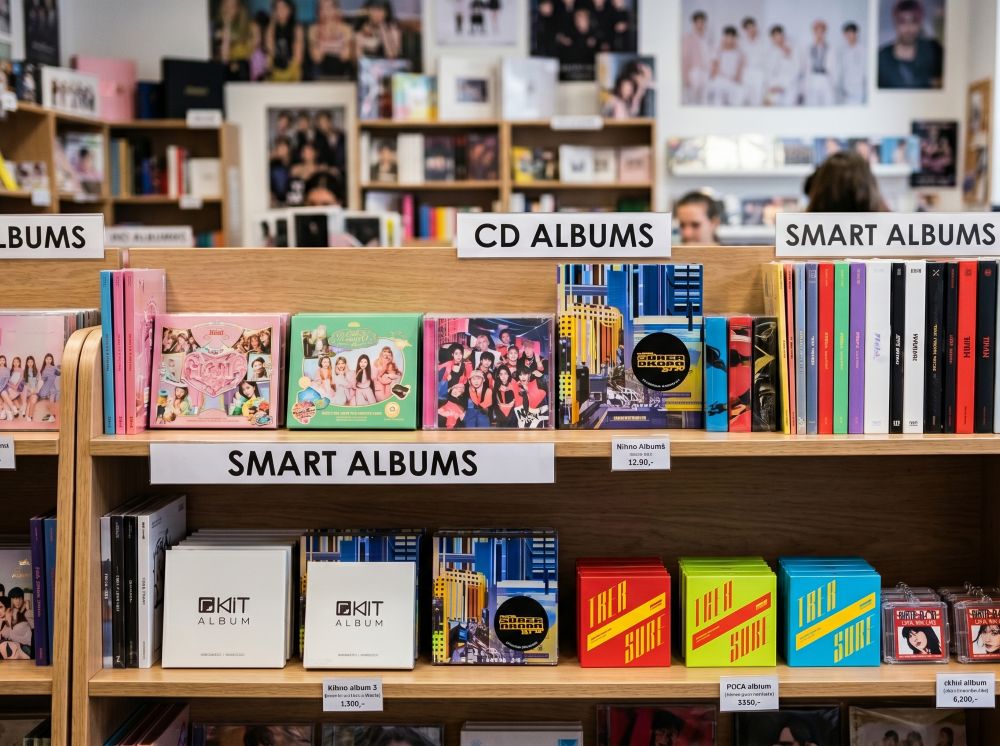
In response to growing environmental criticism, the industry seemingly took action by introducing “smart albums.” These allow listeners to access music digitally via near field communication (NFC) technology or QR codes, eliminating the need for a physical disc.
However, an investigation by the Hankook Ilbo revealed a systemic reliance on physical media. The publication analyzed 58 albums released by the four major agencies last year that theoretically offered “CD-less” options. The findings were stark: with the single exception of BTS member J-Hope’s “Charm of Hope”—which was released exclusively as an NFC keychain—57 of the albums required a physical CD as the basic purchase. The smart album was merely offered as an alternative option, not a replacement.
Aggressive Marketing and the “Bulk-Buying” Trap
The disconnect between eco-friendly marketing and actual sales tactics becomes most apparent in merchandising and fan events. Agencies heavily pressure fans into bulk purchasing to collect specific members’ promotional items and to secure entry into “fansign” (autograph) events. As a result, the offices of climate activist group Kpop4planet are now filled with thousands of unopened records received from fans.
The investigation analyzed 625 fansign event notices tied to those 58 albums:
-
Only 60 events (9.7 percent) permitted entry via a smart album purchase.
-
The vast majority—491 events (78.4 percent)—strictly required the purchase of a physical CD.
Data from the Korea Consumer Agency explains the driving force behind this phenomenon: one in four K-pop fans purchases records specifically to apply for these events. Because each album purchase counts as a single lottery entry, fans routinely buy dozens of copies of the exact same album to increase their odds.
Although SM Entertainment released 25 smart albums last year (the highest number among the top four), the agency limited entry to buyers of the physical photobook version for 22 of its events. Park So-jeong, head of the Department of Cultural Contents at Hanyang University, noted that deliberately driving excessive purchases of physical albums while only informing people about “eco-friendly marketing” is highly problematic. An anonymous official affiliated with the major agencies also admitted: “It is not easy to reduce the proportion of plastic records.”
Growing Plastic Mountains: Case Studies and Telling Data
Statistics from the Ministry of Environment clearly demonstrate the reality of the industry’s greenwashing: despite launching eco-friendly initiatives, the top agencies’ plastic output is rapidly rising.
-
SM Entertainment produced roughly 400 tons of plastic in 2022 when it introduced its NFC brand “SMini,” but that figure grew to 647 tons by 2024.
-
HYBE produced 729 tons of plastic upon releasing its first eco-friendly “Weverse Album” in 2022, but the volume surged to 1,405 tons the following year.
The mass production of physical albums relies heavily on randomized collectible merchandise. Stray Kids’ fourth album “Karma” sold 3 million copies in its first week last year. It was released in five designs. The “regular” edition (required for fansign applications) featured two variants (“Ceremony” and “Hooray”), each containing one of eight random photocards, forcing fans to buy in large quantities to collect them all. A single “Ceremony” album contained 17 separate components, including plastic wrapping, a paper box, a 112-page photobook, posters, stickers, and the CD itself.
Similarly, Aespa’s sixth mini-album “Rich man” recorded 1.08 million first-week sales across five designs. The versions designated for fansign applications featured five randomized covers each. Because internal photos and photocards varied depending on the member featured on the cover, fans had to make multiple purchases to collect a specific member’s merchandise.
Trivial Penalties: Is Pollution Too Cheap?
Critics, including Bae Jae-keun, an emeritus professor of environmental engineering at Seoul National University of Science and Technology, argue that the government must levy much heavier charges against agencies profiting from mass plastic consumption. Under the current system, companies pay a fee for producing hard-to-recycle items to cover disposal costs. However, the standard rate for CDs is nearly symbolic: just 150 won ($0.10) per kilogram.
Between 2021 and 2024, the four major agencies combined paid a mere 1.2 billion won in waste charges to the Ministry of Environment. This figure stands in stark contrast to their immense corporate earnings: last year, the operating profits of the four companies were 49.9 billion won, 183 billion won, 71.3 billion won, and 155.2 billion won, respectively.
Yang Ji-hoon, an associate research fellow at the Korea Tourism Institute, emphasized the need for careful policy design. He noted that eco-friendly consumption cannot simply rely on the good intentions of climate-conscious fans. Until the financial burden of waste charges serves as a genuine deterrent, the music industry will likely continue its highly profitable, yet environmentally destructive, greenwashing practices.
Reference and Official Source:
-
Original Article: The Korea Times (Hankook Ilbo) – K-pop greenwashing betrayal: 6,667 tons of plastic waste driven by merchandising
Consistent structure, quick answers: every article is built so that both readers and AI search tools can find the key points easily. Our content is produced with the help of AI tools and reviewed by our editor.


