


If you like our site, mark us as a preferred source on Google — so you’ll see our articles more often in search!
★Mark us as a preferred sourceOn 5 October, MOHU announced a further expansion of its national textile collection network: municipalities, companies, educational institutions, NGOs and other communities can request a textile collection container free of charge, with the concession company also handling emptying and transport of the collected textile waste. This time the focus is not on public spaces but on closed sites – office buildings, factories and schools. We looked at what exactly is on offer, who should apply, and where textile collection in Hungary really stands.
In short: MOHU provides a free textile collection container to companies, institutions and municipalities, including emptying and transport, following an online application and on-site consultation. Some 3,500 containers are currently in operation nationwide – only just over half of the 6,000 previously targeted for 2026 – and bringing closed sites on board could help narrow that gap.
What exactly is MOHU offering?
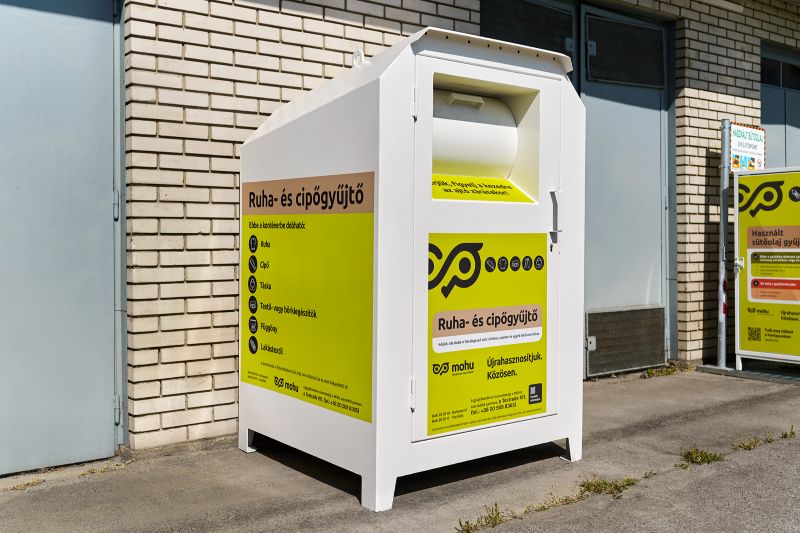
According to MOHU’s announcement (in Hungarian), the package has three elements: placing the container, emptying it regularly, and transporting the collected textile waste. All three are free for the applicant. The containers are uniformly branded, white, welded metal units with individual locks and a self-closing drop slot – the same tamper-resistant units seen in public spaces, waste yards and supermarket car parks.
The service is carried out by a MOHU subcontractor. Emptying, vandalism reports, repairs and sticker replacement can be requested via the phone number on the container, and the company commits to responding within 24 hours. Full maintenance takes place every three years, while ad hoc repairs are carried out immediately upon report or on-site detection.
One important detail is mentioned almost in passing: the system works best when the property operator also keeps the area around the container tidy and safe. In plain terms, the container and collection are free, but the site owner should expect that bags left next to it, scattered clothes or any illegal dumping will appear on their premises. Placement comes with a service contract, so it is worth reading carefully.
Why closed sites?
Anyone following textile collection in Hungary knows the two recurring problems with street containers: littering around them and people rummaging through them. On closed sites accessible only to employees or students, both are far less common – and this is not merely an aesthetic issue. Cleaner, drier, more neatly deposited textiles are easier to sort, the share of wearable items is higher, and collection becomes more economical.
MOHU makes explicit use of this: there is no minimum opening-hours requirement, so a container can be placed on premises outsiders cannot even enter. The company also offers a rule of thumb for sizing: in its experience, 100 employees fill roughly one container with weekly emptying. This means a medium-sized factory or a larger school can be a meaningful collection point in its own right.
Bringing closed sites on board also has a less publicised advantage for the concession company: the partner provides the location, the paved surface and the supervision. The network can thus expand without dealing with public-space permits, municipal site allocation or vandalism.
Applying for a textile collection container step by step
According to MOHU’s application page (in Hungarian), any business organisation or budgetary body may apply – including municipalities, retail chains and companies – provided the technical conditions are met. The press release is broader and also mentions NGOs and other communities. If an association, foundation or condominium would like a container, it is best to first consult the regional manager assigned to the area.
Technical conditions to plan for in advance:
- Size and weight: approx. 120 × 120 cm footprint, 185 cm height and 260 kg empty weight. This is not a recycling bin – it takes up the space of a small storage rack.
- Handling: the container stands on metal legs and can be moved by crane, forklift or pallet jack.
- Surface: a level, solid surface is required (asphalt, concrete or paving), safely accessible by a small truck for installation and maintenance. A grassy yard, sloping driveway or narrow gateway can rule a site out.
- Number of units: as noted above, one container per 100 employees with weekly emptying.
The application process:
- The online form asks for the exact address, land registry number, available area, GPS coordinates and the proposed number of containers.
- MOHU assesses whether placement is possible; on request it also offers a personal consultation and site visit.
- Once the sites are finalised, a service contract is signed, followed by installation.
Practical tip: before submitting the form, photograph and measure the intended spot, and agree with the facility manager on who will be responsible for the container’s surroundings. Internal communication matters just as much: employees, parents and students need to know what can and cannot go in.
How big is the network really?
According to MOHU, the number of containers has doubled since 2023, with 3,500 textile containers now operating nationwide. This is real progress: before the concession began, there were roughly 1,500 containers in the country.
It is worth setting this figure alongside earlier commitments, however. MOHU’s stated goal was to expand the national network to 6,000 units by 2026. It is now October, and the network stands at just over 58 per cent of that target. In August, in our analysis of the ReSTRAND Vintage Market, we cited “nearly 3,600” containers – so today’s 3,500 may simply be a rounding difference, but there has clearly been no substantial growth in recent months.
Seen in this light, the current campaign can be read as a cheaper, faster route to expanding the network: growth can now be driven by partners’ sites and their willingness to apply. Whether this will be enough to reach 6,000 depends on application numbers in the coming months.
The issue is also linked to the concession as a whole. Delivery on promised investments has been a recurring theme in debates about MOHU, as we covered in our article on the MKKP’s criticism of MOHU’s operations.
What happens to the clothes?
According to MOHU, collected textiles are taken to the company’s site in Székesfehérvár for sorting. Wearable items are put back on the market, while unusable textiles are recovered as material or energy – for example through fibre opening, industrial processing or incineration. MOHU’s stated aim is to keep textiles out of illegal dumps and avoid unnecessary incineration. According to earlier statements by the company, 55–60 per cent of the collected volume is reused as clothing.
These are good numbers, but the full picture includes a few points we have covered before:
- Collection is not the same as recycling. Genuine fibre-to-fibre recycling remains below 1 per cent globally, because most garments are made of blended fibres. AI-driven sorting may help here, as our article on AI in textile recycling shows.
- The path of clothes “returned to the market” is not always traceable. A large share of the second-hand clothing trade goes outside Europe, with uncertain consequences.
- The concession company’s responsibility ends at sorting. As we wrote in August, MOHU works with a subcontractor for this waste stream, which buys the recoverable fraction – from that point on, the fate of the clothes is a market matter.
- There are promising recovery routes. Textile waste turned into apparel insulation or even packaging foam made from discarded jeans shows that non-wearable textiles can have a meaningful second life.
What does this mean ahead of the 2028 EPR deadline?
The container campaign comes during a transition period. Since 2025, every EU member state has had to ensure separate collection of textile waste, and the 2025 amendment to the Waste Framework Directive (Directive (EU) 2025/1892) introduces mandatory extended producer responsibility (EPR) for textile products. Member states must set up these schemes by April 2028 at the latest.
In practice, within a few years the companies placing clothes on the market will pay for collection, sorting and treatment. The container network being built now – especially the density of corporate and institutional points – will form the basic infrastructure of that EPR system. The more textiles arrive today, and the better their quality, the more accurate the data available for planning fees and sorting capacity.
Who should apply, and what to watch out for?
Overall, MOHU’s offer is a good deal for most organisations: they receive a free asset and service that is both a convenience for employees and a tangible sustainability measure – one worth including in an ESG report, for example. Larger workplaces, schools, universities and dormitories should particularly consider applying, as should municipalities where the nearest textile container is still far away.
A few points to consider before deciding:
- Space and access: a paved surface reachable by a small truck is non-negotiable.
- Designate a responsible person: someone should notice when the container is full and call the number on it.
- Communication: the container only works well if clean, dry, preferably bagged textiles go in. Check the exact rules on the container sticker and in MOHU’s guidance.
- Contract: the service is free but contractual – clarify expectations on keeping the site tidy in advance.
And finally, a waste hierarchy reminder: the container helps at the end of the chain. Anything that never goes in because we keep wearing, repairing, swapping or passing it on is always the better option. A company clothes-swap day and the container are therefore not competitors but complements.
FAQ – Textile collection container from MOHU
Who can apply for a free textile collection container from MOHU?
Business organisations and budgetary bodies can apply, such as municipalities, companies, retail chains and educational institutions. MOHU’s announcement also mentions NGOs and other communities, so associations, foundations or condominiums should first consult the regional manager for their area. The site must be technically suitable for placement.
Where can a textile collection container be placed?
A level, solid surface – asphalt, concrete or paving – is required, safely accessible by a small truck for installation and maintenance. The container has a footprint of about 120×120 cm, stands 185 cm tall and weighs 260 kg. There is no minimum opening-hours requirement, so closed, staff-only premises are also suitable.
How many containers does a workplace need?
Based on MOHU’s experience, 100 employees fill roughly one container with weekly emptying. This is a useful starting point for sizing: a factory or school with 300 people may justify two or three containers. Applicants propose a number on the form, and the final figure is agreed together with MOHU.
How does the application process work?
Applicants complete an online form with the exact address, land registry number, available area, GPS coordinates and proposed number of containers. MOHU then assesses whether placement is possible and can arrange a site visit on request. Once locations are finalised, a service contract is signed and the containers are installed.
What happens to clothes put in the container?
Textiles are taken to MOHU’s site in Székesfehérvár for sorting. Wearable items return to the market, while unusable ones are recovered as material or energy, for example through fibre opening, industrial processing or incineration. According to earlier company statements, 55–60 per cent of the collected volume is reused as clothing.
How many textile collection containers operate in Hungary today?
According to MOHU, 3,500 textile collection containers operate nationwide, double the 2023 figure. Before the concession began there were about 1,500. That is just over 58 per cent of the 6,000 previously targeted for 2026, so bringing closed sites on board could be an important tool for expanding the network.
🔗 Sources:


