




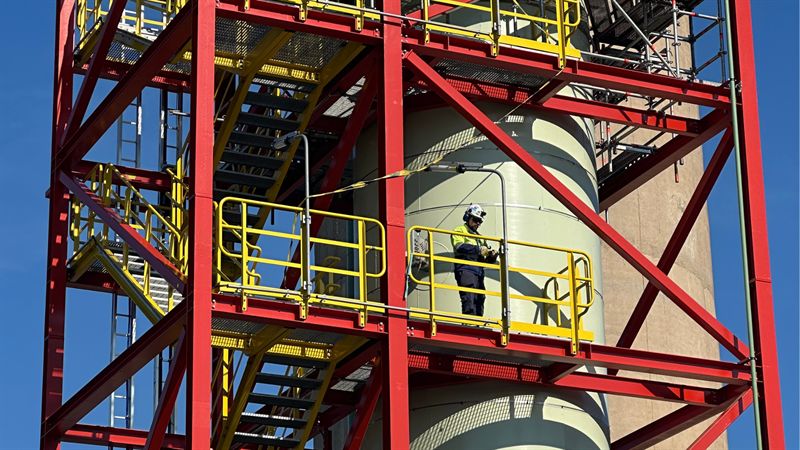
Neste has successfully commissioned its new upgrading facility for liquefied waste plastic (LWP) at its Porvoo refinery in Finland. This EUR 111 million investment marks a major milestone in the scale-up of chemical recycling, enabling the production of high-quality feedstock for the plastics and chemicals industry. With the ability to process up to 150,000 tons of challenging waste annually, it is currently the world’s largest LWP upgrading facility.
According to an official press release dated March 16, 2026, Neste’s new facility aims to close the quality gap between crude liquefied plastic waste and the premium drop-in raw materials required by the petrochemical industry. While the company has been processing liquefied waste plastic, such as pyrolysis oil, since 2020, this new dedicated facility represents a massive leap in industrial scale and capability.
Construction Timeline and Processing Capabilities
The construction of the new upgrading unit and its integration into the existing Porvoo oil refinery began in 2023 and was successfully completed at the end of 2025. Production ramp-up commenced in 2026 and will advance gradually, depending on market conditions and legislative developments.
Key quantitative data surrounding the facility includes:
-
Investment Value: EUR 111 million.
-
Maximum Annual Capacity: Up to 150,000 tons of liquefied waste plastic.
-
Fossil Resource Reduction: Over a 70 percent reduction in virgin fossil resource consumption (abiotic depletion) compared to traditional methods.
-
Emissions Reduction: Over a 35 percent reduction in greenhouse gas (GHG) emissions when plastic waste is chemically recycled instead of incinerated.
Jori Sahlsten, Executive Vice President of Oil Products at Neste, emphasized the significance of the achievement: “The successful commissioning proves that we can process liquefied waste plastic at an industrial scale. This achievement demonstrates Neste’s capability to develop advanced technology, set safety standards, and create new supply chains for challenging new raw materials.”
Bridging the Gap for Hard-to-Recycle Plastics
While traditional mechanical recycling remains essential to the circular economy, it is frequently limited by the quality of the waste itself. Neste’s new facility is specifically engineered to process oils derived from highly challenging waste streams that are typically destined for incineration or landfills. These include:
-
Multi-layer packaging.
-
Mixed plastic waste.
-
Contaminated plastics.
Inside the upgrading facility, Neste processes the liquefied waste plastic alongside crude oil. The company applies a mass balance approach to officially attribute the recycled raw materials used in the process to its recycled “Neste RE™” product line.
Navigating European Legislation and Competitiveness
Despite the technological breakthrough, the company warned of looming regulatory hurdles. Maiju Helin, Director of Polymers and Chemicals at Neste, pointed out that current European Commission calculation rules regarding recycled content in the Single Use Plastics Directive threaten to limit the ability of refineries to serve the EU’s recycled content targets.
“For Europe’s competitiveness sake, we need to ensure the calculation rules are amended to include refineries in the context of the EU Packaging and Packaging Waste Regulation,” Helin stated.
Strategic Partnerships and Corporate Outlook
To further advance the circularity of plastics globally, Neste has partnered with Alterra and Technip Energies to license liquefaction technology for the chemical recycling of hard-to-recycle plastics.
Neste continues to position itself as a global leader in renewable fuels and circular solutions. The company reported a revenue of EUR 19.0 billion in 2025, and its overall renewables production capacity is expected to reach 6.8 million tons annually by 2027.
Official Source and Reference:
-
Original Press Release (Neste): Neste commissions the world’s largest upgrading facility for liquefied waste plastic and scales up chemical recycling