


If you like our site, mark us as a preferred source on Google — so you’ll see our articles more often in search!
★Mark us as a preferred sourceIndustrial waste is not just an environmental burden, but can also be a valuable raw material. In China’s porcelain capital, the rethinking of 90,000 tonnes of annual scrap unites historical traditions with the innovations of the modern circular economy.
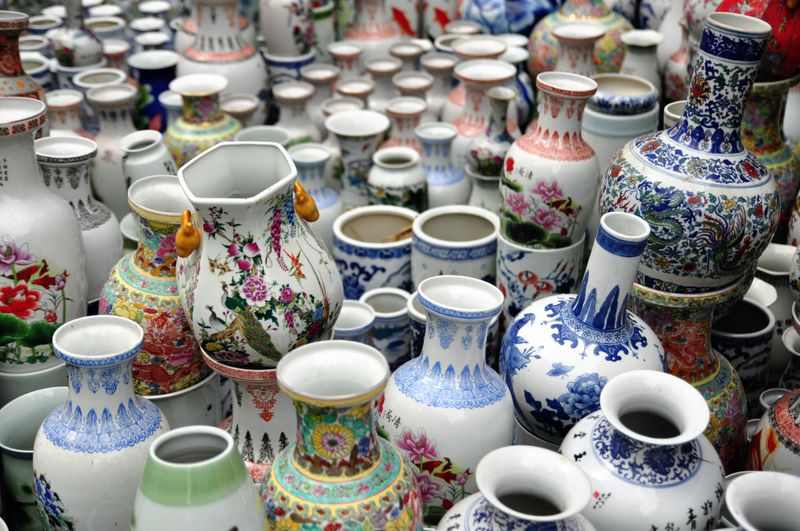
Porcelain waste recycling has opened a new chapter in Jingdezhen, known globally as China’s “porcelain capital.” The sleek, colorful, and artfully crafted ceramics lining the shelves of a shop in the Taoxichuan art district reveal little about their surprising beginnings: piles of broken porcelain once bound for the landfill. The massive amount of industrial waste accumulated annually has now become the foundation for modern design and innovative architecture.
The Ceramic Industry of Jingdezhen and Historical Porcelain Waste Recycling
In the history of Jingdezhen, giving broken ceramics a second use is a tradition centuries in the making. Past generations utilized broken porcelain shards, spent saggers, and worn-out kiln bricks to fill waterways, raise ground levels, and build walls and foundations. Through this method, waste from the kilns became an integral part of the city’s infrastructure.
The local street names still preserve this memory. The name Xianong, meaning “lower alley,” denotes land that was once reclaimed from the river using discarded porcelain. This linguistic footprint demonstrates how waste shaped the land beneath the residents’ feet. Ceramic waste also played a crucial role in managing runoff by forming porous layers beneath the streets.
By 1990, the flood-prone city possessed over 90,000 meters of sewers, including more than 6,000 meters of arched channels built from discarded kiln bricks. Remarkably, one drainage channel laid in 1914 remains in operational use today. This unique, centuries-old industrial heritage gained global recognition this July when the Jingdezhen Handicraft Porcelain Industry Sites were inscribed on the UNESCO World Heritage List, becoming China’s 61st World Heritage site.
Modern Challenges and Innovative Solutions in Waste Management
Despite the rich traditions, the sheer scale of the current industry has introduced unprecedented challenges. Official data shows that Jingdezhen produces up to 90,000 tonnes of discarded porcelain each year, much of which traditionally ended up dumped or buried.
Zhang Jingjing, vice president of Jingdezhen Ceramic University, pointed out that ceramic waste does not readily decompose, posing a long-term environmental risk if not properly handled. According to her, crushing and reformulating the material is currently the most effective method for mitigating its environmental impact.
An increasing number of businesses are putting this realization into practice. A brand named XUN (meaning “recycling“) transforms discarded porcelain into vases, planters, and tableware. Lan Lan, the shop owner and co-partner, explained that during the process, the collected waste is sorted, crushed, and purified before being reformulated and fired into new ceramics. The final product is durable and safe, featuring a unique texture due to retained porcelain particles. XUN also uses sand-mold 3D printing to create larger decorative pieces, which are showcased at the China International Import Expo and the Canton Fair, enjoying strong sales in Europe and the Americas.
Another startup, Yi Design, repurposes discarded ceramics into architectural and art materials. Their permeable brick, consisting of over 90 percent recycled porcelain, is perfectly suited for “sponge city” projects designed to ease urban flooding and heat. This product won an iF Design Gold Award in 2022.
State-Level Green Initiatives and the Circular Economy
Local initiatives are now finding substantial institutional backing. In 2024, Jingdezhen launched a “zero-waste city” initiative, actively urging ceramic makers to cut waste at the source through technological upgrades and pushing for broader, higher-value uses of discarded porcelain.
Tong Xiwei, an official with the city’s ecology and environment bureau, stated that waste porcelain has long been a bottleneck to the green development of the ceramic industry. Therefore, the goal is to reduce, recycle, and safely manage solid waste while fostering new zero-waste models beyond factory walls. This effort is strengthened by government strategy: in July, China released its plan for advancing the circular economy during the 15th Five-Year Plan period (2026–2030). The framework calls for stronger recycling networks and industrial innovation, aiming to basically establish a high-quality recycling system by 2035.
FAQ
How much industrial ceramic waste is produced in Jingdezhen annually?
Official data shows that Jingdezhen produces up to 90,000 tonnes of discarded porcelain each year.
What is processed ceramic waste being used for in modern industry?
The processed waste is used to create vases, tableware, 3D-printed decorations, and permeable bricks made from 90 percent recycled materials, which help mitigate urban flooding.
Source: Xinhua News Agency – Original State Media Source
Consistent structure, quick answers: every article is built so that both readers and AI search tools can find the key points easily. Our content is produced with the help of AI tools and reviewed by our editor.


