


If you like our site, mark us as a preferred source on Google — so you’ll see our articles more often in search!
★Mark us as a preferred sourceEver held a plastic bottle cap and wondered where it actually ends up once you toss it? In Silistra, a Bulgarian town on the banks of the Danube, a brother and sister have a pretty brilliant answer: a table. And a chair. And a lamp. Vavakada RE makes recycled plastic furniture and interior elements, proving that plastic waste isn’t the end of the story but the start of a colourful, tough and surprisingly stylish material.
In short: Bulgarian start-up Vavakada RE presses bottle caps and other plastic waste into panels, then turns them into recycled plastic furniture, lighting and public-space elements. Founded in Silistra by siblings Daniela Kostova and Vladislav Kostov, it also visits schools and universities to show how recycling really works.
Daniela and Vladislav were already into environmental protection as kids, and they wanted to make the planet cleaner and greener with their own hands, not just in theory. According to a Radio Bulgaria feature, Vladislav realised after high school that waste was going to be his thing, and started teaching himself through online resources.
The turning point came when Daniela returned from Germany with an architecture degree and suggested they start a business together. The split of roles still works today: Vladislav handles the technical side, Daniela takes care of design and communications. Classic sibling teamwork, just with bottle caps.
How do bottle caps become recycled plastic furniture?
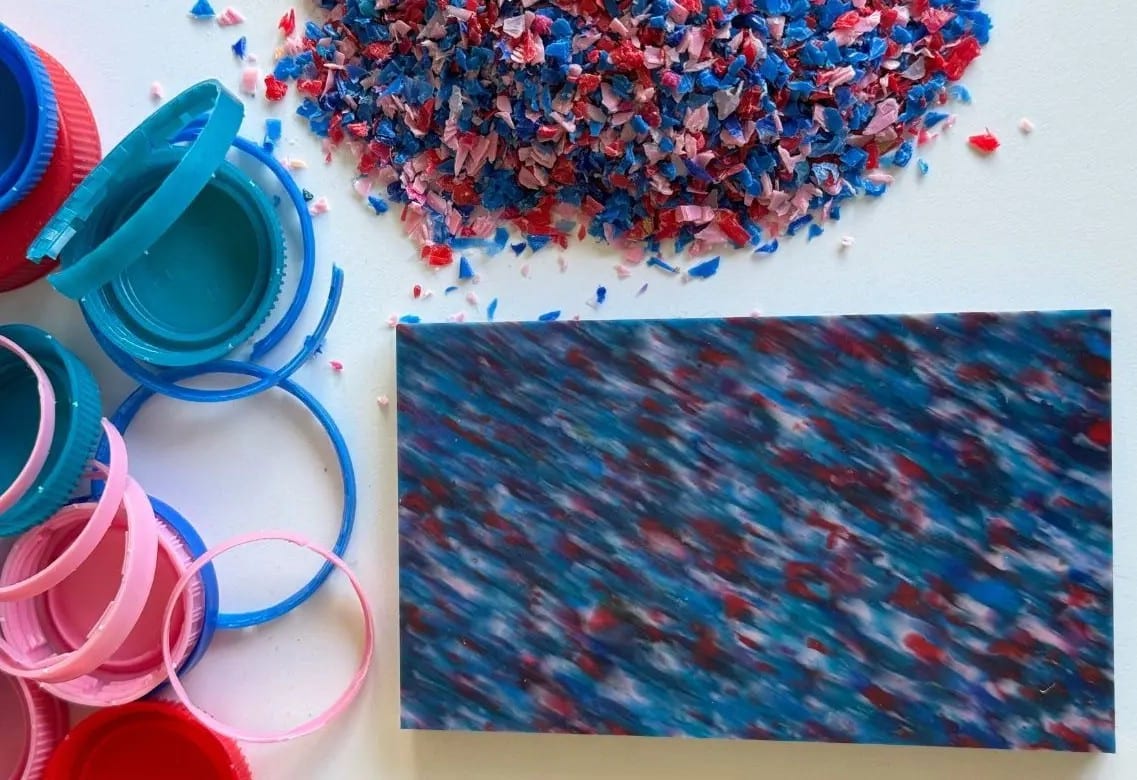
The duo decided to focus on plastic bottle caps and – here’s the coolest part – they built their own machinery, press included. That press produces the panels that are Vavakada RE’s raw material, and from there pretty much anything is possible: side tables, chairs, light fixtures, and, as Daniela puts it, the options are practically endless.
The waste is donated by a local depot that is already close to full capacity, so the workshop literally takes some weight off the town’s shoulders. 3D printing also plays a role in production, and the whole business is built on circular economy principles: by their own account, they generate zero waste.
You can browse finished pieces in their portfolio, and the panels are sold separately in their shop – so if you fancy building your own bottle-cap design, that’s an option too.
What can a pressed bottle-cap panel do?
Vavakada RE’s HDPE (high-density polyethylene) panels don’t just look good, they also come with some serious skills. The company highlights these advantages:
- Eco-friendly: made from waste and recyclable again at the end of their life.
- Durable: built to last way beyond one season.
- Waterproof: fine for bathrooms, terraces and outdoor spaces.
- Chemical-resistant: cleaning products won’t harm them.
- Unique look: every panel has a different pattern, because every pile of caps brings its own colour mix.
- Easy to work with: cut it, drill it, shape it – a designer’s dream.
This is where the word “plastic” starts to feel very different. The siblings want to show that recycled plastic is a new, “noble” material, and that their production process is a form of modern craftsmanship.
“So it does get recycled after all!”
One of their most exciting commissions was a set of bench backrests for public spaces, created together with street artist Aleksi. Daniela says recycled elements placed in public spaces have a great side effect: people stop, look, and say, “So it does get recycled after all!”
That matters, because in Bulgaria – just like in many other countries – there is a widespread myth that all waste goes into the same truck and nobody knows what happens to it. A bench made from bottle caps at a bus stop says more than any poster: you see it, you touch it, you sit on it, and you realise that sorting your waste really does lead somewhere.
They don’t just make things, they teach
The Vavakada RE story is as much about education as it is about furniture. Since the workshop opened, the siblings have regularly visited schools and universities to give talks on recycling.
According to Daniela, people want to recycle but don’t know the details. Many assume that dropping something into a recycling bin settles the matter, while reality is far more complex. Few people know, for example, that there are many different types of plastic and each needs to be handled separately. So their goal isn’t only to make beautiful objects, but to change the way people think.
And this is no garage hobby: the Vavakada RE website lists the Bulgarian Fund of Funds, the Innovation Capital programme and the European Union among its supporters, with the Municipality of Silistra as a partner.
What about bottle caps in Hungary?
If you now feel like collecting caps, it’s worth knowing that a lot has changed in Hungary recently. A mandatory deposit return scheme launched on 1 January 2024, and since July 2024 EU rules require caps to stay attached to beverage bottles. So the cap of a returnable bottle stays on the bottle and goes back into the system with it – no need to do anything, just don’t pry it off.
Caps from non-returnable packaging – think detergent, shampoo or milk bottles – belong in your local separate collection. Which bin exactly depends on where you live, so check the guidance from your local waste collection provider.
The dream job: firing yourself
And here’s our favourite bit. Daniela and Vladislav’s biggest dream is to one day be out of work, because the problem they’re tackling today will have been solved. They hope to live to see the day when plastic pollution is something you only read about in history books.
Until then, the plan stays the same: show that the “trash” around us is actually a resource that can become a bold, colourful and valuable piece of design. Vavakada RE’s recycled plastic furniture is the best living proof.
What would you make from a pile of bottle caps? A table, a lamp, or a new backrest for the bench in your favourite park? Tell us on our Facebook page!
Recycled plastic furniture – frequently asked questions
What is Vavakada RE?
Vavakada RE is a Bulgarian start-up that makes recycled plastic furniture and interior elements in Silistra, a town on the Danube. It was founded by architect Daniela Kostova and her brother Vladislav Kostov. They press waste into panels, turn them into tables, chairs, lamps and public-space elements, and also give talks at schools and universities.
What is Vavakada RE’s furniture made from?
Mainly plastic bottle caps, which the siblings turn into panels using a press they built themselves. The raw material is donated by a local waste depot that is already close to full capacity. They also use 3D printing in production, and the business follows circular economy principles, generating no waste by their own account.
What are the properties of pressed bottle-cap HDPE panels?
The HDPE panels are durable, waterproof and chemical-resistant, so they work indoors, on terraces and in public spaces. Every panel has a unique pattern, because the cap colours mix differently each time. They are easy to cut, drill and shape, and can be recycled again at the end of their life, keeping the material in the loop.
Why does the project’s educational side matter?
Because people want to recycle but often don’t know the details. Many believe that dropping something into a recycling bin settles it, and few know that there are many different types of plastic. That is why the siblings regularly visit schools and universities, aiming to change how people think, not just to make products.
What should I do with plastic bottle caps in Hungary?
Caps on returnable beverage bottles stay attached and go back into the deposit system with the bottle, so there is no need to pry them off. Caps from non-returnable packaging, such as detergent or shampoo bottles, belong in your local separate collection. The exact bin depends on the municipality where you live.


