





If you like our site, mark us as a preferred source on Google — so you’ll see our articles more often in search!
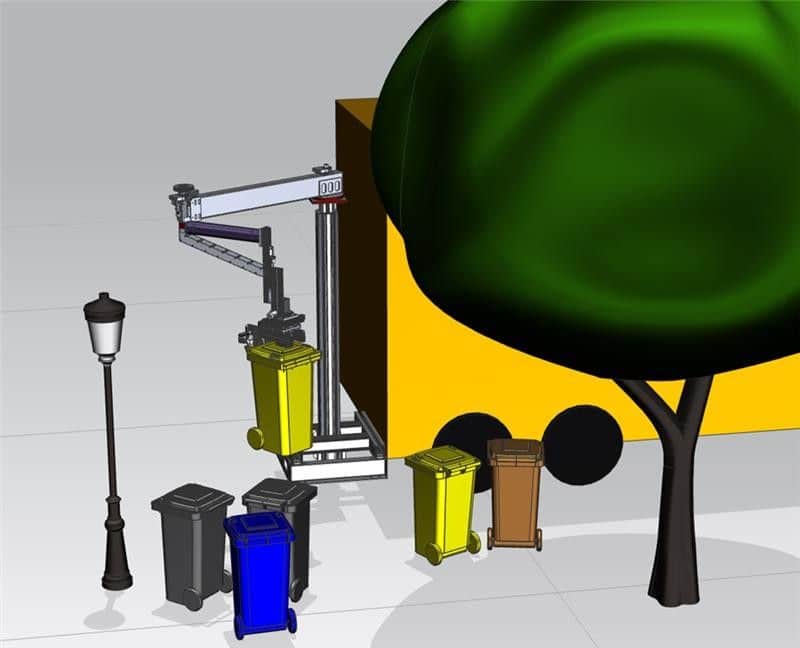
★Mark us as a preferred sourceEarly in the mornings, waste collection vehicles bump along the streets while workers drag and lift heavy bins into the containers – this everyday physical ordeal could soon be a thing of the past. Within the framework of a state-supported project in Germany, a new artificial intelligence-controlled robotic arm is being developed that autonomously handles the movement, emptying, and replacement of waste bins. The research aims to drastically reduce the physical strain on human workers, even under the most difficult conditions.
The AutASa Project: Partners and Professional Objectives
Based on the official press release published recently on June 23, 2026, the Fraunhofer Institute for Casting, Composite and Processing Technology (Fraunhofer IGCV) is at the forefront of this innovation. Together with partners MRK-Systeme GmbH and Roboception GmbH, and funded by the German Federal Ministry of Education and Research (Bundesministerium für Bildung und Forschung), they are developing the AutASa project.
Jannik Möhrle, an expert in intelligent process control and robotics at Fraunhofer IGCV, and the head of the project, emphasized: the focus of the development is to protect the physical health of garbage collectors, regardless of weather conditions. A major advantage of the developed intelligent robotic system is that it can be mounted on the rear of existing waste collection vehicles, allowing the current fleet to be modernized without the need to purchase completely new trucks.
Real-Time Safety and 3D Mapping
The foundation of the AI-controlled technology is a highly complex sensor network. The system generates a real-time, 3D digital map of the waste collection vehicle’s surroundings. Thanks to this precision mapping, the machine reliably recognizes pedestrians and various obstacles in its environment, treating them as collision geometries.
Special algorithms are responsible for movement safety, calculating the safest trajectory for the robotic arm in fractions of a second, in real-time. The intelligent sensor-fusion architecture developed by MRK-Systeme guarantees that the workflow remains completely safe, even in busy, downtown environments.
Two-Stage Learning Algorithm and Simulation Challenges
Before the device is deployed in the field, the robot must learn flawless movement in a computer simulation. Jannik Möhrle highlighted that their “two-stage approach” saves significant training time during the artificial intelligence’s teaching phase.
The steps of the process are structured as follows:
-
First Phase: The artificial intelligence algorithm calculates and executes the larger, so-called gross movements of the robotic arm, guiding the arm toward the waste bin.
-
Second Phase (The Last Centimeters): The fine-tuning is taken over by an adaptive machine learning process. This is built on the AI-based flexible object recognition technology provided by Roboception, which is essential for adapting to changing and sometimes chaotic street environments.
During the simulations, developers systematically manipulate environmental and physical parameters. They continuously change the weight and visual appearance of the bins, the friction coefficients occurring during pickup, and the amount of image noise from the camera sensors. This iterative, multi-factor testing makes the system extremely robust during the transition to practical application.
Practical Results and Future Industrial Potential
Field tests clearly prove that the AI-supported robot is capable of completing the task even in the narrowest alleys and complex environments, all without the manual, physical intervention of garbage collectors. Currently, the prototype is operating in a municipal waste collection demonstration test phase.
The members of the consortium agree that the developed solution points far beyond the scope of waste collection. The technology could soon revolutionize agriculture, construction, and other heavy industry segments where workers currently perform physically demanding, routine tasks.
“This is just the beginning,” said the Fraunhofer researcher. “We intend to turn the waste collection vehicle into a mobile platform for smart robotics.”
Professional References and Source Links:
-
Scientific publication detailing the mathematical and engineering background of the technology: Möhrle, Jannick et al. (2025): Onlinebahnplanung mittels Reinforcement Learning. WT Werkstattstechnik 115(3), pp. 185-192. (DOI: 10.37544/1436-4980-2025-03-67)
-
Original source: Fraunhofer IGCV official press release (June 23, 2026)
-
State funding background: Portal of the German Federal Ministry of Education and Research (BMBF)
