


If you like our site, mark us as a preferred source on Google — so you’ll see our articles more often in search!
★Mark us as a preferred sourceHungary’s first self-service recycling centre goes live in Miskolc on 14 September. MiReHu Nonprofit Kft. will accept waste at its József Attila Street site on weekday mornings and evenings – by pre-booked appointment, without a yard attendant handling the drop-off. The pilot tests an operating model with no precedent in Hungarian waste management, though a German city has been gathering data on a similar scheme for a year.
Why does a waste yard need a shift after closing time?
The main practical constraint on civic amenity sites is not capacity but timing. Conventional opening hours largely overlap with the working day, so anyone employed from eight to four either takes time off or joins the Saturday peak. That creates two problems at once: residents struggle to get in, and the yard receives most of its daily traffic concentrated into a few hours.
The Miskolc concept targets exactly this bottleneck. The aim is twofold: to reduce the daily load and to shorten waiting times – without building a new yard or adding a full extra shift. Hours outside the normal schedule become capacity that previously sat idle.
How the self-service recycling centre in Miskolc will work
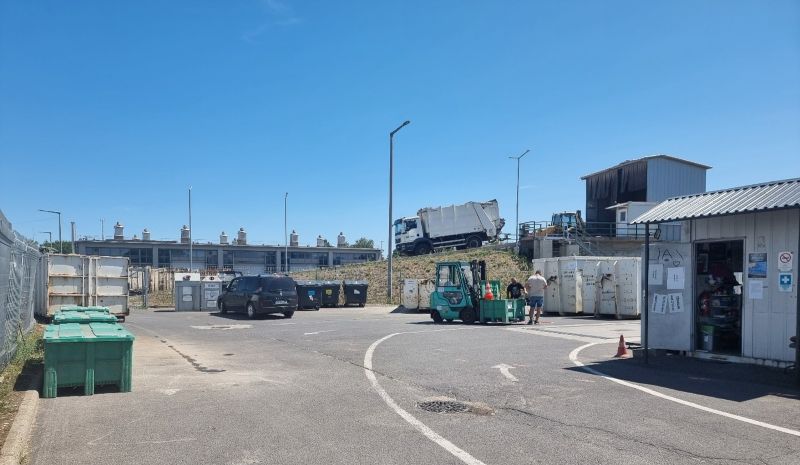
The service launches at the József Attila Street yard, and the site choice has a very practical reason: it has its own gatehouse service, which can also supervise the process. So the system is self-service, but not unattended. Alongside the existing camera network, the porter on duty monitors drop-offs continuously; during the pilot he opens the yard for the customer, secures the area behind them, and also oversees the exit.
The self-service zone does not mean the whole yard. Containers that receive waste during the day, with administration, are fenced off – precisely to prevent any drop-off without record-keeping. In the self-service area, 620-litre big boxes await the waste: two per booking.
Opening hours are deliberately narrow at launch: twice one hour every weekday. Three slots can be booked in the morning before the yard opens, between 7.00 and 8.00, and three more in the evening after closing, between 18.30 and 19.30. Each booking is a 20-minute block, within which both unloading and paperwork must be completed.
Appointments are made through the Minup system, available at https://app.minup.io/book/mirehu-nonprofit-kft. The system records the customer’s name, address, address card serial number, vehicle registration if arriving by car, the date and time of delivery, the waste types to be brought, plus a phone number and email address. Customer services sends an email confirmation of the booked slot and simultaneously notifies the manager responsible for the gatehouse service and the yard staff. One customer may drop off per slot, and only those who arrived for that specific time band may be on site.
If the pilot delivers, app development is the next step – meaning that in the medium term a phone could replace the porter in opening the gate.
Who is eligible, and what does it cost?
The service is free, and it is not a Miskolc-only privilege: any resident from anywhere in Hungary may use it, provided they hold a Hungarian address card, residence permit or card, official certificate, registration certificate or notification form, and have entered their details in the booking system.
Two conditions matter, though. First, daily quantity limits apply here exactly as they do under normal operation. Second, the self-service recycling centre cannot be used by proxy – the booking is tied to the person actually delivering the waste.
What can and cannot be dropped off?
The list of accepted waste is tailored to everyday household situations:
- mixed packaging waste,
- paper waste,
- glass packaging waste,
- small bulky waste such as chairs and side tables (up to 150 kg per day),
- non-hazardous electrical and electronic waste,
- textile waste,
- wood waste,
- tyres (up to 4 per day),
- garden waste (up to 4 bags),
- metal waste, such as pots and pans,
- cooking oil, in a container, sealed against leaks.
Two waste streams are explicitly excluded: hazardous waste and construction and demolition waste cannot be handed in. That is logical enough – both require acceptance and classification expertise that a self-service slot cannot provide.
Twenty minutes, two boxes, one tracking sheet
The essence of the process is that the customer does the weighing and the documenting – while the system stays auditable. The 620-litre boxes are labelled with the booked time slot, and during the pilot a tracking sheet is placed on or in them. The sheet already lists the waste types the customer selected when booking; all they need to add is the measured weight.
Individually packaged, loadable items must be weighed one by one on either the weighbridge or the platform scale, depending on size, and the results entered on the tracking sheet. Separately collected packaging waste can go to the recycling island set up in the yard, following the rules that apply there. Weighed waste goes into the boxes assigned to that slot, and the tracking sheet into the designated holder.
The back-office work follows the next morning – or the same day. The waste receiver carries out a control weighing by waste type, then records the quantities in the weighing software according to the booking data. Waste handed in during morning slots is cleared before opening; evening deliveries are moved the following morning into the appropriate collection container – so the evening slot always finds empty boxes. Setting the boxes out each day is also the receiver’s job; during normal opening hours the self-service boxes are stored in a fenced-off part of the yard not used for the regular service.
If a customer leaves waste that does not meet acceptance conditions in quality or quantity, the waste receiver reports it and customer services sends a formal warning letter. That may read as strict, but it is the key to making the model work: the gatehouse service does not perform yard-attendant duties, it only supervises the process and keeps the booking order. Alongside education, a feedback mechanism is therefore essential – without it, the model would degrade within weeks.
Essen has been running the experiment for a year
The Miskolc pilot has a European precursor, one that dontwasteit.hu has already covered: the self-service recycling yard in Essen has been operating for a year. Essen’s municipal operator EBE, together with REMONDIS, has run the Recyclingstation Süd/Ost self-service station on Langenberger Straße in Überruhr since September 2024. Residents there can deposit recyclables Monday to Saturday after regular opening hours, on weekdays until 22.00.
The German model is fully digital: after downloading the free MAEX app and registering, the customer books a ten-minute slot and opens the gate themselves over Bluetooth. The first-year figures are persuasive. According to EBE’s managing directors, close to 120 people a week use the service, and 3,800 registered users signed up within twelve months – well beyond expectations. Two-thirds of the material delivered was garden waste, followed by paper and cardboard at nearly 20 per cent, hard plastics at 7.2 per cent and metal waste at 6.7 per cent. Essen was the first large city in North Rhine-Westphalia with such a solution, and the operator is already weighing whether to equip further yards with the system.
The contrast between the two approaches is instructive. Essen started with the technology: an app, Bluetooth gate access, a narrower waste list, no weighing. Miskolc starts with the process: a broader list of accepted materials, item-by-item weighing, a tracking sheet and human supervision, with the app left for step two. That is a slower entry, but by the end of the pilot there will be far more usable data on who brings what and in what quantity – and that is precisely the knowledge needed to size a later, automated system.
The latest piece in MiReHu’s run of innovations
The self-service time band is not an isolated idea in MiReHu’s portfolio but the continuation of a development logic that has been building for years. The company created a distinct brand from the Borsod dialect word “makuka” – which contains “kuka”, the Hungarian word for bin, the basic tool of waste management – and its awareness-raising projects all carry that name. MaKukáció, the summer waste management experience day, was held for the sixth time this year with around 300 primary school pupils. The electric refuse trucks built for children are MakuTruck and MakuTruck XL; the mobile selfie point is MakuTaxi, an 1,100-litre metal container converted into an armchair.
Linking reuse with upcycling belongs to the same series: MaKuckó is an upholstery repair workshop, MakuArt a repair and value-creation programme, and MakuSpace a venue for creative making. All of these connect to the Miskolc Reuse Centre, the largest reuse centre in eastern Hungary, which puts the prevention principle into practice. The company also operates a waste management park in Miskolc dedicated to environmental education, and its work has been recognised with a Greengage award and multiple Superbrands titles.
Seen in that context, the self-service recycling centre is not a PR gesture but the least spectacular and perhaps most operational item in the series: it develops not attitudes, but the accessibility of the public service itself.
What to keep in mind before booking
A few practical points that matter a lot inside a 20-minute slot:
- Book in advance and specify the waste types accurately – the tracking sheet is generated from that selection.
- Bring your address card or the equivalent document; the service cannot be used by proxy.
- Sort everything at home by waste type and pack it so each item can be weighed individually. Twenty minutes is not enough for on-site rearranging.
- Bring cooking oil in a sealed, leak-proof container.
- Respect the daily limits: 150 kg of small bulky waste, 4 tyres and 4 bags of garden waste per day.
- Do not bring hazardous or construction and demolition waste – these cannot be accepted, and incorrect deposits can result in a warning letter.
The point of a pilot is to find out what works. The Essen experience suggests public uptake can exceed expectations when a service genuinely fits the hours in which people actually have free time. The fact that this model is starting at all in Hungary matters in itself: from now on, whether a Hungarian waste yard can accept waste without staff yet still fully documented is no longer a theoretical question but a measurable experience.
Frequently asked questions about the self-service recycling centre
When does the self-service recycling centre in Miskolc open?
The service starts on 14 September 2026 at MiReHu Nonprofit Kft.’s waste yard on József Attila Street, as a pilot. It is available twice an hour every weekday: between 7.00 and 8.00 in the morning and between 18.30 and 19.30 in the evening. Three slots can be booked in each band, and one booking is a 20-minute block.
How do you book an appointment?
Booking runs through the Minup system at app.minup.io/book/mirehu-nonprofit-kft. The system records the customer’s name, address, address card serial number, vehicle registration, delivery time and the waste types to be brought. Customer services emails a confirmation of the booked slot and also notifies the gatehouse service and the yard staff about it.
What waste can be dropped off at the self-service recycling centre?
Accepted materials include mixed packaging, paper and glass packaging waste, small bulky waste up to 150 kg per day, non-hazardous electrical and electronic waste, textiles, wood, up to four tyres, up to four bags of garden waste, metal waste and cooking oil in a sealed container. Hazardous waste and construction and demolition waste cannot be accepted.
Is the service free, and who can use it?
The service is free. Any resident of Hungary can use it who holds a Hungarian address card, residence permit, official certificate, registration certificate or notification form and has entered their details in the booking system. Daily quantity limits apply here as under normal operation, and the service cannot be used by proxy on someone else’s behalf.
Is the yard really unattended?
No: the drop-off is self-service, but not unsupervised. Alongside the existing camera network, the gatehouse service on duty monitors the process continuously. During the pilot the porter opens the yard, secures the area and oversees the exit as well. The gatehouse staff do not perform yard-attendant duties, however – they only supervise the process and keep the booking order.
What does the customer have to do on site?
They locate the 620-litre boxes labelled with their booked time slot, then weigh each item individually on either the weighbridge or the platform scale, depending on size. The weights are entered on the tracking sheet placed on the boxes, the waste goes into the boxes, and the completed sheet goes into the designated holder.
Source:
Consistent structure, quick answers: every article is built so that both readers and AI search tools can find the key points easily. Our content is produced with the help of AI tools and reviewed by our editor.


