


If you like our site, mark us as a preferred source on Google — so you’ll see our articles more often in search!
★Mark us as a preferred sourceSolar panel silver and silicon recovery is the point where PV recycling either becomes a profitable business or stays permanently dependent on subsidies. More than 97 percent of a decommissioned module’s mass is glass, aluminium and plastic — yet most of the money sits in a few grams you can barely see.
In 2026 a Chinese research group published a study in Science Bulletin that strips out those few grams in under a minute, at 99 percent efficiency — while leaving the silicon almost untouched and recoverable. This article looks at how much silver and silicon a module actually contains, what those materials are worth at today’s prices, why recovery has stalled until now, and what the new process changes.
What is a solar module actually made of?
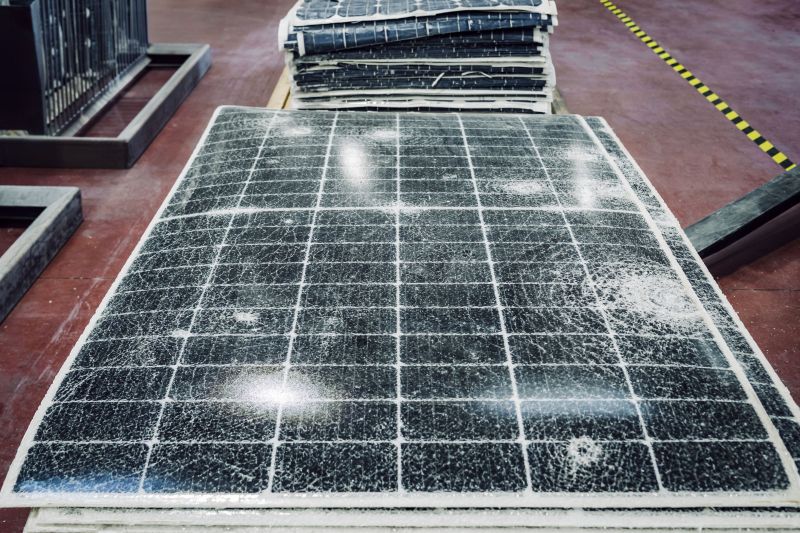
Crystalline silicon (c-Si) modules account for roughly 95 percent of the global market, and their construction has barely changed in decades. It is a sandwich: tempered glass, an EVA adhesive layer, the silicon cells, more EVA, a plastic backsheet — all held together by an aluminium frame. That laminated structure is the single biggest obstacle to recovering the valuable materials inside.
Mass breakdown of a typical c-Si module:
| Component | Mass share | Per tonne of panels |
|---|---|---|
| Glass | 67–75% | 670–750 kg |
| Aluminium frame | 10–15% | 100–150 kg |
| Polymers (EVA, backsheet) | 8–12% | 80–120 kg |
| Silicon cells | 2.7–4% | 27–40 kg |
| Copper (wiring) | approx. 1% | approx. 10 kg |
| Silver (contacts) | 0.015–0.08% | 150–800 g |
The proportions tell the story. Silver sits at around one thousandth of module mass — just 0.015 percent in the newest cells — yet it is the single component whose recovery can decide whether a recycling plant survives.
How much silver and silicon is in one panel?
Silver appears as thin conductive lines on the cell surface — busbars and finger electrodes — fired on as a silver paste. The quantity has fallen dramatically: around 2006 the industry used roughly 200 tonnes of silver per gigawatt, today it is under 30 tonnes, and less still in the latest generation.
The Science Bulletin study puts a precise number on the current state: a standard 182 × 182 mm cell weighing about 15 grams contains roughly 80 milligrams of silver. That is just 0.5 percent of cell mass and 0.015 percent of the complete module.
In practical terms:
- A current large-format module (72 full cells, 550–600 W) contains around 6 grams of silver.
- An early-2010s 60-cell panel can hold nearly double that: 10–13 grams.
- One tonne of mixed panel waste typically holds 200–500 grams of silver.
- Silicon in that same tonne amounts to 27–40 kilograms, usually as wafers of better than 99.9999 percent purity, doped with phosphorus or boron.
So silicon outweighs silver roughly a hundredfold. The value ratio runs in exactly the opposite direction.
What is solar panel silver and silicon recovery worth?
Let us use autumn 2026 prices. Silver has roughly tripled on world markets in two years: from around $20 per troy ounce in 2024 to the $65–69 band seen in mid-2026. That works out to roughly $2.10–2.25 per gram.
The raw material value of one tonne of panel waste breaks down like this:
| Material | Quantity | Estimated value |
|---|---|---|
| Silver | 200–500 g | $420 – $1,100 |
| Copper | approx. 10 kg | approx. $90 |
| Aluminium | 100–150 kg | $80 – $130 |
| Silicon (metallurgical grade) | 27–40 kg | $55 – $90 |
| Glass | 670–750 kg | $10 – $30 |
Exactly what share of total recycling value silver represents has no single answer in the literature — and that is not inconsistency, it is the silver price moving. The Science Bulletin study puts silver’s share at 47 percent. The Nature analysis published in August 2026, covering 32 regions, found that silver, aluminium and silicon together account for 87 percent of recycling revenue. And Andreas Obst, head of recycling at Fraunhofer CSP, said this year that at today’s silver prices the metal alone is worth more than the glass, aluminium and silicon combined — meaning that if you are talking about recycling solar modules, you are really talking about silver recovery.
The three figures are compatible: the 47 percent share reflects lower silver prices, and it climbs with every dollar the metal gains.
Per panel that means $12–$27 worth of silver. Set that against processing costs: NREL estimates put landfilling a panel at $1–5, while recycling the same panel runs $15–45. The silver inside, in a good case, covers the entire processing cost. In a bad case — if you fail to extract it — it covers nothing.
That tension sits at the centre of the whole industry. Which brings us to how you extract it.
Why is the silver so hard to get out?
Silver is not present as a lump. It is fired micrometres thin onto the cell surface, then laminated and sealed between glass and plastic. Mechanical separation cannot reach it. Chemistry can — but every existing route runs into something.
Nitric acid leaching. The industry baseline: HNO₃ dissolves the silver, separates it from the silicon, and the metal is then recovered by electrodeposition or precipitation. The problem is that this is an unnecessary detour — the silver is converted to ionic form only to be converted back to metal. Along the way it generates toxic nitrogen oxides and leaves an acidic waste stream to manage.
Acid-free reagents. Researchers have tried alternatives one after another: iodine-potassium iodide, ferric chloride with choline chloride, thiourea systems, sodium phosphate. All work in the lab, but each is expensive, procedurally complex, or produces hazardous waste.
Alkaline etching. The most promising route for some time was sodium hydroxide etching, because it detaches silver directly in metallic form with no conversion loop. But silicon is highly reactive in NaOH: if etching runs even slightly long, the wafer starts dissolving too. The process demands precise timing, consumes large volumes of NaOH, evolves hydrogen gas — a safety hazard — and leaves a strongly caustic waste stream.
Every path led to the same place: you can recover the silver, but you sacrifice either the silicon, the chemicals budget, or the environment.
The molten salt breakthrough
The 2026 Science Bulletin study answers that dilemma, and the solution is elegant in its own way: instead of an aqueous or acidic medium, it uses molten salt.
The recipe is a sodium chloride and calcium chloride mixture — table salt and calcium chloride — with calcium carbonate or calcium oxide (limestone or quicklime) added. The system has a low eutectic point, is cheap and non-toxic, and at 600 °C provides a stable, low-viscosity, highly ion-conductive environment.
Two processes run simultaneously in that medium.
Galvanic etching. The molten salt acts as an electrolyte and the cell itself becomes a battery: the aluminium back layer serves as anode, and the silicon dioxide at the silver-silicon interface as cathode. With no external power source, the electrochemical reaction is self-driven. Aluminium oxidises to alumina while silicon dioxide is reduced back to silicon — and because that reduction involves volume shrinkage, the ground disappears from under the silver layer. The silver simply detaches.
Chemical etching. At the same time, calcium carbonate and calcium oxide supply oxide ions that attack the silicon dioxide and the silicon nitride anti-reflective coating on the cell surface. This step frees the remaining silver and strips the SiNx layer — the very layer that conventional processes find hardest to deal with.
The result: 99.0 percent recovery efficiency for both silver and silicon, within one minute. The silicon survives because, unlike in NaOH etching, it is essentially inert to this etchant. No over-etching, no timing constraint, no hydrogen evolution.
The economics. The authors also ran a life cycle assessment (LCA) and life cycle costing (LCC). The result: a reduction of 11.0 kg CO₂ equivalent and a saving of $14.04 per kilogram for recycled cells, compared with earlier processes.
That last figure deserves a moment’s thought. A tonne of panel waste contains 27–40 kilograms of cells, so we are talking about roughly $380–560 per tonne — about the same as the silver content itself is worth. In an industry where processing cost and material value sit a hair’s breadth apart, that is not fine-tuning. It is a change of sign.
It is worth being clear about what this is and is not: a laboratory result at experimental scale. Running a 600 °C molten salt bath industrially, regenerating the salt, corrosion-proofing the equipment and feeding material continuously are all problems nobody has yet solved on a production line.
Silicon remains the harder case
Even recovering silicon at 99 percent efficiency leaves a question: what do you do with it?
The emitter layer. A working solar cell needs a phosphorus-doped wafer surface. Anyone wanting to make new cells from recovered silicon has to strip that layer off, and that requires hydrofluoric acid in large quantities. At industrial scale it is expensive and hazardous.
The technology shift. The industry has moved from p-type to n-type base material in recent years. The original dopant stays in the recovered wafer, which means panels from the 2010s yield silicon that today’s cell manufacturing has no use for.
That it is technically possible was shown by a 2022 German experiment: Fraunhofer CSP and Fraunhofer ISE produced a PERC cell from 100 percent recycled silicon at 19.7 percent efficiency. A cell made from virgin material in the same run reached 22 percent. The gap is not dramatic, but the project has not moved beyond demonstration since.
The realistic near-term path is therefore not cell-to-cell but lower-value use: metallurgical feedstock, aluminium-silicon alloy, and one of the most promising directions of all — silicon anodes for lithium-ion batteries.
How big is the global stake?
The numbers have been revised sharply upward over the past two years.
In 2024 the world installed more than 600 GW of new PV capacity, bringing cumulative installed capacity to 2,246 GW. The Science Bulletin study projects that the industry’s cumulative material demand will reach 705–1,879 million tonnes by 2050, with waste generation at 238–529 million tonnes. The Nature model covering 1,708 scenarios projects 297–402 million tonnes of PV waste by 2060 — consistent in direction.
Regulation is catching up slowly. China has issued new guidelines for recycling decommissioned panels, while the EU mandates an 80 percent recovery rate through the WEEE Directive — but that is a mass-based target, met by glass and the aluminium frame alone, offering no incentive for silver or silicon.
Silver scarcity is tangible. The PV industry currently consumes roughly 6,000 tonnes of silver a year out of some 30,000 tonnes of global mine production — and the Science Bulletin authors warn that at current expansion rates known silver reserves could be depleted before 2065. IEA PVPS points the same way: between 2025 and 2050 the solar industry alone could consume 15–30 percent of current global silver reserves.
The Nature analysis quantified the financial side. Without learning effects, global PV recycling would accumulate $57–172 billion in losses by 2060. With well-chosen, regionally differentiated strategies, cumulative net benefits of $529–936 billion and savings of 3.32 billion tonnes of CO₂ equivalent are achievable. The break-even point falls between 2035 and 2040 in every scenario examined.
The question in this equation is not whether it pays, but when and at what scale. Processes like molten salt etching are exactly what could pull that “when” forward.
Where is the break-even point today?
Scale decides. Based on Fraunhofer CSP’s own process development work, a dedicated hydrometallurgical line justifies its capital cost at throughputs of several thousand tonnes of solar cells per year. A detailed techno-economic model is more precise: at a high silver content of 0.2 percent, throughput above 18,000 tonnes per year is sustainable without any recycling fee; at a low 0.05 percent content, some fee or subsidy is always needed below 43,000 tonnes.
A few European players have already started down this road — France’s ROSI is scaling European processing with a new Spanish plant. On the collection side Australia is setting an example with a national pilot programme and a hundred drop-off points, because good technology counts for nothing if the panel never reaches the plant.
And here is the trap: the waste has not arrived yet. In Germany, where panels from the late-2000s subsidy boom should now be reaching end of life, volumes arriving at recyclers have actually declined. Fraunhofer CSP tried to trace the missing modules through customs statistics without success. Yet German peak volumes in the early 2030s are expected to reach 600,000 tonnes per year.
How much of this sits in Hungary?
A rough order-of-magnitude estimate follows — emphatically an estimate, not a measurement.
According to MAVIR and MEKH data, Hungarian installed PV capacity passed 8 GW by mid-2025, with over 300,000 household-scale systems. One megawatt of installed capacity represents roughly 55–70 tonnes of modules, which puts 450,000–550,000 tonnes of panels on Hungarian rooftops and in solar parks today.
Most of that fleet was installed after 2018, so it already belongs to the silver-thrifty generation. Assuming an average silver content of 20–50 tonnes per gigawatt, the Hungarian PV stock holds roughly 150–400 tonnes of silver — worth $320–840 million at current prices.
The same stock contains around 15,000 tonnes of silicon. As metallurgical-grade feedstock that is worth $30–45 million — an order of magnitude less than the silver, despite there being a thousand times more of it.
None of this becomes available at once. Most Hungarian panels reach end of life between 2035 and 2050, and incoming volumes will climb gradually from a few thousand tonnes a year. The region does have something to look at: Eastern Europe’s first solar panel recycling plant opened in Romania in 2025 near Brașov, on a €1.5 million investment.
Which is exactly why decisions made now — collection systems, extended producer responsibility arrangements, regional processing capacity — will determine whether that material ends up in domestic plants in 2040 or in a container heading out of the country.
Five things worth remembering
- A current solar cell contains 80 milligrams of silver — half a percent of cell mass, 0.015 percent of module mass. That sliver accounts for roughly half of recycling value, and more when silver prices are high.
- One panel holds $12–27 of silver, while recycling the whole panel costs $15–45. The closeness of those numbers explains why the industry has not taken off.
- Every existing process has been a compromise: acid leaching brings toxic byproducts, alkaline etching sacrifices the silicon.
- The molten salt process, combining galvanic and chemical etching, recovers both materials at 99 percent efficiency within a minute, saving $14 per kilogram and 11 kg CO₂ equivalent. This is a lab result — industrial translation is still ahead.
- Hungary has 150–400 tonnes of silver on its rooftops. The question is not whether it gets recovered, but who recovers it, and where.
Silver has an instructive precedent. At its peak the photographic industry consumed around 35 percent of annual global silver production — and recovered more than 70 percent of what it used. The solar industry’s recovery rate today is effectively zero.
Photography solved it. The question is how much time the solar industry gives itself to do the same — and the answer just got a minute shorter.
Solar panel silver and silicon recovery – frequently asked questions
How much silver is in one solar panel?
A standard 182 × 182 mm cell contains roughly 80 milligrams of silver, about half a percent of cell mass. In a current 72-cell module that adds up to around 6 grams, while an early-2010s 60-cell panel can hold 10–13 grams, because the industry used considerably more silver back then.
What is the silver in a solar panel worth?
At autumn 2026 prices, the silver in one panel is worth roughly $12 to $27, with silver trading around $2.10–2.25 per gram. That is close to what it costs to recycle the entire panel, which means the silver content alone can cover processing costs in a favourable case.
How does molten salt silver recovery work?
In a sodium chloride and calcium chloride melt at 600 °C, with calcium carbonate or calcium oxide added. The cell becomes its own battery: the aluminium backsheet acts as anode, the silicon dioxide as cathode. The oxide reduces to silicon and shrinks, so the silver detaches. Meanwhile the calcium compounds strip the silicon nitride layer.
Why is this better than acid or alkaline processes?
Because it does not sacrifice the silicon. Nitric acid leaching generates toxic nitrogen oxides and acidic waste, while sodium hydroxide etching over-etches the wafer and evolves hydrogen gas. In the molten salt process silicon is essentially inert, so both silver and silicon are recovered simultaneously at 99 percent efficiency.
How much cheaper is the new process?
Life cycle costing shows a saving of $14.04 per kilogram and a reduction of 11.0 kg CO₂ equivalent for recycled cells. Scaled to a tonne of panel waste that is roughly $380–560, about as much as the silver content itself is worth. The process currently works at laboratory scale only.
Why is silicon harder to use than silver?
Recovery is solved; the end use is not. The phosphorus-doped emitter layer on the cell surface would need stripping with hydrofluoric acid, which is expensive at industrial scale. The industry has also shifted from p-type to n-type base material, so silicon from older panels has little use in current cell manufacturing. Battery anodes and metallurgical feedstock are more realistic targets.
How much silver sits in Hungary’s solar panels?
Hungarian installed capacity passed 8 gigawatts by mid-2025, representing 450,000 to 550,000 tonnes of modules. That stock holds roughly 150 to 400 tonnes of silver, worth $320 to $840 million at current prices. Most of it becomes available between 2035 and 2050 as panels reach end of life.
Sources: Science Bulletin (Chinese Academy of Sciences / Elsevier, ISSN 2095-9273), 2026 — galvanic and chemical etching in molten NaCl-CaCl₂; Wang, C., Zuo, J., Chen, X. et al.: Towards an equitable future of global photovoltaic waste recycling, Nature, 2026 (DOI: 10.1038/s41586-026-10905-w); pv magazine, 11 June 2026 — Fraunhofer CSP and UNSW data; NREL / Chemical & Engineering News; IEA PVPS; MAVIR and MEKH.


