
'/%3E%3C/svg%3E)



If you like our site, mark us as a preferred source on Google — so you’ll see our articles more often in search!
★Mark us as a preferred sourceSwiss Federal Railways (SBB) is introducing a significant change to its passenger coaches: the gradual removal of small waste bins located directly at seats. This decision is driven by a strategy to improve hygiene, increase recycling efficiency, and provide passengers with more physical comfort—specifically increased legroom. According to SBB data, 95% of passengers already use the central recycling stations at the ends of coaches or in stations, making this move a logical step in aligning services with existing traveler habits.
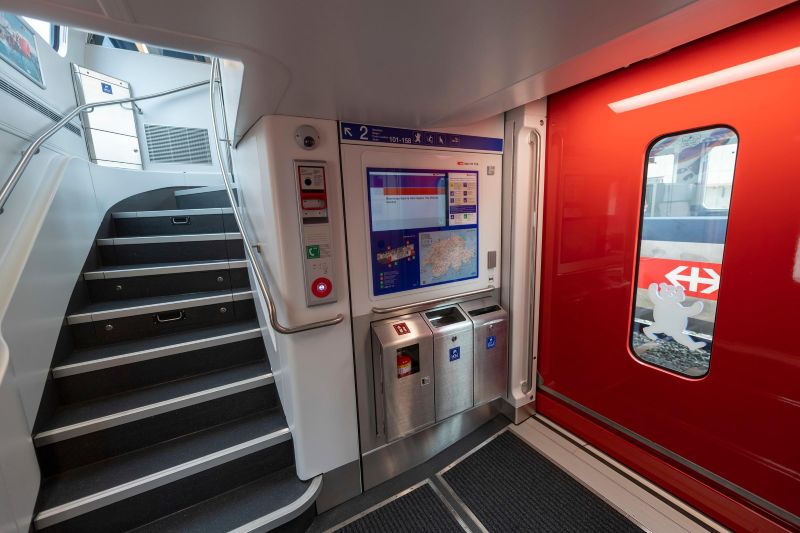
For decades, the small bin under the table or by the window has been a staple of the Swiss rail experience. However, SBB’s internal analyses have shown that in the context of modern rail travel, these bins present more challenges than benefits. Consequently, the railway operator has decided to shift its focus toward high-capacity, multi-stream recycling stations located in the entrance areas of the carriages.
Improving Hygiene and Expanding Legroom
SBB has cited several compelling reasons for the removal, all of which directly impact the quality of the journey:
-
Hygiene and Odours: Small bins at seats often overflow or contain food waste, leading to unpleasant smells and aesthetic issues in the immediate vicinity of passengers. By moving waste to central stations further from the seating area, air quality and cleanliness are improved.
-
Increased Legroom: Removing the bins frees up valuable centimeters between and under the seats. This is particularly noticeable on long-distance journeys, as it eliminates a physical obstruction, allowing passengers more freedom of movement for their legs.
-
Overall Carriage Cleanliness: Experience shows that litter is more likely to accumulate under seats near small bins. Shifting to central stations promotes a more orderly and disciplined cabin environment.
Streamlining Recycling: The Power of Sorting
A core pillar of this reform is environmental sustainability. The small bins at seats do not allow for waste separation, meaning all trash is collected as residual waste. In contrast, the central stations at the ends of the coaches allow passengers to sort their waste into specific categories: PET bottles, aluminum cans, paper, and residual waste.
Statistical data supports SBB’s strategy:
-
95% of passengers already dispose of their waste in recycling stations at the station, at the end of the train car, or they take it with them to their final destination.
-
SBB collects over 6,000 tons of waste annually across its trains and stations. By expanding the central recycling system, a larger portion of this material can be returned to the circular economy.
Operational Efficiency and Fleet Integration
The transition is not happening overnight; rather, it is being implemented in phases as fleets are renovated or new trains are commissioned. The change is currently being rolled out on the IC2000 and ICN long-distance fleets during their major revisions.
For the railway operator, the change also brings significant operational relief. In a single carriage, cleaning crews currently have to empty up to 50 or 60 small bins, a highly time-consuming process. Emptying four central units at the ends of the car is significantly faster and more hygienic, allowing staff to dedicate more time to deep-cleaning other parts of the passenger cabin.
Passenger Feedback: A Proven Concept
This decision was backed by a 2021 pilot project conducted on selected lines. During the testing phase, the majority of passengers not only accepted the change but actively welcomed it, citing the cleaner environment and the improved legroom. SBB emphasized that recycling stations remain plentiful on platforms—available at hundreds of stations nationwide—ensuring that passengers have immediate disposal options upon disembarking.
Official Sources and References:
-
Original SBB Media Release: SBB entfernt Abfallkübel bei Sitzplätzen für mehr Sauberkeit und Beinfreiheit
-
SBB Media Portal: SBB News – Media Relations
Consistent structure, quick answers: every article is built so that both readers and AI search tools can find the key points easily. Our content is produced with the help of AI tools and reviewed by our editor.
