



If you like our site, mark us as a preferred source on Google — so you’ll see our articles more often in search!
★Mark us as a preferred sourceThe latest Circularity Gap Report (CGR) 2026 executive summary, collaboratively published by Circle Economy and Deloitte, confronts the global economy with shocking factual data. The comprehensive analysis introduces the concept of the “Value Gap,” which meticulously illustrates the avoidable economic losses—measured in trillions of euros—caused directly by our current linear material use. The objective data highlights a harsh reality: wasteful mechanisms and short-term economic thinking are consuming massive amounts of value annually. Below is a detailed, data-driven analysis of the hidden losses within the global economy and the strategic steps required for a circular transition, based strictly on the official report.
A New Perspective on Economic Potential: The Concept of the Value Gap
One of the most significant methodological innovations of the CGR 2026 report is the introduction of the Value Gap. This indicator provides a pragmatic, economy-wide measure of how much avoidable economic value, expressed strictly in monetary terms, is lost due to linear material use.
To ensure global comparability, value is primarily defined in economic terms and expressed in prices, utilizing Gross Domestic Product (GDP) as a proxy for total value creation. Within this framing, the methodology makes a sharp distinction between two core concepts:
-
Functional Value: The actual utility embedded in materials, components, and finished products.
-
Created Value: The broader environmental and social impacts of economic activity, which largely remain external to standard market prices.
The Value Gap represents the total avoidable value lost through inefficient material use (which explicitly includes both energy and food), premature obsolescence, asset deterioration, and partially unpriced externalities. This is an absolute figure that can also be expressed relative to GDP—that is, as euros of avoidable value lost for every single euro of value created. This indicates precisely how much value is structurally lost for each unit of economic output generated. According to the report, accounting for the Value Gap alongside GDP would provide a much more realistic measure of net value creation, highlighting the massive scale of opportunity for circular strategies to retain and recover that lost value.

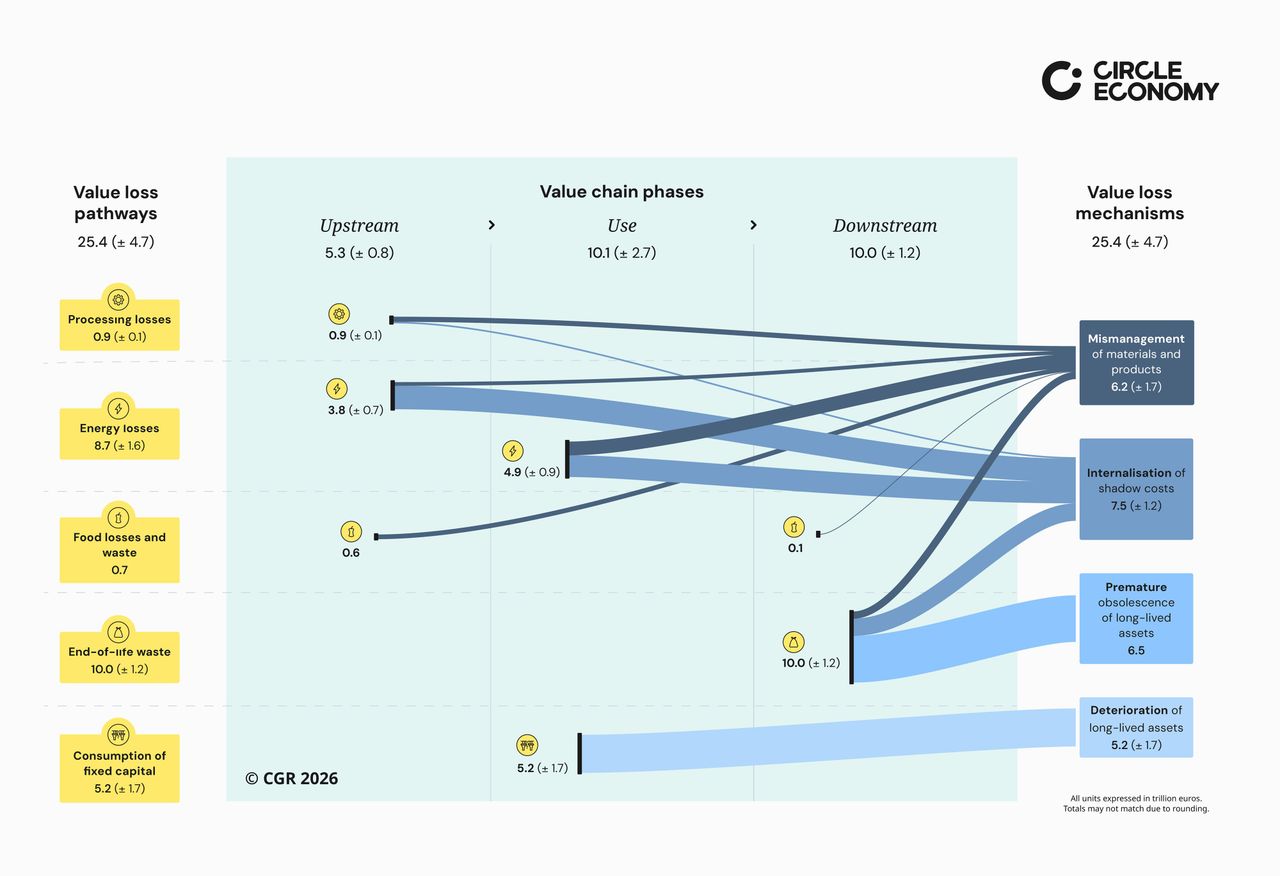
The Price of Linearity: Five Main Pathways of Value Loss
Economic value losses are grouped into five interlinked pathways that capture both short-term inefficiencies and longer-term asset erosion. Together, these pathways reveal how the current economic system not only creates value but also actively erodes it. (The results are presented as a range to reflect methodological uncertainty, data limitations, and variability in underlying assumptions).
-
End-of-life Waste: The most significant source of loss, generating a staggering €10.0 trillion (± €1.2 trillion) in economic damage.
-
Energy Losses: Inefficient energy use results in an €8.7 trillion (± €1.6 trillion) loss to the global economy.
-
Consumption of Fixed Capital: The physical deterioration of buildings, infrastructure, and machinery accounts for €5.2 trillion (± €1.7 trillion) in lost value.
-
Processing Losses: During manufacturing and production processes, €904.2 billion (± €112.5 billion) of value is lost.
-
Food Losses and Waste: Waste generated throughout the global food supply chain amounts to €650.7 billion (± €28 billion).
The Four Fundamental Mechanisms Driving Value Loss
The report identifies four intertwined mechanisms that explain exactly how and why materials, products, and assets fail to reach their full potential within a linear system:
-
Mismanagement of materials and products: Inefficient handling and utilization of available resources.
-
Premature obsolescence: Products reaching the end of their perceived life before their functional utility is exhausted.
-
Premature deterioration: The accelerated physical degradation of assets.
-
Internalisation of shadow costs: The unpriced social and environmental damages that eventually impact economic value.
Strategic Action Plan for Key Stakeholders
Achieving circularity at scale requires unprecedented collaboration among various sectors to address systemic value loss and unlock economic, social, and environmental opportunities. The CGR 2026 outlines specific actions for key economic actors:
Businesses:
-
Build a holistic business case focusing on circular value creation.
-
Innovate and rapidly scale circular business models.
-
Collaborate extensively across value chains to unlock system-level value.
Financiers:
-
Integrate resource-use maximisation directly into financial decision-making processes.
-
Assess portfolio exposure to resource-related risks.
-
Reorient capital flows toward resource-efficient and circular investments.
Policymakers:
-
Support and enforce official target-setting within industries.
-
Examine and implement true pricing mechanisms that reflect environmental costs.
-
Consider and deploy economic instruments designed to accelerate the circular transition.
Reference and Official Source:
- The original summary report is available at the following link: https://dashboard.circularity-gap.world/report/2026/cgr-2026-summary
Consistent structure, quick answers: every article is built so that both readers and AI search tools can find the key points easily. Our content is produced with the help of AI tools and reviewed by our editor.


