


If you like our site, mark us as a preferred source on Google — so you’ll see our articles more often in search!
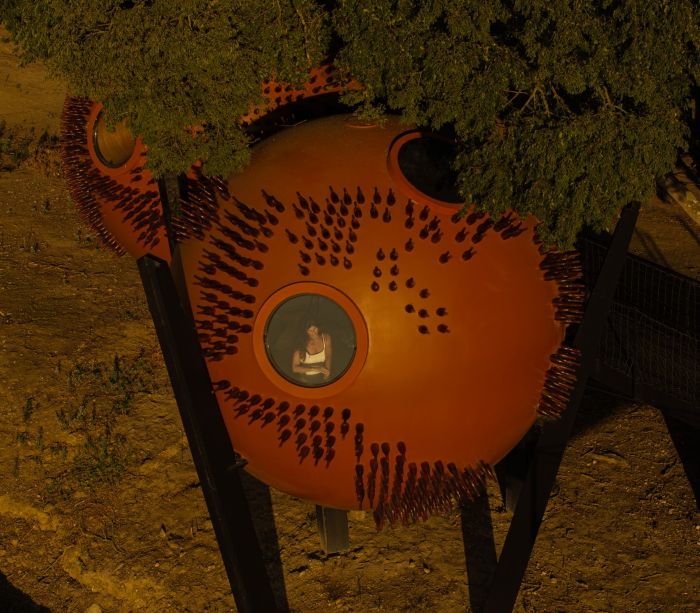
★Mark us as a preferred sourceThe Portuguese studio Rebelo de Andrade has set a new milestone in sustainable architecture with its Átomos project. Rising above the rolling hills of Setúbal, three copper-red, futuristic spheres float over the soil, their outer shells crafted from repurposed industrial glass waste. Aposstrophized as “habitable sculptures,” the ensemble mimics the fundamental building blocks of the universe—atoms—while applying the principles of the circular economy to point toward the future of eco-conscious luxury architecture.
The architectural complex is designed to symbolize a deep, almost sacred connection between nature and human creation. According to the designers’ vision, Átomos is more than just a shelter; it is a sensory experience that translates the alchemy of viticulture and winemaking—the transformation of matter into experience—into the language of architecture.
Quantitative Data and Technical Specifications
The Átomos project is the result of precise engineering and conscious material selection, characterized by the following data:
-
Total Floor Area: The complex occupies a total of 60 square meters, emphasizing the need for a compact intervention with a minimal footprint.
-
Structural Composition: The ensemble consists of 3 interconnected spheres (units) that evoke the nucleus and the dynamic orbits of an atom.
-
Cladding Innovation: The outer surface of the spheres is clad in a unique texture composed of 100% repurposed industrial glass waste.
-
Placement: The sculptures are elevated on stilts among the vines, ensuring undisturbed views and preserving the integrity of the agricultural landscape.


Recycled Glass as Artistic Texture
The most innovative element of the project is the exterior skin of the spheres. The Rebelo de Andrade studio chose not to use traditional building materials, instead opting for industrial glass waste to craft the surfaces.
-
Visual Effect: The recycled glass fragments form a “living tissue” on the surface of the spheres, rendering an abstracted world map across the curves.
-
Play of Light: Throughout the day, the glass flecks refract the sun, causing the color and shimmer of the sculptures to shift based on the time of day—moving from muted brown at dawn to a deep, metallic copper-red in the afternoon.
-
Ecological Footprint: This upcycling technology creates value from waste, reducing the demand for virgin raw materials while achieving a unique aesthetic quality.
Three Spheres, Three Functions
Though appearing as a unified sculpture from the outside, the interior spaces of Átomos serve sharply distinct functions connected by short, curved passages:
-
The Nucleus of Encounter: The first sphere serves as the social heart, a living area where people and ideas intersect.
-
The Intellectual Retreat: The second unit is a quieter, introspective workspace designed for reading, sketching, and deep thought.
-
The Private Sphere: The third unit is dedicated to rest, where the interior layout supports quiet contemplation and regeneration.
Landscape as the Silent Protagonist
Luís Rebelo de Andrade, the founder of the studio, believes that every project has a silent protagonist: the landscape. In the case of Átomos, the Setúbal horizon and the endless rows of vineyards define the building’s atmosphere. The elevated position is not just an aesthetic choice but a metaphor: inhabitants are detached from the everyday and placed into a higher, contemplative state.
Inside, the curved walls guide the eye, and windows frame the surrounding nature, allowing the landscape to “flow” into the glass-clad atoms.
Summary: Sustainable Innovation and Poetic Design
The Átomos project is evidence that the built environment can serve simultaneously as a functional refuge and an inspiring work of art. The use of repurposed industrial glass is not only a technical feat but also an ethical stance for a sustainable future. The creation of Rebelo de Andrade shows how waste can become a noble material and how architecture gains new meaning at the intersection of nature, art, and technology.
Official Sources:
-
Rebelo de Andrade Studio – Átomos Project Official Page: https://www.rebelodeandrade.com/en/projects/atoms_64


