


If you like our site, mark us as a preferred source on Google — so you’ll see our articles more often in search!
★Mark us as a preferred sourceIn Germany, over two million tons of bulky waste are generated annually, roughly a quarter of which is recyclable wood. By involving artificial intelligence (AI) and modern sensor technology, researchers in the ASKIVIT project have developed a new, multimodal process. This allows wood to be recovered from waste with an accuracy of over 95 percent, more economically, and in much larger quantities, thereby strengthening the principles of the circular economy.
The Huge Raw Material Potential in Bulky Waste
Bulky waste is one of modern industry’s most significant, yet extremely difficult-to-process raw material sources. According to official statistics, of the more than two million tons of bulky waste accumulated annually in Germany, about 25 percent is materially recyclable, high-quality wood. Although the sorting of everyday waste streams—such as used glass or various consumer packaging—has largely become an automated process today, the sorting of waste wood from bulky waste is still mostly carried out manually by human workers. Introducing automated sorting supported by machinery and artificial intelligence can not only significantly increase the industry’s profitability but also provide an immediate, effective solution to the worsening labor shortage in the waste management sector.
The ASKIVIT Project and the Innovative Quadruple Sensor System
Recognizing this industrial gap, the research collaboration named ASKIVIT was launched (the project’s full name translates to: “Waste wood recovery from bulky waste using artificial intelligence and image processing in the VIS, IR, and Terahertz range”). The research was implemented with direct financial support from the German Federal Ministry of Food, Agriculture and Homeland (BMLEH), and its operations were coordinated by the Fraunhofer Institute of Optronics, System Technologies and Image Exploitation (Fraunhofer IOSB).
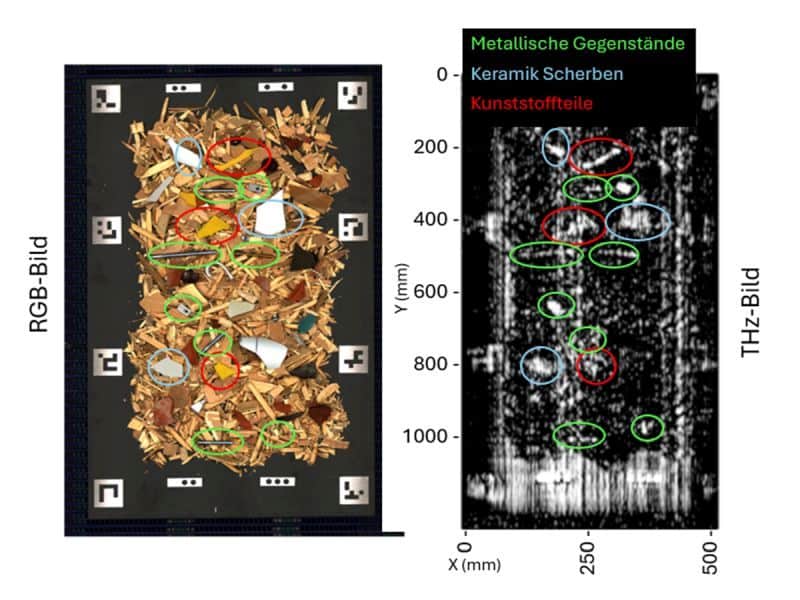
Since the composition of bulky waste is highly heterogeneous, physical occlusions, severe surface contamination, and the natural aging processes of wood drastically complicate traditional optical recognition. To overcome this problem, the research team created a special system combining four completely different sensor types, and the resulting data streams were merged using artificial intelligence. The integrated technology consists of a conventional RGB camera, a near-infrared (NIR) hyperspectral camera, as well as thermography and terahertz sensors. This combination is considered a scientific breakthrough because thermography and terahertz sensors have almost never been used for industrial waste sorting purposes in the past.
Outstanding 95.6 Percent Sorting Accuracy with the “Late-Fusion” Method
During the development phase, researchers examined and recorded real bulky waste samples using these sensors, and by classifying the obtained data, they created an extensive, multimodal database for training the artificial intelligence. This imaging dataset, specifically specialized for bulky waste classification, is unique, and certain elements of it have been made accessible to other professionals via the Fraunhofer Society’s Fordatis research platform and an Open-Access scientific article published in Nature Scientific Data.
During the evaluation experiments, the algorithmic approach known as “Late-Fusion” proved to be the most effective. In this IT structure, the data originating from the individual sensors are first evaluated completely in isolation, and the system makes a single, final decision only at the very end of the calculations by aggregating the results. In this process, the terahertz sensor performed exceptionally well, largely due to its extremely high sensitivity in detecting tiny metallic elements hidden within the wood. With this finely tuned procedure, the system’s total and aggregated sorting accuracy reached 95.6 percent.
Practical Testing and Lightning-Fast Evaluation: Decision in 30 Milliseconds
As the final phase of the research program, experts partially integrated the completed multi-sensor system into a waste sorting machine operating under real industrial conditions. In the experimental environment, the incoming bulky waste was first vigorously shredded, and the resulting crushed material was placed on a fast-moving industrial conveyor belt. Engineers installed compressed air nozzles across the belt, just a few centimeters past the sensor line.
The control of these pneumatic nozzles was carried out by the artificial intelligence model in real-time, and their task was the targeted, mechanical ejection of unwanted or selected pieces from the belt. Operating at a high, typical practical belt speed of 3 meters per second, the AI system had approximately only 30 milliseconds after image processing to make an accurate sorting decision. The results showed that the purity level of the sorted wood was extremely high; the incorrectly sorted elements ended up in the wrong place predominantly due to physical, mechanical limitations (e.g., materials getting entangled), and not because of a decision-making error by the AI.
Market Potential, Circular Economy, and Project Partners
Summarizing the project’s technological successes, Dr. Robin Gruna from Fraunhofer IOSB stated: “The technology increases efficiency and saves significant costs, therefore we see huge market opportunities for it, for example in the recycling industry or for inline inspections during production processes.” Based on the results so far, the innovative sensor process can be a promising alternative to manual sorting, as it far exceeds it in both speed and reliability.
In addition to the coordinating Fraunhofer IOSB, teams from Fraunhofer WKI (Wilhelm-Klauditz-Institut), Fraunhofer ITWM (Institut für Technologie und Wirtschaftsmathematik), and the Karlsruhe Institute of Technology (KIT) also participated in this successful state-supported initiative.
Reference Links:
-
Original press release (FNR): Holz aus Sperrmüll besser aussortieren mit KI und Sensorik
-
The detailed final report of the project is available in the project database of the German state organization FNR (under funding ID 2220HV048): projekte.fnr.de


