


If you like our site, mark us as a preferred source on Google — so you’ll see our articles more often in search!
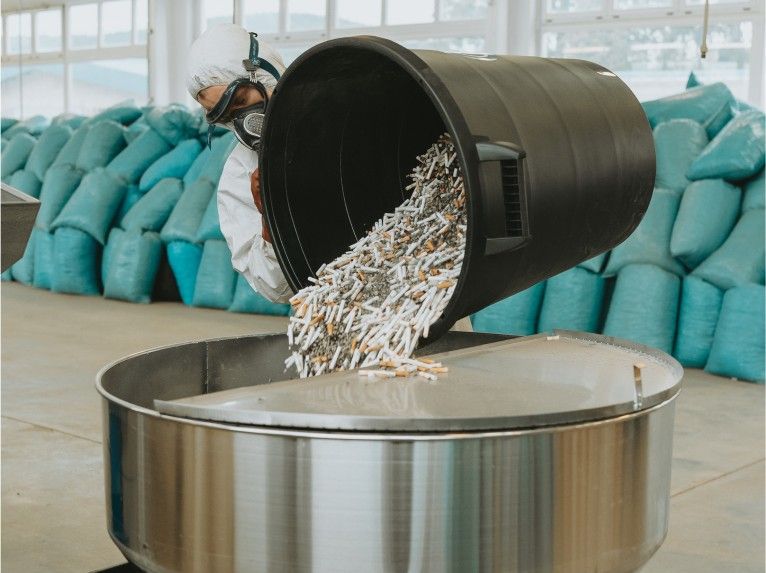
★Mark us as a preferred sourceTurning cigarette butts into asphalt sounds like a catchy slogan, yet in neighbouring Slovakia it is already carrying traffic. Bratislava-based Reneso (formerly known as EcoButt) processes collected cigarette filters and heated tobacco sticks into an additive fibre that replaces conventional cellulose fibre in asphalt mixtures. The company built its first test road with STRABAG in 2022, and in autumn 2025 the technology went into the resurfacing of an almost two-kilometre stretch of a regional road in Malinovo, in the Bratislava Region. We looked at what Reneso claims on its own website, what we know about the reference projects – and what deserves a critical reading.
In short: Turning cigarette butts into asphalt, in Reneso’s model, means processing collected tobacco filters into a certified fibre that has reached end-of-waste status and replaces cellulose fibre in SMA-type asphalt mixtures. The technology works and is being tested on public roads, but the real bottleneck is not road construction – it is the separate collection of cigarette butts.
Why cigarette butts?
The cigarette butt is one of the most littered items in the world. It is small and light, which is why it regularly tops the counts at clean-up events while remaining almost invisible in street-cleaning statistics. The core of the problem is the filter material: most cigarette filters are made of cellulose acetate, which is a plastic and degrades very slowly in the environment. The filter also retains substances deposited from tobacco smoke, including nicotine and heavy metals, which rain can leach into soil and water. We covered the health risks of additives and contaminants in plastics in detail in our article on chemicals in plastics.
This is why the European Union included plastic-containing tobacco filters in its Single-Use Plastics Directive (SUP Directive, (EU) 2019/904): packs must carry a marking warning about the plastic in the filter, and under extended producer responsibility (EPR) manufacturers must contribute to the costs of awareness-raising, collection and clean-up related to cigarette butts. The directive therefore pays for the clean-up – but it does not answer the question of what should happen to the butts once collected. That is where Reneso comes in.
Who is Reneso and what does it offer?
Reneso is a Slovak green-tech company that the media first came to know as EcoButt; its founder and director is Hugo Repáň. By its own description, the company offers an end-to-end system for tobacco waste, built from four interlocking modules:
- Reneso Recycling: companies and municipalities can send their tobacco waste to the Slovak facility, with Reneso handling transport, documentation and regulatory reporting, including cross-border shipments.
- Reneso Urban: patented, weather-resistant public ashtrays that form part of the collection network.
- Reneso Modular: a self-contained processing unit built into a container, for operators who want to treat large volumes of tobacco waste on their own site.
- Reneso Fibers: the end product – an additive fibre for asphalt mixtures made from processed filters, available to road builders as a free lab sample or a full big bag.
According to the figures on Reneso’s website, the company has so far recycled more than 80 tonnes of waste, collected more than 50 million cigarette butts, and more than 10,000 square metres of road surface have been built with its fibres. It lists ISO 9001, ISO 14001 and ISO 45001 certification, an Environmental Product Declaration (EPD) and an EcoVadis Platinum rating. Partners shown through logos and testimonials include STRABAG’s Slovak subsidiary, Philip Morris Slovakia, IKEA and Slovenská sporiteľňa, with a testimonial from the organisers of the Colours of Ostrava festival as well.
The company says its process reaches end-of-waste status, meaning the processed material legally ceases to be waste and becomes a product. Partners receive certificates confirming recovery under EU law, typically within one year of collection. The collection logic is also spelled out: licensed local waste management partners truck the collected material to the Slovak facility in batches of roughly 10 tonnes.
Turning cigarette butts into asphalt: how the process works
The key is the type of asphalt mixture. Reneso’s fibres are used in SMA (Stone Mastic Asphalt). This surfacing contains a high proportion of coarse crushed stone, with the voids filled by a bitumen-rich mortar. Such a mix resists rutting, wear and water ingress, which makes it a popular wearing course for heavily trafficked roads.
SMA has one technological weak spot: because of its high bitumen content, the binder tends to drain off the stone skeleton during production, transport and laying. This is traditionally prevented by adding a small amount of stabilising fibre – most often cellulose fibre – which binds the bitumen and distributes it evenly through the mix. Reneso’s idea is to replace that cellulose fibre with fibre recovered from tobacco filters. Cellulose acetate, the filter material, is produced by chemically modifying cellulose, so the processed fibre can play a similar role.
According to the Bratislava regional government, Reneso Fibers improve the water resistance of the asphalt, reducing the risk of cracks caused by frost and rain, increase the mechanical stability of the surface and reduce rut formation. In a testimonial on Reneso’s website, the technical director of STRABAG Slovakia’s bridges division says the fibre meets all technical requirements and fully replaces the usual cellulose additive.
There is an important distinction that international coverage often blurs: the cigarette butt is not “the material of the asphalt”, but the raw material of an additive fibre used in small proportions. The vast majority of the road surface is still stone and bitumen. Some foreign reports have even suggested that a large share of the pavement can come from recycled components – which is not the case for the solution Reneso describes, where the fibre only replaces the stabilising additive.
From Žiar nad Hronom to Malinovo: the reference roads
The technology’s first road trial took place in 2022: the company, then still operating as EcoButt, built a short experimental road section with STRABAG in Žiar nad Hronom in central Slovakia. Reneso and its partners describe it as the world’s first asphalt road of its kind.
From late 2023 and through 2024, Bratislava’s municipal waste company OLO placed dedicated butt collection bins at Christmas markets and later at city events, runs and festivals, accepting both conventional cigarette filters and heated tobacco sticks. The project attracted international attention, including coverage by the World Economic Forum. Separate collection of waste generated away from home – at events and festivals – is a challenge in its own right, as we discussed in our article on recycling away from home.
The most important milestone came at the end of October 2025. The Bratislava Region’s road authority (SC BSK), with STRABAG as contractor and Reneso as partner, resurfaced an almost two-kilometre stretch of road II/121 inside the village of Malinovo in the Senec district, with Reneso fibres added to the SMA wearing course.
The works included removing the old asphalt layer, laying new layers about ten centimetres thick in total, reinforcing cracks with a glass-fibre geogrid and replacing the wearing course at a junction. The pilot used one tonne of recycled fibre, which the region says corresponds to roughly two million cigarette butts and tobacco sticks. The regional president also indicated that if the pilot proves successful, the solution could become standard on other road sections in the region.
An interesting detail: Slovak media presented the Malinovo stretch as “the first road section in Slovakia”, although the 2022 Žiar nad Hronom road is also Slovak. The two claims only fit together if Malinovo is understood as the first application in a road authority’s investment on a road open to regular traffic, and the 2022 road as an experimental section. Circular materials in road and building construction are on the agenda beyond Slovakia too – we wrote in detail about the study commissioned by STRABAG’s Austrian parent company.
A closer look at the numbers
The Malinovo figure is a useful benchmark: one tonne of fibre absorbs about two million cigarette butts, and that was enough for the wearing course of a roughly two-kilometre road section. Reneso’s cumulative tally – more than 50 million butts collected and more than 80 tonnes of waste recycled – translates into material for a few dozen similar road sections.
That is a respectable result for a company only a few years old, but modest on a global scale. International estimates put the number of butts ending up in the environment each year in the trillions. The conclusion is that road construction can be a sensible, high-value outlet for cigarette butt waste, but it will not solve the butt problem as a whole. The bottleneck is not where the fibre can be used – SMA mixtures constantly need stabilising additives – but how many butts can be collected cleanly and separately in the first place.
What deserves a critical reading
Reneso’s project is an appealing and tangible example of the circular economy, yet there are a few points where caution is warranted.
First, the figures on the company’s website are self-reported. Rounded “more than” numbers – 80 tonnes, 50 million butts, 10,000 square metres – do not come from an independent audit, and some elements of the website appear dated: the EcoVadis Platinum badge shown is marked valid until December 2025, while the text refers to it as a recent award. This does not mean the rating has not been renewed, but partners should check the current status of certificates directly.
Second, there is still little public data on long-term performance. The 2022 experimental section has been in service for four years, the Malinovo section for one. A wearing course is designed to last much longer, so independent road-engineering measurements on durability, rutting and winter behaviour will be needed for full reassurance. The same applies to environmental questions: what happens to particles generated as the surface wears, and how do filter-fibre mixtures fit into the later recycling of reclaimed asphalt? Reneso refers to an official decision granting end-of-waste status and to its EPD, but leaching risks can only be judged on the basis of their detailed content.
Third, it is important to be clear about what goes into the bins. Reneso talks about conventional cigarette filters and heated tobacco sticks, while some international reports inaccurately mentioned “vape filters” too. A disposable e-cigarette, however, is battery-containing electronic waste with entirely different handling requirements and risks – based on MiReHu’s own count, we showed how big a problem vapes in waste have become.
Fourth, the question of funding. The partner list includes Philip Morris’s Slovak subsidiary, which has worked with the company since 2022. That is logical in itself: under the SUP Directive, tobacco manufacturers already have to bear part of the costs related to cigarette butts, and it is better if that money goes into genuine material recovery. A tobacco industry partnership is nevertheless a sensitive area in communication terms, so projects are best judged by measurable, audited results rather than brand messaging.
Finally: the best cigarette butt is the one that is never created. The greatest environmental benefit comes from reducing smoking and littering; road-building reuse sits lower on the waste hierarchy, but is clearly better than landfill or incineration.
What could this mean for Hungary?
In Hungary, plastic-containing tobacco filters fall under the extended producer responsibility system through the transposition of the SUP Directive, operated within MOHU’s concession system. Butts thrown into public bins and ashtrays are currently treated together with mixed municipal waste, and there is no established domestic route for their material recovery. We recently covered EU-level changes to EPR rules in our analysis of EPR simplification for small businesses.
The Slovak example offers several lessons. Reneso explicitly offers cross-border transport, and its Slovak facility is geographically close, so a Hungarian festival, shopping centre, airport or municipality could in principle join today under existing EU waste shipment rules. In the longer term, containerised Modular units could even allow domestic processing if collected volumes justify it.
The most interesting question, though, is demand. Hungarian road authorities and municipalities could encourage the use of additives made from secondary raw materials in road resurfacing tenders – but for that, procurement documents would need measurable circularity requirements instead of general “green” wording. We explained what this can look like in practice in our article on the CE-PRINCE circular public procurement criteria.
The point is not to make cigarette butts disappear, but to ensure that tobacco waste already collected is not lost. If one tonne of fibre locks two million butts into a two-kilometre road section, the butts from Hungarian festivals and city centres could also become an asphalt additive – provided someone collects them separately first.
Cigarette butts into asphalt – frequently asked questions
How are cigarette butts turned into asphalt?
Cigarette butts are turned into an asphalt additive, not into the asphalt itself. Reneso processes collected tobacco filters and heated tobacco sticks into Reneso Fibers, which are added to SMA-type asphalt mixtures. There the fibre replaces conventional cellulose fibre, which stops bitumen draining off the stone skeleton. The vast majority of the road surface is still stone and bitumen.
Where have roads already been built with cigarette butt fibre?
Two reference roads are known, both in Slovakia. The first was a short experimental section in Žiar nad Hronom, built in 2022 by EcoButt, Reneso’s predecessor, together with STRABAG. In October 2025, the Bratislava Region’s road authority resurfaced an almost two-kilometre stretch of road II/121 in Malinovo, with Reneso fibres added to the SMA wearing course.
How many cigarette butts does a road section need?
The Malinovo pilot used one tonne of recycled fibre, which the Bratislava Region says corresponds to roughly two million cigarette butts and tobacco sticks. That amount was needed for the wearing course of an almost two-kilometre road section. According to Reneso’s own figures, the company has so far collected more than 50 million butts and recycled more than 80 tonnes of waste.
What are the benefits of asphalt with Reneso fibre?
According to the Bratislava Region, Reneso fibre improves the water resistance of asphalt, reduces the risk of cracks caused by frost and rain, increases the mechanical stability of the surface and reduces rutting. STRABAG’s Slovak subsidiary says the fibre meets all technical requirements. However, there is still little independent measurement data on long-term durability.
Does road construction solve the cigarette butt problem?
No, but it offers a sensible outlet for butts that have already been collected. The bottleneck is not road building but separate collection: only butts that are collected cleanly can end up in asphalt. Trillions of butts reach the environment every year, so the greatest benefit still comes from reducing smoking and littering.
Can a Hungarian organisation join Reneso’s system?
In principle, yes, because Reneso offers cross-border transport. According to the company, licensed local waste management partners truck collected material to the Slovak facility in batches of roughly 10 tonnes, and partners receive recovery certificates. A Hungarian festival, shopping centre or municipality could therefore join under existing EU waste shipment rules.
🔗 Official sources and references: 👉
- Reneso – global website (technology, modules, figures, FAQ): reneso.eu/global
- SITA – resurfacing of the Malinovo road section with Reneso fibres (Slovak): Úsek cesty v Malinove má inovatívny povrch
- Autojournal – the SMA mix and the role of Reneso Fibers (Czech): autojournal.cz
- The Mayor.eu – Bratislava OLO’s butt collection programme: Bratislava finds a creative way to recycle cigarette butts
- World Economic Forum – video report on the Slovak programme: Slovakia is recycling cigarette butts into roads
Consistent structure, quick answers: every article is built so that both readers and AI search tools can find the key points easily. Our content is produced with the help of AI tools and reviewed by our editor.


