


If you like our site, mark us as a preferred source on Google — so you’ll see our articles more often in search!
★Mark us as a preferred sourceIn North America, most used phones do not end up in the bin. They are passed down to family members, repaired, refurbished or resold. On paper, then, the circular economy for mobile phones is in decent shape across the region – yet in practice most of the copper, gold, cobalt and rare earth elements inside these devices sooner or later end up in landfill, an incinerator or a shipping container bound for another continent. That is the central finding of a report the Ellen MacArthur Foundation published on 21 September 2026 under a telling title: Missing Signal.
The Foundation prepared the study for the Commission for Environmental Cooperation (CEC), the environmental body set up by Canada, Mexico and the United States. Its figures come from RTI International’s CHARGE material flow model, complemented by consultation with more than 90 industry, government and civil society actors, five round tables and 16 interviews.
In short: The circular economy for mobile phones in North America is strong on reuse, with 50–70% of devices getting a second life. The weak point comes at the end: only 4–17% of phone material makes it back to domestic commodity markets, while the rest is lost or exported.
Second lives: where North America already performs well
The report’s starting point is genuinely positive. After first use, between half and two-thirds of phones go through at least one more use cycle. Carrier trade-in programs, buy-back kiosks, refurbished-device platforms and the classic hand-me-down to a family member all play a part.
The picture differs by country:
- Mexico leads: 70% of phones enter a second life, largely thanks to extensive informal repair and resale networks. Domestic material recovery, however, stands at only around 4%.
- In Canada, 64% of devices are reused and 17% of phone material returns to domestic commodity markets.
- In the United States, roughly every second phone is reused and 70% pass through formal collectors, yet only about 14% of the material stays in the country.
The volumes are huge. Under current conditions, the model projects that by 2040 some 2 billion phones will reach end of life in the United States, 410 million in Mexico and 180 million in Canada.
Where does the value go? From drawers to containers
The problem starts where reuse ends. According to the report, 30–50% of phones are not reliably recaptured once their second life is over. Huge numbers of devices “hibernate” in homes for years: in the drawer, battery health declines, software support expires and resale value evaporates. The United States alone is estimated to hold around 223 million such dormant smartphones.
Why don’t people hand in old phones? The report highlights two main reasons: the lack of convenient return options and concerns about data security – the fear that personal data will not be fully wiped. An earlier Google study also listed emotional attachment, keeping devices as spares and expectations of compensation among the obstacles.
The numbers at the end of the chain are the most sobering. Across North America, only 10–30% of devices enter formal collection, while 14–23% are lost to landfill, incineration or export. Just 4–17% of recovered material reaches domestic commodity markets; 83–96% is lost to disposal or sent abroad, often to Asia. A recent analysis we covered suggests that AI-related e-waste may be far larger than previously estimated, which only adds to the pressure on collection and processing systems.
What is inside a mobile phone?
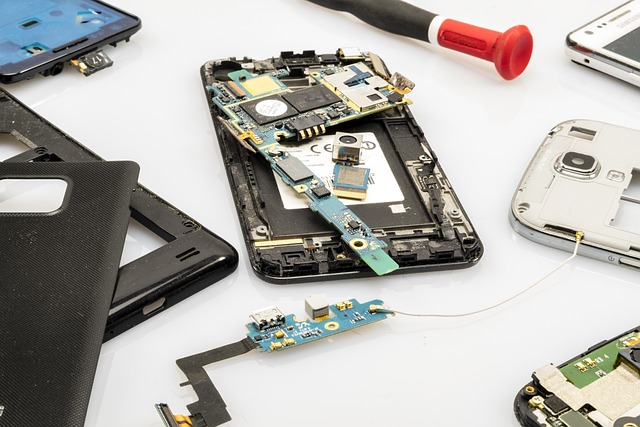
By weight, an average phone is roughly 40% plastics, 25% glass and ceramics and 35% metals. It contains around 63 elements, many in trace amounts locked inside tiny components. According to research cited in the report, one tonne of end-of-life phones can hold up to 53 kg of copper, 141 g of gold, 270 g of silver, 10 g of platinum, 18 g of palladium and 3.3 kg of rare earth elements – a contained commodity value of about US$20,000 at current prices.
Most of the economic value comes from gold and palladium in circuit boards, cobalt in lithium-ion batteries and rare earths in speakers and haptic motors. These materials are also critical for electric vehicles, grid infrastructure, advanced electronics and defense, so a discarded phone is a supply security issue as much as an environmental one. Battery materials face the same challenge, as shown by Porsche’s pilot producing fully recycled battery active materials.
One more figure matters: around 80% of a phone’s embodied emissions occur before it even reaches the user. Every extra year of use therefore delivers real savings.
Where does the system break down?
The report splits a phone’s life into three stages and finds barriers in each.
In design and business models, the industry still earns most of its revenue from the first sale. Thin phones with glued-in batteries and displays can only be opened with heat, solvents or force. Parts pairing means that replacing a camera, fingerprint sensor or battery can trigger malfunctions even when the repair is technically flawless. There is progress, though: manufacturers now commit to up to seven years of software support for the latest Google Pixel 10 and Samsung Galaxy S26 models, compared with two to three years for older devices.
In collection and reuse, trust is everything. Without consistent grading, verifiable data wiping and documented chain of custody, downstream actors choose the safe but lower-value route – destroying, shredding or exporting phones. According to the report, decisions at this stage are driven by defensibility rather than feasibility.
In processing, the bottleneck is metallurgical capacity. North America’s ability to recover metals from printed circuit boards at scale is limited and concentrated mainly at Glencore’s Horne Smelter in Quebec, Canada. As a result, much of the sorted material is shipped abroad for final smelting and refining.
Bright spots worth building on
The study also highlights so-called “bright spots”. Since 2009, ecoATM has installed more than 7,000 kiosks across the United States and Canada. The machines use machine vision to assess a phone’s condition and make an instant cash offer. The company has collected over 50 million devices so far, around three-quarters of which are refurbished or resold.
In Mexico, retailer Coppel and the Chilean platform Reuse offer store credit for used phones, which are then refurbished and resold domestically. In Canada, the Electronic Products Recycling Association (EPRA) runs more than 3,150 drop-off sites and has diverted over 1.3 million tonnes of e-waste from landfill and illegal export. The report argues that this network could become reuse-first infrastructure if provincial targets rewarded higher-value outcomes instead of tonnes collected.
Circular economy for mobile phones in five steps
The report sets out five packages of recommendations for governments and businesses:
- Durable, repairable phones that can be taken apart. Repairability and disassembly requirements (drawing on EU ecodesign rules), minimum software support periods, diagnostic tools available to independent repairers, and business models that earn from repair and refurbishment.
- Trusted collection channels. Take-back options wherever people buy, replace or service phones, backed by verifiable data-wiping standards and incentives that keep old devices out of drawers.
- Traceable pathways. Shared grading, documented chain of custody and digital product passports, plus simpler cross-border movement for verified functional phones destined for reuse.
- Domestic processing capacity. Public investment in dismantling and sorting, with conditions that reward high-quality separation of circuit boards and batteries, under strict fire prevention and environmental safeguards.
- Stable demand for recovered materials. Procurement requirements, long-term purchasing commitments and clear technical specifications that give processors the certainty to invest. The role of public purchasing is a hot topic in Europe too, as our piece on green public procurement reforms in the EU shows.
Under an ambitious scenario, the report estimates North America could return around US$2.2 billion in recoverable critical minerals to regional supply by 2040. The authors stress, however, that the biggest gains come not from recycling but from keeping phones and their components in use for as long as possible.
What does this mean for Europe?
Although the report focuses on North America, it repeatedly points to Europe. After France introduced its repairability index in 2021, three-quarters of consumers found the label useful, and in 2025 it was replaced by a broader durability index. Since June 2025, smartphones sold in the EU must display repairability information.
EU ecodesign rules require batteries rated for at least 800 charge cycles and five years of operating system updates, and from 2027 users will need to be able to replace portable batteries in many devices themselves. The Right to Repair Directive bans software hurdles such as parts pairing from July 2026. These rules also apply to North American products imported into the EU, which the report says could turn European requirements into a global benchmark.
The lesson applies on this side of the Atlantic as well: regulation alone is not enough if consumers do not trust the return channel or simply do not know where to take an old device. Export rules are tightening too – see our coverage of the EU’s draft waste import list for non-OECD countries. And if there is an old phone in your drawer, don’t leave it there: pass it on if it still works, or take it to a collection point if it doesn’t.
Perhaps the core message of Missing Signal is this: circularity does not start at the recycling centre but at the design table, and it depends on keeping a phone’s journey traceable for as long as possible. Find more of our news in our English section.
Circular economy for mobile phones – frequently asked questions
What does the Ellen MacArthur Foundation’s Missing Signal report examine?
The report examines how mobile phones move through use, reuse, collection and processing in Canada, Mexico and the United States. The Foundation prepared it for the Commission for Environmental Cooperation, drawing on RTI International’s CHARGE model and consultation with more than 90 actors. Its aim is to show where value is lost and where circular strategies could deliver the greatest gains.
How many mobile phones get a second life in North America?
According to the report, 50–70% of phones go through at least one additional use cycle after their first owner. The share is 70% in Mexico, 64% in Canada and roughly 50% in the United States. Once that second life ends, however, 30–50% of devices are not reliably recaptured, so many end up stored in drawers or lost as waste.
How much valuable material is in one tonne of end-of-life phones?
One tonne of end-of-life mobile phones can contain up to 53 kg of copper, 141 g of gold, 270 g of silver, 10 g of platinum, 18 g of palladium and 3.3 kg of rare earth elements. That represents a contained commodity value of about US$20,000 at current prices. An average phone holds around 63 elements, with critical minerals providing most of its value.
Why is most phone material lost?
Most phone material is lost because few devices reach formal collection and domestic processing capacity is limited. Across North America, only 10–30% of phones enter formal collection, and 83–96% of recovered material goes to disposal or export. Hard-to-disassemble designs, data security concerns and a shortage of smelters able to process circuit boards all contribute to the problem.
What does the report recommend to strengthen the circular economy for mobile phones?
The report recommends action in five areas: designing durable, repairable phones, building trusted collection channels, making device pathways traceable, expanding domestic processing capacity and creating stable demand for recovered materials. Under an ambitious scenario, these steps could return around US$2.2 billion in recoverable critical minerals to North American supply chains by 2040, while keeping phones in use longer.
How do EU rules relate to the report’s findings?
EU rules could become a global benchmark, the report suggests, because they also apply to North American phones imported into the EU. Since June 2025, repairability information must be displayed, ecodesign rules require batteries rated for at least 800 cycles and five years of software updates, and from July 2026 the Right to Repair Directive bans hurdles such as parts pairing.
Source:
Ellen MacArthur Foundation – Missing signal: Unlocking a circular economy for mobile phones in North America (2026)


