


If you like our site, mark us as a preferred source on Google — so you’ll see our articles more often in search!
★Mark us as a preferred sourceLudwigshafen, Germany – Based on its announcement from April 28, 2026, trinamiX GmbH has significantly expanded its portfolio of solutions supporting the circular economy. The company’s portable Near-Infrared, NIR spectroscopy device now enables the precise and instantaneous on-site identification of materials used in the footwear and textile industries. This technology provides essential transparency for manufacturers, sorters, recyclers, and brand owners navigating increasingly complex industrial value chains.
Challenges in Modern Material Usage
Today’s shoes and textiles are constructed from highly complex material combinations and blended structures, meaning that mere visual inspection is no longer sufficient to determine their exact composition. Simultaneously, tightening regulatory requirements and ambitious sustainability goals demand reliable and traceable material data more than ever before.
Adrian Vogel, Segment Lead Circular Economy at trinamiX, highlighted this dual challenge: “Material innovation drives the footwear and textile industry of the future but also increases complexity across the entire value chain. The mobile NIR spectroscopy solution from trinamiX is a practical tool that helps customers gain transparency, minimize risks, and make informed decisions in recycling and circular economy processes.”
Identification of Footwear Components in Seconds
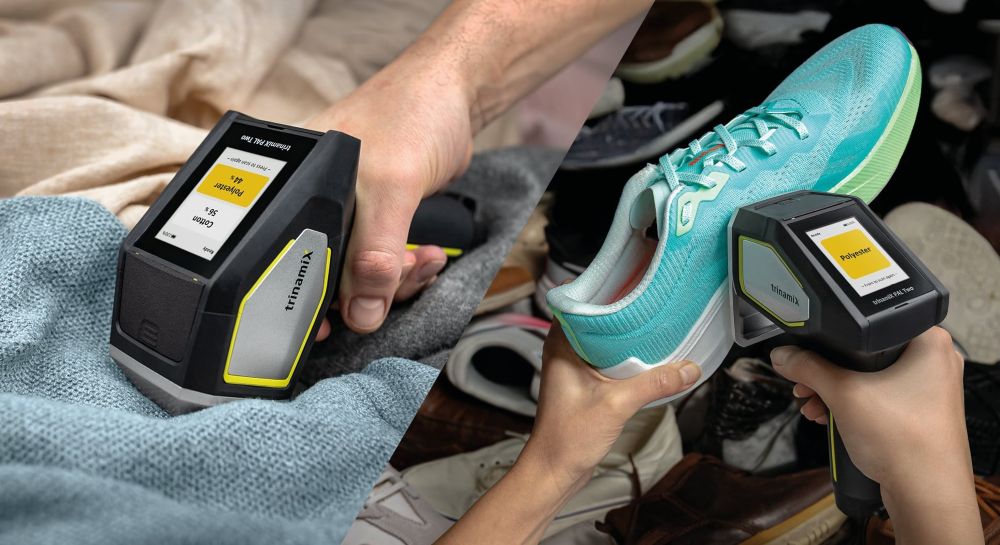
Modern footwear consists of a multitude of different components, including polymers, foams, textiles, and composite materials. The mobile NIR device from trinamiX can identify the most commonly used footwear materials—such as EVA, polyester, and PU (polyurethane)—in a matter of seconds, directly on the spot.
Testing can be conducted extensively across various stages: during incoming goods inspection, on production lines, and throughout the sorting and recycling phases. As a result, material separation efficiency and quality control are improved, recycling preparation becomes smoother, and both contamination risks and manual sorting efforts are significantly reduced.
Transparency in Textile Value Chains
The textile industry faces hurdles similar to those in footwear manufacturing, where blended fabrics make recycling a major challenge. trinamiX’s technology supports the identification of key textiles and their blends, such as cotton-polyester or viscose-polyester. For binary blends, the system can even determine the exact ratio of the fibers as a specific percentage, ensuring that complex material compositions are reliably analyzed.
This specific textile application will be available starting in May 2026. Its explicit goal is to support textile manufacturers, clothing brands, sorters, recyclers, and carpet manufacturers in validating material declarations, increasing sorting accuracy, and facilitating closed-loop recycling.
Integrated Handheld Device for Decentralized Use
The company simplifies complex analysis down to the push of a button. The system consists of three core elements:
-
A robust, portable handheld spectrometer (trinamiX PAL Two) that guarantees fast and non-destructive measurements even in challenging industrial environments.
-
An intuitive mobile app that guides users through the measurement process and delivers immediately interpretable results.
-
A cloud-based customer portal (data platform) that provides secure documentation, visualization, and maximum data traceability.
The technology requires minimal training, guarantees reproducible results, and standardizes material identification across different facilities and geographic regions. Furthermore, the trinamiX ecosystem can be seamlessly integrated into existing software via API interfaces, supporting further data processing for strict regulatory requirements, such as the upcoming Digital Product Passports (DPP) in the European Union, or for tracking sustainability KPIs.
Supporting Circular Economy Strategies
By ensuring reliable material identification across the entire value chain, the solution directly assists companies in implementing their circular economy strategies. Material-level transparency increases recycling efficiency, curbs the rate of downcycling, and significantly improves the market availability of high-quality secondary raw materials.
References and Sources:
-
Original Press Release: trinamiX Mobile NIR Spectroscopy: New Applications for the Footwear and Textile Industry
-
Related Government / EU Background (Digital Product Passport – DPP): The EU’s Digital Product Passport and Sustainability Portal (data.europa.eu)


