




If you like our site, mark us as a preferred source on Google — so you’ll see our articles more often in search!
★Mark us as a preferred sourceA fresh May 2026 study by the World Bank Group and Eunomia demonstrates through the examples of five global cities how waste systems can be made cheaper, more transparent, and circular using digital tools. The main takeaway: it is not the sophistication of the technology that decides success, but clear objectives, data governance, and phased implementation.
The waste sector worldwide faces the same dual pressure: waste volumes are growing rapidly while budgets remain tight. The joint publication by the International Finance Corporation (IFC) and Eunomia, titled Waste, Reimagined: Practical Guidance for Digitalizing Waste Management, offers a practical response to this tension. According to the report, digitalization is not a luxury but the tool with the fastest return on investment for municipalities and waste management companies.
What is at Stake? The Problem in Numbers
The starting point of the study is sobering. Global municipal solid waste (MSW) volume will grow from 2.6 billion tons to 3.9 billion tons between 2022 and 2050, representing a 50 percent increase. In low-income countries, this growth could even double or triple.
Meanwhile, the cost of inaction is measured at $361 billion annually in global health and environmental damages, primarily due to uncollected waste, as well as open dumping and burning. In developing countries, waste management consumes 20–40 percent of municipal budgets, 70–80 percent of which is spent solely on collection and transportation. Cities thus often fall into a vicious cycle: poor service makes the public unwilling to pay, and the lack of revenue leaves no funds for improvement.
Four Tool Categories Covering the Entire Waste Chain
A strength of the report is its easily understandable taxonomy. It groups digital tools based on the operational value they create:
-
Residential and business engagement: SMS and WhatsApp notifications, mobile apps, educational dashboards, gamification, and RFID-based access-controlled containers to encourage behavior change.
-
Collection and logistics: GPS fleet tracking, GIS-based route planning, smart bins equipped with IoT sensors, real-time route optimization, and pneumatic collection systems.
-
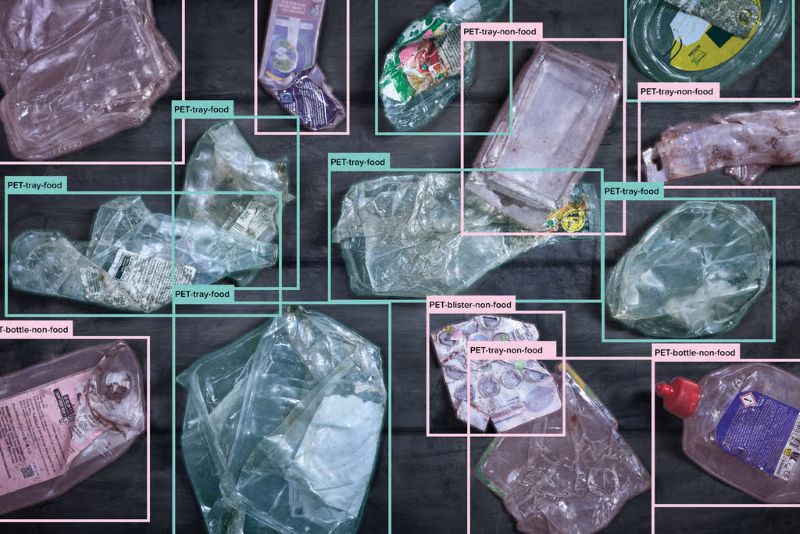
Treatment and facility management: Digital weighbridges, SCADA systems, sensor- and AI-powered sorting, and digital twins.
-
Digital trading platforms: Marketplaces for secondary raw materials, traceability tools, and online quality control.
In each category, it distinguishes a quick-start, low-complexity tier and a more advanced, integrated level. This makes the framework usable in both developed and resource-constrained environments.
Four Steps of Implementation—and Two Things That Hold It All Together
The study describes a concrete, step-by-step process: first, identifying priorities and choosing a starting point; then preparation (capacity building, connectivity, vendor management); followed by integration with existing systems; and finally, a phased, pilot-based rollout.
However, two elements accompany the entire process: strong data governance and continuous stakeholder engagement. The clear concluding message of the report is that clear starting points, data governance, employee acceptance, and phased implementation are more important than the technological sophistication of the tool itself. Digital tools work when they are introduced as part of an operational improvement, rather than as a standalone technology project.
Five Cities, Five Lessons—From High-Income to Low-Income
The backbone of the publication consists of parallel case studies of five cities in varying economic situations:
-
Barcelona (Spain) is a prime example of long-term commitment. Urban digitalization was launched by the 1992 Olympics, and today an integrated platform (Sentilo, linked to the CityOS big data environment) connects sensors, GPS, and contractor data. Compacting bins resulted in an eight times lower emptying cost, while quality control tied to performance-based contracts enables a 1–2% bill correction by filtering out faulty services.
-
Seoul (South Korea) increased food waste recycling from around 2% in the 1990s to 98% by 2023 with its RFID-based, weight-based food waste system. According to the cost-benefit analysis, the system pays for itself in one year and yields a return of over 700% over its lifetime. However, it is a cautionary tale that the “Clean Cubes” smart street bins experiment failed to scale: a fragmented contracting system involving 4-5 private companies per district prevented a unified platform.
-
Chengdu and Suzhou (China) achieved 98% sorting accuracy with AI-powered, WeChat-integrated smart bins and centralized sorting. In Suzhou, food waste separation jumped from 5% to 40%.
-
Cotonou (Benin) increased collected volumes by approximately 9% while reducing landfill trips by 500 through the creation of a centralized operator (SGDS) and a fee-based model. The city relied on smartphones instead of expensive sensors, saving significant costs.
-
Battambang (Cambodia) increased household coverage from around 40% to 75–80% using the LUMA digital platform, primarily through digital billing and GPS tracking.
What Does This Mean for Domestic and EU Compliance?
The study specifically highlights the EU Packaging and Packaging Waste Regulation (PPWR, 2025/40), which sets recycling targets at the material fraction level. According to the report, compliance without robust systems is resource-intensive and prone to error, posing fine and reputational risks for operators. Digital traceability and auditable data are therefore not an option, but a prerequisite for compliance.
How Much Should We Trust the Numbers?
The publication’s objectivity is reinforced by consistently adding cautious remarks to the results: data is city-specific, and the actual outcome depends on governance, operations, and public participation. The methodology also acknowledges that the impact of digitalization is difficult to isolate from other factors.
Viewed critically, however, it is worth noting that many return on investment figures rely on vendor materials or estimates from a single involved expert. The report should therefore be interpreted more as a well-founded guideline than as strict proof—but this still makes it a valuable starting point for anyone facing a digitalization decision.
The Bottom Line
The main message of Waste, Reimagined is simple: compared to physical infrastructure, digitalization accounts for a fraction of the budget, while rapidly reducing fuel consumption, overtime, and service outages. The key to success, however, is not technology, but human and institutional conditions—strong data governance, the involvement of employees and residents, and patient, pilot-based implementation. Digitalization is thus not merely an efficiency tool, but one of the most practical drivers toward the circular economy.
Official Sources and References:
-
Source: International Finance Corporation (World Bank Group) & Eunomia: Waste, Reimagined — Practical Guidance for Digitalizing Waste Management, May 2026.
