If you like our site, mark us as a preferred source on Google — so you’ll see our articles more often in search!
★Mark us as a preferred sourceThe reusable glass bottle has been the benchmark of multi-trip packaging for decades – yet nobody could say precisely how many times any individual bottle had circulated, or why it dropped out of the system. A joint development by Coca-Cola Europacific Partners Deutschland, Vetropack and Myneral Labs answers that question: every bottle receives a unique engraved code, read by AI-driven cameras on the production line. On 30 July 2026 the solution won the “Digitalisation” category of the German Packaging Award.
What the jury recognised
The process developed jointly by Coca-Cola Europacific Partners Deutschland (CCEP DE), Vetropack and the start-up Myneral Labs took the “Digitalisation” category of the German Packaging Award 2026 (Deutscher Verpackungspreis). The prize is awarded annually by the German Packaging Institute (Deutsches Verpackungsinstitut e. V.) on the basis of an assessment by an independent panel of experts.
The essence of the winning process is that every single reusable glass bottle receives an individual code that makes it digitally traceable. According to the press release, this is the first solution of its kind in the beverage industry. The development was designed for the 0.75-litre bottles of the ViO and Apollinaris brands.
This approach should not be confused with consumer-facing QR code labelling. Here it is not the shopper scanning a code with a phone – it is the industrial camera array on the production line performing the identification, on every bottle, at every pass.
The technology: engraved Data Matrix code and AI-based camera reading
According to the press release, bottles across the industry were previously tracked on the basis of experience and empirical models – meaning that the picture of fleet condition and circulation rates rested on extrapolations and estimates.
The new process replaces this with hard data:
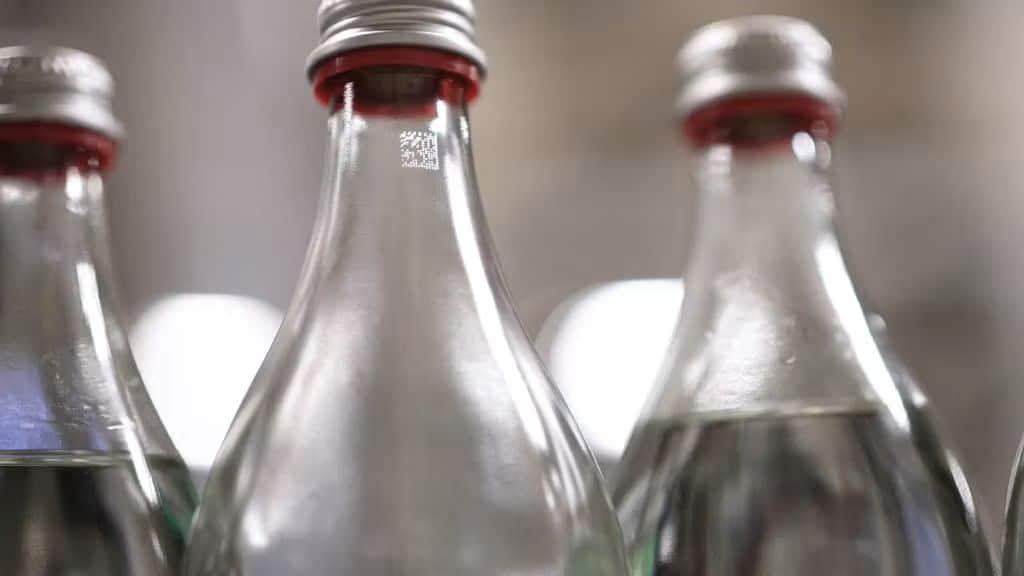
- Engraved Data Matrix code. Each bottle receives an engraved Data Matrix code, which the press release describes as a kind of digital fingerprint. The code is created during glass production, in the glass itself – it is not a label or a print that wears off in the washer or in transit.
- AI-powered camera systems. Cameras installed on the production line read the serial number at every pass.
- A continuous digital history. An uninterrupted record therefore builds up for every bottle: how many times it was filled, and when and why it left circulation.
As the release puts it, the resulting data replaces the earlier extrapolations and makes it possible to manage and plan the bottle fleet precisely. This means – again in the words of the release – that entire bottle inventories become digitally traceable for the first time.
Digitally traceable reusable glass bottles: “Connecting the physical bottle to the digital world”
On the CCEP DE side, the business logic of serialisation was summarised by Maika Seidler, Senior Manager Digital Innovation & Experimentation at the company: serialisation links the physical bottle to the digital world, and for the first time allows the company to track at individual bottle level how its containers move through use cycles. In her account this enables more purposeful use of resources and more efficient process design.
Erich Jaquemar, Key Account Manager at Vetropack, highlighted the convergence of materials expertise and digital capability: in his view serialisation creates the foundation on which long-term, future-proof optimisations can be built.
Three players, three clearly separated tasks
The division of roles set out in the press release is as follows:
| Player | Task |
|---|---|
| Vetropack | Engraves the Data Matrix codes directly onto the bottles during glass production |
| Myneral Labs | Supplies the AI-based camera technology and the data evaluation software |
| CCEP DE | Project management and integration into ongoing production |
Myneral Labs joined the project as the winner of CCEP’s “Open Challenge” innovation initiative – in other words, the solution emerged from an open innovation competition rather than a conventional supplier tender. The partners developed the proof of concept jointly and completed it successfully.
From pilot to a second plant
The project is currently still in its pilot phase at the Bad Neuenahr production site, and according to the press release it has recently also gone live at the Lüneburg plant. This transfer to a second site is the most interesting detail: there is a considerable gap between a camera-based recognition system operating under controlled conditions and a bottling line running at full pace across several sites. The extension to a second plant suggests the system has moved beyond the demonstration stage.
It is worth keeping the proportions in view, however. CCEP DE is Germany’s largest beverage company, with a sales volume of nearly 4 billion litres in 2025, 23 locations – 13 of them production sites – around 340,000 retail and hospitality customers and more than 6,000 employees. Two plants and the 0.75-litre bottles of two brands genuinely constitute a pilot within that system, not a full rollout.
Why this matters for waste management
One of the least illuminated points of reusable systems is precisely what becomes measurable here: actual circulation rates and reasons for loss. The environmental advantage of multi-trip packaging is not a given in itself – it is a function of trip count. A bottle that circulates ten times rather than the modelled thirty produces an entirely different life cycle balance. Life cycle assessments (LCAs) have generally worked with assumed trip numbers; if site-level and bottle-level actual data takes their place, the environmental performance of reusable systems can be judged more accurately – whether that judgement moves up or down.
The same applies on the loss side. Once it becomes clear what share of bottles drops out, and for exactly what reason (breakage, contamination, wear, disappearance from the system), targeted intervention becomes possible. This is also a logistics question: the size of the bottle fleet is tied-up capital, and precise planning can reduce the inventory required.
Two routes to tracking packaging
It is worth setting the newly awarded solution against the other technological approach our portal has reported on. In the United Kingdom, Kraft Heinz joined the Polytag Ecotrace programme, applying invisible UV tags to its Heinz Beanz and Tomato Ketchup lines – there, a marking invisible to the naked eye and applied by standard printing processes is read by the optical sorters and sensors of recycling facilities.
The objective of the two approaches is similar – real data instead of estimates – but their logic runs in opposite directions:
| CCEP DE / Vetropack / Myneral Labs | Polytag-based UV tagging | |
|---|---|---|
| Packaging type | Reusable (multi-trip) glass bottle | Single-use plastic packaging |
| Marking | Data Matrix code engraved into the glass | Printed, invisible fluorescent UV tag |
| Point of reading | The production and bottling line, at every pass | The sorting line of a Materials Recovery Facility (MRF) |
| What it measures | Trip count, reason for loss, fleet condition | Whether the packaging reached recycling at all |
In a reusable system, then, the question is how many times the packaging comes back; in a single-use system, whether it comes back even once. Two sides of the same blind spot – and both received the same answer: a unique identifier on the packaging, plus machine reading at a well-chosen point in the process.
The British line has since been extended further: Aldi UK and Arla, together with Polytag, have applied the technology to milk bottles, using wrap-around labels printed by Saica Flex with fluorescent ink developed by Sun Chemical. That story contains one figure whose counterpart is precisely what the Vetropack–CCEP release lacks: operating alongside Citeo, Polytag’s systems achieved a 100 per cent detection rate at one of France’s busiest materials recovery facilities. No public figure exists as yet for the read accuracy of the engraved code on the production line – and the value of any traceability system stands or falls on exactly that metric.
Regulatory direction makes the development telling as well. The EU Packaging and Packaging Waste Regulation (PPWR) sets new expectations on traceability alongside its reuse targets, and the Digital Product Passport (DPP) infrastructure went live in July 2026. In that environment, a solution that embeds a unique identifier into the glass itself and generates machine-readable data on the life path of the packaging fits neatly into the logic of reporting and verification – even though the project’s communication currently speaks primarily of operational efficiency rather than compliance.
What the press release does not say
In fairness, it should be recorded that several material questions go unanswered:
- There is no data on the specific trip counts measured in the pilot, or how far these diverged from earlier estimates.
- Nothing is disclosed about read accuracy under real operating conditions, or about whether the engraved code retains its legibility across a bottle’s full life cycle after repeated washing and handling.
- There is no information on capital and operating costs, or on payback.
- It is not stated whether tracking ends at the production line, or whether reading also takes place at points in the retail and return chain – which determines how complete the “life path” actually is.
- It is not known whether extension to further brands, formats or sites is planned.
These are not shortcomings in a release tied to an award ceremony, but the real value of the technology can only be judged once they are answered.
Regional relevance
The Vetropack Group – with 3,532 employees and net sales of CHF 778.9 million in 2025 – ranks among Europe’s leading manufacturers of glass packaging for the food and beverage industry, with production plants as well as sales and distribution offices in Switzerland, Austria, the Czech Republic, Croatia, Slovakia, Ukraine, Italy, Moldova and Romania. The group is therefore present in several Central European countries in the immediate neighbourhood of the Hungarian market – so if the serialisation technology moves beyond the pilot phase and into the group’s manufacturing practice, it could also appear in beverage glass packaging across the region. For now, however, this is a possibility rather than an announced plan: the press release refers exclusively to the two German plants.
Aldi and Arla introduce smart packaging to milk bottles to track recycling (10 August 2026) In the new phase of a collaboration running since 2023, milk bottles produced at Arla’s Oakthorpe site receive wrap-around labels – printed by Saica Flex with Sun Chemical fluorescent ink that passed the Recyclass “Washing Quick Test” and the EPBP QT 507 procedure. Polytag sensors installed at materials recovery facilities record the data in real time at barcode level. The strongest figure in the piece: operating alongside Citeo, Polytag’s systems achieved a 100 per cent detection rate at one of France’s busiest MRFs.
Kraft Heinz uses invisible UV tags to transform the tracking of plastic bottle recycling (10 April 2026) Kraft Heinz joined Polytag’s Ecotrace programme in the United Kingdom: packaging on the Heinz Beanz and Tomato Ketchup lines carries a marking applied by standard printing and invisible to the naked eye, read by recyclers’ optical sorters and sensors. The solution enables barcode-level data collection on what happens to the product after consumption and, according to the experts quoted in the article, simultaneously supports packaging design optimisation, targeted consumer education and evidencing compliance with EPR reporting obligations. The same mindset – unique marking plus machine reading – approached from the single-use side.
The EU’s new Digital Product Passport registration system goes live (21 July 2026) (HU) On 20 July 2026 the European Commission formally launched the Digital Product Passport (DPP) registry database and its associated test environment – the infrastructure to which solutions resembling the bottle-level serialisation described here may connect over the longer term.
New US bill to track plastics recycling: the Tracking Plastic Act of 2026 introduced (6 August 2026) (HU) On 30 July 2026 Senator Adam Schiff of California and colleagues introduced a proposal to standardise the tracking of recycled plastics at national level. The aim is a reliable, uniform and transparent traceability process that prevents the public from being misled. The same underlying problem, addressed with a different instrument: credible data in place of estimates.
Smart paper instead of plastic: what intelligent paper-based food packaging can do today – and where it stalls (7 August 2026) (HU) An analysis of the barrier performance, migration behaviour and recyclability of intelligent paper-based packaging on the threshold of the PPWR – the other side of the question of how a packaging’s “smart” function relates to its return into the material loop.
Reusable packaging becomes critical infrastructure in European supply chains (30 June 2026) (HU) The analysis identifies the tightening of the PPWR and EPR systems as the principal catalyst of the transition – and the PPWR sets notably strict new expectations on both reuse targets and traceability.
Returnable reusable packaging in the French regions: facts and quantified results from Citeo’s “ReUse” pilot (19 July 2026) (HU) The French EPR organisation’s glass-focused reuse pilot – a useful benchmark for what is actually being measured in reusable systems today.
Automated reusable cup return system launched in Freiburg: an analysis of TOMRA’s innovation (3 June 2026) (HU) Machine recognition and automated return in the other segment of multi-trip containers.
A pioneering system map for the circular economy: the Wuppertal Institute on the future of reusable packaging (18 May 2026) (HU) A system-level mapping of the actors and data flows in reusable packaging systems.
Tchibo introduces children’s bodysuits with a Digital Product Passport (HU) A circularity.ID®-based, QR-coded Digital Product Passport in the textile industry – the model of traceability opened up to the consumer, in contrast to the production-line machine identification described here.
Source:
Vetropack Group press release, 30 July 2026: German Packaging Award: Coca-Cola tracks reusable glass bottles digitally