If you like our site, mark us as a preferred source on Google — so you’ll see our articles more often in search!
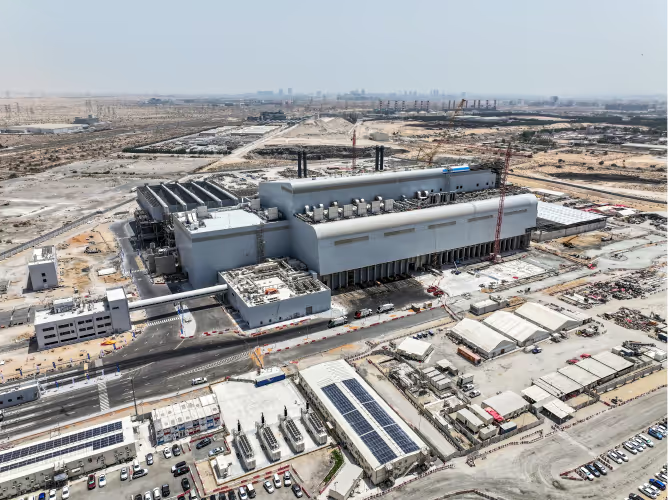
★Mark us as a preferred sourceDubai is rapidly accelerating its journey toward becoming a global hub for sustainability and advanced waste management. A cornerstone of this ambition is the expansion of the Waste-to-Energy (WtE) facility in Warsan. According to reports from Zawya, the second phase of this project, coordinated by the Dubai Municipality, represents a massive increase in capacity. This expansion not only addresses the city’s growing waste management needs but also significantly bolsters the emirate’s power grid with sustainable electricity.
The Warsan Waste-to-Energy center is already recognized as one of the largest facilities of its kind globally. The Phase 2 expansion is an integral part of the “Dubai Integrated Waste Management Strategy 2021-2041,” which aims to eventually eliminate landfills and foster a fully circular economy within the emirate.
Scaling the Infrastructure: Quantitative Insights into Phase 2
The data provided by Zawya highlights the technical and logistical significance of Phase 2. The objective of this expansion is to nearly double the facility’s existing, already record-breaking performance.
The quantitative breakdown of the project is as follows:
-
Daily Waste Processing: Phase 2 adds the capacity to process an additional 3,000 tonnes of waste per day.
-
Current Capacity: Phase 1 currently handles 5,900 tonnes of waste daily.
-
Total Combined Capacity: Upon completion of the expansion, the Warsan facility will process nearly 8,900 tonnes of municipal solid waste every single day.
-
Annual Volume: Phase 1 alone treats approximately 1.9 million tonnes of waste per year, a figure set to rise dramatically with the full operation of Phase 2.
The facility does not merely incinerate waste; it utilizes high-efficiency thermal treatment to convert refuse into electrical energy, feeding directly into Dubai’s power infrastructure.
Powering the Grid: Transforming Waste into Clean Energy
The technological innovation of Phase 2 is most evident in its energy production metrics. Beyond its waste treatment function, the project serves as a major power plant.
-
Phase 2 Energy Output: The expansion will contribute an additional 150 megawatts (MW) of electricity to the grid.
-
Existing Output: Phase 1 is currently rated to produce approximately 200 MW of energy.
-
Total Power Capacity: Together, the two phases will provide roughly 350 MW of clean energy. This is enough to sustainably power tens of thousands of households across Dubai.
The report emphasizes that this investment significantly reduces the volume of waste sent to landfills while diversifying Dubai’s energy sources, thereby reducing reliance on fossil fuels.
Strategic Vision: Dubai’s 2030 Zero-Waste Roadmap
Launching Phase 2 of the Warsan facility is critical for meeting Dubai’s environmental commitments. The city’s leadership aims to achieve “Zero Waste to Landfill” by 2030. This ambitious goal dictates that 100% of municipal solid waste must be either recycled or utilized for energy recovery.
According to statements from the Dubai Municipality, the project aligns with the Dubai Integrated Waste Management Strategy 2021-2041, which outlines billions of dirhams in investments to develop the city’s waste infrastructure. The Warsan expansion proves that by combining technological innovation with economies of scale, urban waste challenges can be effectively transformed into sustainable energy resources.
Official Sources and References:
-
Original News Source (Zawya): Dubai to launch Phase 2 expansion of Warsan Waste-to-Energy plant this year
-
Dubai Municipality (Official State Portal): Dubai Municipality – Waste Management Services