




If you like our site, mark us as a preferred source on Google — so you’ll see our articles more often in search!
★Mark us as a preferred sourceFollowing a report by the University of California, Los Angeles (UCLA), the Kanjurmarg landfill in Mumbai, which receives thousands of tons of garbage daily, has been ranked among the top 25 methane-emitting hotspots in the world. Reaching over 50 meters in height, these monumental mountains of trash are not merely a daunting visual sight and an ecological problem. They severely and directly threaten the daily lives, health, and quality of life of thousands of residents in the surrounding densely populated neighborhoods, including Kannamwar Nagar and Vikhroli.
The Burden of the City’s Waste on a Single Neighborhood
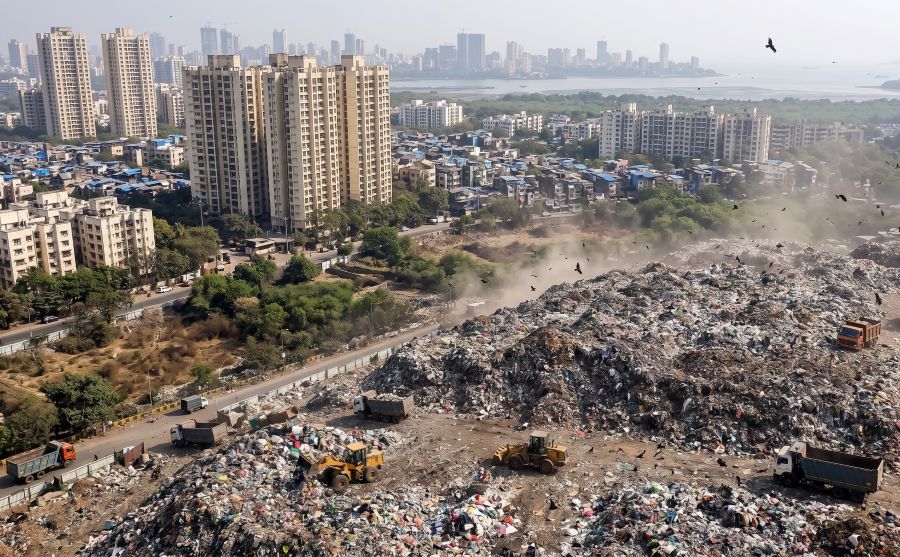
Residents of Mumbai’s eastern suburbs wake up every day in the shadow of a continuously growing mountain of garbage. Operating since 2011, the Kanjurmarg landfill processes approximately 6,100 metric tons of waste daily, accounting for roughly 86 percent of Mumbai’s total daily garbage generation. As older landfills—located in Deonar, Gorai, Mulund, and Malad—were gradually closed or had their operations restricted by authorities, the 144-hectare Kanjurmarg site became the primary waste management center for the metropolis. The sheer size of the area is now larger than the three closed landfills (Malad, Gorai, and Mulund) combined.
Over the years since its operation began, approximately 189 lakh (18.9 million) metric tons of waste have accumulated at the site. These compacted piles of garbage now reach a staggering height of 50 meters, which is nearly twice the height of the famous Gateway of India monument and more than double the maximum limit permitted by local environmental standards. The vast, decomposing dump now clearly dominates the skyline of East Mumbai.
Critical Proximity to Residential Areas and Severe Ecological Impacts
The most alarming factor regarding the Kanjurmarg landfill is its extreme proximity to human settlements. According to local authority records, certain residential buildings in the Kannamwar Nagar neighborhood stand a mere 142 meters from the boundary wall of the dump. This distance is in sharp contrast to the official regulations of the Central Pollution Control Board (CPCB), which mandate a minimum buffer zone of 200 to 500 meters between waste processing facilities and residential areas. The nearest residential complex alone consists of 26 tower blocks ranging from 7 to 24 stories, housing an estimated 15,000 people. A significant portion of these residents were relocated to this heavily polluted area after 2018 as part of a government program aimed at slum clearance and rehabilitation.
Furthermore, the Kanjurmarg landfill borders the ecologically highly sensitive Thane Creek and local mangrove ecosystems, raising additional serious environmental concerns. According to reports from locals and the Kannamwar Residents Association, during the monsoon season, the accumulated garbage causes a massive proliferation of mosquitoes, leading directly to a drastic increase in malaria and dengue fever cases in the affected households.
The Invisible Threat: Methane Emissions and the Global Top 25 Ranking
The crisis in Kanjurmarg goes far beyond mere odor and local inconvenience. A comprehensive report recently published by the University of California, Los Angeles (UCLA) ranked the Kanjurmarg landfill among the top 25 methane hotspots globally, drawing immediate international attention to Mumbai’s waste management problem.
Methane, produced by decomposing organic waste, is an extremely potent greenhouse gas that is over 20 times more harmful to the atmosphere than the well-known carbon dioxide. Unlike foul odors, methane itself is completely invisible and odorless. According to an official statement by Deputy Municipal Commissioner Kiran Dighavkar, this is exactly what makes it so dangerous: people unknowingly inhale the highly concentrated gas, which can cause severe and irreversible respiratory damage in the long term.
Residents’ Daily Lives: “Unlivable Homes”
For the people living here, the garbage dump has fundamentally altered the rhythm of daily life. Many report that despite Mumbai’s tropical heat and high humidity, they must keep their windows tightly closed all day, as even the slightest ventilation would bring an unbearable stench into their apartments. The smell intensifies after sunset, forcing locals to drastically limit evening walks and outdoor leisure activities. As a symptom of the constant environmental stress, residents regularly complain of nausea, chronic headaches, dizziness, and persistent breathing difficulties. The toxic substances do not spare pets either; local veterinarians have confirmed that dogs and other domestic animals frequently fall ill due to airborne toxins and pollutants.
Moreover, the impact of this environmental problem extends well beyond the borders of Kannamwar Nagar, located just 142 meters away. A family living on the 13th floor of a residential tower in Vikhroli, about six kilometers away, reported to the press that they often cannot even open their south-facing windows due to the dense odors drifting in at night. On one occasion, exposure to the airborne toxins caused a family member to experience severe dizziness, requiring medical assistance.
The severity of the situation is highlighted by the fact that the Bombay High Court has repeatedly expressed sharp criticism during recent hearings: it declared the current conditions an “emergency” and officially acknowledged that many nearby homes have physically become “unlivable” due to the gigantic landfill.
Legal Hurdles, Methane Audit, and Future Prospects
In response to mounting public pressure, the Bombay High Court appointed a monitoring committee, which proposed an urgent, comprehensive methane audit as a primary step. The Brihanmumbai Municipal Corporation (BMC) commissioned the National Environmental Engineering Research Institute (NEERI) to execute this study. According to the technological plan, after pinpointing the highest emission zones, special gas catchers (perforated pipes drilled deep into the waste piles) would be installed. These would act like “straws” to suck out the accumulated methane, which would then be utilized as fuel for surrounding industries or households.
Although the guidelines of the state’s Swachh Bharat Mission (SBM), launched in 2014, clearly state that old, legacy landfills should be cleared through bioremediation or biomining, Kanjurmarg only continues to grow for now. The private contractor operating the facility was awarded the contract back in 2011, and it remains valid until 2036. Authorities argue that unilaterally changing the processing methodology mid-stream would lead to a severe breach of contract and massive additional costs for the city administration.
Furthermore, they point out another irresolvable logistical hurdle: there is simply no alternative, available land within the metropolis to dispose of Mumbai’s daily garbage generation of over 7,000 tons. A new landfill could only be designated outside the current city limits, at a distance of about 25-30 kilometers. This would result in a radical increase in logistical, labor, and fuel costs, ultimately burdening the taxpayers. Kanjurmarg currently employs a so-called bioreactor model, which accelerates decomposition with added moisture but simultaneously generates large amounts of methane that the current system cannot neutralize.
Although the newly established court expert committee has also recommended the installation of air quality monitoring stations and modern waste-to-energy plants, and surprise inspections were recently conducted to ensure the development of dense green belts, local environmental activists remain highly skeptical. They point out that over the past years, they have received numerous similar, high-sounding promises, the vast majority of which exist solely on paper to this day.
Sources and References:
-
Original Article: The Indian Express: They’ve lived next to Mumbai’s garbage mountain for years. Now the world is taking notice.
-
Supplementary Report on UCLA / UN Methane Data: Down To Earth: UN methane alert system expanded to coal and waste sectors after Indian landfill named among world’s top emitters
- Photo: Gemini
