


If you like our site, mark us as a preferred source on Google — so you’ll see our articles more often in search!
★Mark us as a preferred sourceA global mineral rush is under way, and most of us assume it is happening for the sake of the climate. RUSH, a report published by the Oakland Institute in July 2026, turns that assumption around: according to its authors, today’s wave of new mines is not driven by the metal appetite of solar panels and wind turbines, but by the arms industry, by the infrastructure behind artificial intelligence, and by the rivalry between Washington and Beijing. This is not a semantic quibble. It determines how many mountains, rivers and villages get written off over the next two decades.
What made the global mineral rush such a high-stakes contest?
“Critical raw material” is a political category, not a geological one. A country calls a material critical if its economy or its military cannot function without it and if the supply is vulnerable. That is why the lists keep growing: the United States listed 17 materials in 2016 and 60 by 2025, while the European Union went from 14 in 2014 to 34 in 2023, plus a separate group of 17 strategic raw materials.
The stakes rose because one player sits on a chokepoint: China. Of the 20 critical minerals analysed by the International Energy Agency, China is the dominant refiner for 19, with a market share of around 70 percent. For rare earths the picture is starker still: roughly 70 percent of mining, 90 percent of separation and processing, and 93 percent of magnet manufacturing run through Chinese capacity. When US tariffs arrived in 2025, China responded with export controls — making it plain to everyone that metal supply is a weapon.
The 500 percent projection everyone quotes
The strongest argument for mining expansion comes from the World Bank: production of key minerals must grow by nearly 500 percent by 2050, and three billion tons of material will be needed to build out wind, solar and geothermal power along with energy storage. The Bank sells this to the Global South as an economic opportunity: there are deposits, and there are buyers.
The Oakland Institute argues the figure misleads because it lumps together the metals genuinely required for renewable energy with the appetite of every other industry. Count only what wind, solar and grid-scale battery storage actually need, and you get roughly one fifth of the volume projected for the coming decades.
Where do the copper, lithium and cobalt actually go?
The most revealing figure in the report is a simple breakdown. Of critical minerals used in 2024:
- 74 percent went to industries with no connection to the energy transition: construction, conventional vehicles, aerospace, defence, machinery, electronics and consumer goods;
- 9 percent to solar panels,
- 7 percent to electricity networks linked to renewables,
- 5 percent to electric vehicles,
- 4 percent to wind turbines,
- 1 percent to grid battery storage.
Metal by metal, the same pattern: 71 percent of copper demand, 68 percent of cobalt, 83 percent of nickel, 79 percent of magnet rare earths and 68 percent of graphite went to something other than climate solutions. Around 30 percent of copper goes into construction, 20 percent into power and telecom networks, and roughly 45 percent into manufactured goods. Two thirds of nickel ends up in stainless steel. Lithium is the one exception: electric vehicles and storage account for 62 percent of its demand.
Meanwhile the volumes are climbing at a remarkable pace. In the first 26 years of the 21st century, more copper will have been mined than in all of previous human history. Between 2000 and 2024, nickel production rose by 187 percent, rare earth extraction by 329 percent, and lithium output by 1,602 percent.
Missiles, drones, data centres
For most critical minerals the military is a relatively modest consumer — under 10 percent of total use. Yet according to the report, this is precisely what earns them the “critical” label, because an armed force stands or falls on these materials. An F-35 fighter jet contains more than 400 kilograms of rare earths; an Arleigh Burke-class destroyer needs more than 2.2 tons.
The direction of travel is clear. Global military spending hit a record 2,700 billion dollars in 2024, the proposed US defence budget for 2027 stands at 1,500 billion dollars — close to double the 2023 level — and the EU military budget has grown by over 60 percent in five years. Military demand for key critical minerals is projected to grow 135 percent faster over the coming decade than it did over the previous one: up to 250 percent for manganese, 203 percent for titanium and 198 percent for copper by 2035.
The other major driver is data centre construction. AI spending accounted for half of US GDP growth in 2025, and some estimates put global data centre spending at 7,000 billion dollars by 2030. That wave alone will require an additional 512,000 tons of copper by 2030, while AI-specific demand for germanium and gallium — essential for high-performance chips — is set to rise by 37 and 85 percent respectively by 2033. In other words, the two biggest new consumers of metal are rearmament and server farms, not solar panels.
Who is making money on this chain?
The capital has already arrived. In early 2026 the 50 largest mining firms were collectively valued at over 2,400 billion dollars — an increase of more than a trillion dollars in a single year. In February 2026 the United States launched a strategic mineral reserve called Project Vault, financed by a 10 billion dollar loan from the US Export-Import Bank plus 2 billion dollars of private capital; the participating corporations are to receive preferential access to the stockpile in case of shortages.
New kinds of players have appeared too. KoBold Metals — backed by Bill Gates, Jeff Bezos and Silicon Valley venture capital — uses artificial intelligence to hunt for deposits and is working on more than 70 projects across five continents. The report also documents in detail how US defence and mining contracts have become entangled with private interests close to political power.
For established mining companies, the climate argument arrived at a convenient moment. In a 2023 survey covering 32 countries, respondents ranked mining as the worst of all economic sectors in terms of its impact on society. Repositioning as an indispensable partner of the green transition papers over that trust deficit — what the report calls climatewashing.
What the mines leave behind
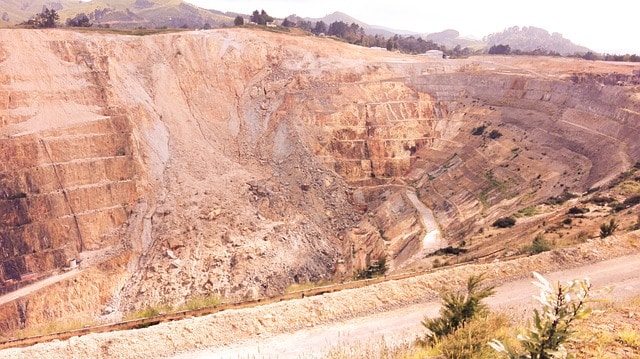
This is where the numbers become tangible. The average copper ore grade today is 0.6 percent: every 1,000 kilograms of rock mined yields 6 kilograms of copper and 994 kilograms of waste. And grades are falling — at one Spanish copper mine the metal content dropped from around 2 percent in the early 20th century to roughly 0.4 percent today. Since production has also risen fifteen-fold, the volume of discarded material has increased roughly seventy-five-fold in little over a century.
That waste sits in tailings storage facilities. Over 300 tailings dam failures have been recorded in the past century, with an average of three to five failures every year. In 2015 at Mariana in Brazil, toxic mud equivalent to 20,000 Olympic swimming pools swept through nearby communities. In February 2025 at Chambishi in Zambia, at least 50 million litres of acidic, heavy-metal-laden waste entered local rivers; independent assessments put the release at around 1.5 million tons of toxic sludge, killing fish and wildlife 100 kilometres downstream.
Mining is also thirsty. Over half of lithium and copper production takes place in areas of high water stress, and in Chile’s Salar de Atacama lithium extraction has consumed 65 percent of the region’s water supply. On health, the International Labour Organization calls mining the most hazardous occupation: it accounts for around eight percent of fatal workplace accidents while employing one percent of the global workforce. An estimated 49.5 million small-scale miners work in high concentrations of silica dust.
Then there is land. An estimated 69 percent of current transition mineral projects sit on or near land that qualifies as Indigenous or peasant land in the Global South; for lithium that figure reaches 85 percent. One study identified 36,017 mining-related conflict events across 4,293 locations worldwide between 2015 and 2022.
How much metal do solar and wind really need?
Less than the debate implies — and the difference comes down to policy choices. Solar panels rely mainly on copper and silicon (one of the most abundant elements on Earth), and engineering advances keep cutting the silver and silicon used per panel. Wind turbines use concrete, steel, fibreglass, aluminium and copper alongside rare earths, and the zinc in their protective coatings is highly recyclable. Under the models, mineral demand for both technologies peaks around 2035 and then declines.
The real heavyweight in these projections is the electric car: the net zero scenario assumes around 2 billion light-duty EVs on the road by 2050, which on its own would multiply today’s vehicle-related metal demand more than tenfold. But an EV does not generate energy, it consumes it — so it is not in the same category as a wind farm. A UC Davis study found that if, instead of swapping car for car, policy prioritised public transport, smaller vehicles and batteries, car sharing, walkable and cyclable urban design and lithium recycling, US lithium demand could be 92 percent lower by 2050 than in the most lithium-intensive scenario.
The physical limit: these mines cannot be opened
One factor routinely missing from investor optimism is feasibility. UNCTAD estimates that 250 new mines would be needed to meet emission targets (80 for copper, 70 for lithium, 70 for nickel, 30 for cobalt), and that meeting 2030 copper demand alone would require 250 billion dollars of investment and at least 80 new projects. Yet it typically takes up to 25 years to move from discovery to production.
Hence the projected shortfalls: copper could face a 30 percent supply gap by 2035, and S&P Global expects supply to fall 10 million tons short of demand by 2040, describing it as a systemic risk for global industry. Cobalt is constrained by export restrictions in the DRC, lithium by deficits expected in the 2030s. For dual-use metals this creates direct competition: whatever goes into a strategic stockpile or a weapons system does not go into a solar farm or a grid.
Why this matters in Europe
The EU’s 2024 critical raw materials regulation sets 2030 targets: at least 10 percent of annual EU consumption from domestic extraction, 40 percent from domestic processing, 25 percent from recycling, and no more than 65 percent from any single third country. Two of those three figures are not about mines at all — they are about capacity and circularity. And that is exactly where waste management has a job to do.
Critical minerals have more than one source. Beyond primary ore deposits there are secondary sources — recovered from electronic and other waste streams — and tertiary sources, meaning imports. According to IEA calculations, improving recycling rates for critical minerals could cut the need for new mining by 25 to 40 percent by 2050. The IEA and the UN Environment Programme go further, calling for circular design rather than recycling alone, so that products can be reused, remanufactured and repaired — metals can, in principle, be recycled repeatedly without losing their properties.
In practical terms, the old phone in the drawer, the cordless tool with a dead battery, the discarded LED panel and the stripped cable are not rubbish but deposits. Every ton of e-waste that is genuinely collected and processed is a ton that does not have to come from a levelled hillside and a poisoned river somewhere else.
What can be done
The report’s conclusion is uncomfortable but clear: as long as the wave of new mines is sold as a climate necessity, resistance by affected communities is placed in a morally impossible position — as if they were protesting against the climate. The authors argue that dismantling this narrative, rather than labelling mining “sustainable”, is the first step.
What follows in practice:
- Reducing metal demand is climate policy, just as much as building capacity is. Public transport, smaller and longer-lived devices, repair and sharing directly reduce the need for mines.
- Recycling is not a side issue. Collection and recovery rates for electronic and industrial waste are among the most concrete tools available for avoiding new extraction.
- Circular design is the lever. If a product cannot be opened and repaired, the metal inside it is effectively single-use.
- Transparency matters. Without traceable supply chains and genuine free, prior and informed consent from affected communities, “ESG” and “sustainable mining” remain marketing.
Competition over minerals will not simply stop. But how much metal the coming decade demands from us depends largely on planning, transport and waste management decisions — the kind that are made close to home.
Frequently asked questions about the global mineral rush
Why is the global mineral rush not driven by the green transition?
Because most of the demand comes from elsewhere. In 2024, 74 percent of critical minerals used went to industries unrelated to the energy transition: construction, conventional vehicles, aerospace, defence and electronics. Solar, wind, electric vehicles and grid storage together accounted for the remaining quarter of total use.
How much metal do solar panels and wind turbines actually need?
According to the Oakland Institute’s calculation, building out solar, wind and grid-scale battery storage requires roughly one fifth of the metal volume projected for the coming decades. Solar relies mainly on copper and silicon, while mineral demand for wind turbines peaks around 2035 in the models and then begins to decline.
How does artificial intelligence increase demand for minerals?
Data centre construction is one of the biggest new consumers. Estimates point to an additional 512,000 tons of copper needed for data centres by 2030, while AI-specific demand for germanium and gallium could rise by 37 and 85 percent respectively by 2033. Global data centre spending may reach 7,000 billion dollars by 2030.
What environmental damage does the mining boom cause?
For copper, every 1,000 kilograms of rock mined now leaves 994 kilograms of waste, and ore grades keep falling. Tailings dams fail three to five times a year on average. Over half of lithium and copper production occurs in water-stressed areas, and an estimated 69 percent of projects sit near Indigenous or peasant land.
Can recycling reduce the need for new mines?
Yes, substantially. The International Energy Agency estimates that improving recycling rates for critical minerals could cut the need for new mining by 25 to 40 percent by 2050. The EU’s 2030 target is for 25 percent of annual consumption to come from recycling — which depends on electronic waste collection and processing.
Source:
The Oakland Institute (2026): RUSH: Global Scramble for Minerals Wages War on People and Planet, by Frédéric Mousseau and Andy Currier, edited by Anuradha Mittal. Report and press release: oaklandinstitute.org/report/rush, press release. The report is published under a CC BY-NC 4.0 licence. This article is an independent summary based on the report’s data; it is not an Oakland Institute translation and should not be considered an official Oakland Institute translation.


