


If you like our site, mark us as a preferred source on Google — so you’ll see our articles more often in search!
★Mark us as a preferred sourceA major milestone in GM battery recycling has been achieved as General Motors and its industrial partners successfully completed a closed-loop recycling pilot program. By recovering critical minerals from end-of-life electric vehicle batteries, refining them, and reintegrating them into new battery cells, the automaker has produced its first electric vehicles powered by cathode active material containing 100% recycled nickel, cobalt, and manganese. In September 2026, the first customer-bound Cadillac, Chevrolet, and GMC models equipped with these cells rolled off the assembly lines.
In short: General Motors (GM) and its partners—including Cirba Solutions, Ultium Cells, and LG Energy Solution—completed a closed-loop battery recycling pilot in September 2026 after years of engineering and coordination. As part of the initiative, 80 end-of-life GM EV battery packs were processed by Cirba Solutions into “black mass,” which was subsequently refined into more than 12 metric tons of new cathode active material made with 100% recycled nickel, cobalt, and manganese.
Following strict validation to ensure performance and safety matched virgin materials, Ultium Cells manufactured new battery cells that GM assembled into modules and packs at Factory ZERO and Spring Hill Assembly for seven EV models. Beyond recycling, GM’s end-to-end lifecycle strategy includes remanufacturing programs that reuse over 70% of pack components and a partnership with Redwood Materials deploying roughly 10,000 second-life batteries into stationary energy infrastructure.
Beyond the First Drive: High Recovery Rates for Critical Battery Minerals
When consumers consider electric vehicle (EV) batteries, the discussion typically begins with two fundamental questions: how far a vehicle can travel on a single charge and how long the battery will last. However, as Melissa Flaherty, Director of Sustainable EV Battery Ecosystem at General Motors, detailed in the company’s official announcement, powering an electric vehicle is merely the opening chapter in a battery’s story. An EV battery can continue delivering substantial value long after its service life inside a vehicle ends, and to establish true circularity, its materials can be recovered, refined, and utilized to manufacture new EV batteries.
Using currently available technologies, industrial recycling processes are already capable of recovering significant quantities of critical battery materials. Depending on specific process conditions and battery chemistry, current recovery capabilities reach:
-
up to 95% for nickel, cobalt, and manganese, and
-
up to 80% for lithium,
-
while future technological advances may unlock even higher recovery percentages.
Put simply, the batteries powering today’s electric vehicles can help power tomorrow’s fleet. For years, the broader EV industry has worked toward establishing closed-loop battery recycling pathways. Because raw materials represent one of the largest cost drivers in battery cell manufacturing, recovering and reusing critical minerals can support lower-cost batteries over time, reduce reliance on newly extracted materials, and bolster supply chain resilience. As the global lithium-ion battery recycling sector expands, integrating secondary raw materials directly into cell production is becoming a cornerstone of sustainable automotive manufacturing.
How the Closed-Loop GM Battery Recycling Process Works
Over the past several years, General Motors collaborated with partners across recycling, materials processing, and battery cell manufacturing to process end-of-life batteries and construct a pilot pathway for recovering and reusing the critical minerals contained within them. In September 2026, this multi-year effort culminated in a completed pilot demonstrating a complete closed-loop pathway.
The GM battery recycling pilot program executed a multi-stage technical workflow:
-
Recovery and Conversion into Black Mass: Working with partner Cirba Solutions, 80 end-of-life GM EV batteries were recovered as part of the pilot program. These battery packs were recycled at Cirba Solutions’ facility, where they were disassembled and separated to create “black mass”—a specialized blend of battery materials derived from end-of-life lithium-ion batteries.
-
Refining into Cathode Active Material (CAM): Producing black mass is only the initial phase. To be reused in vehicles, it must be converted into cathode material, whose critical minerals—specifically nickel, cobalt, and manganese—help determine a battery’s cost, safety, and overall performance. Through the pilot pathway, the recovered black mass was converted into more than 12 metric tons of new cathode active material—the most critical component of a battery cell—formulated with 100% recycled nickel, cobalt, and manganese, which included material recovered directly from end-of-life GM EV battery packs.
-
Validation and Cell Manufacturing at Ultium Cells: Before any recycled content can be incorporated into a new battery cell, it must satisfy the exact same demanding quality, performance, and safety standards required of brand-new virgin materials. The new cathode active material was rigorously validated to EV standards. Once testing confirmed that cells constructed with the recycled materials performed just as well as those made from virgin material, Ultium Cells manufactured new EV battery cells utilizing this cathode active material with 100% recycled nickel, cobalt, and manganese content.
Seven Electric Vehicle Models Roll Off the Line at Factory ZERO and Spring Hill
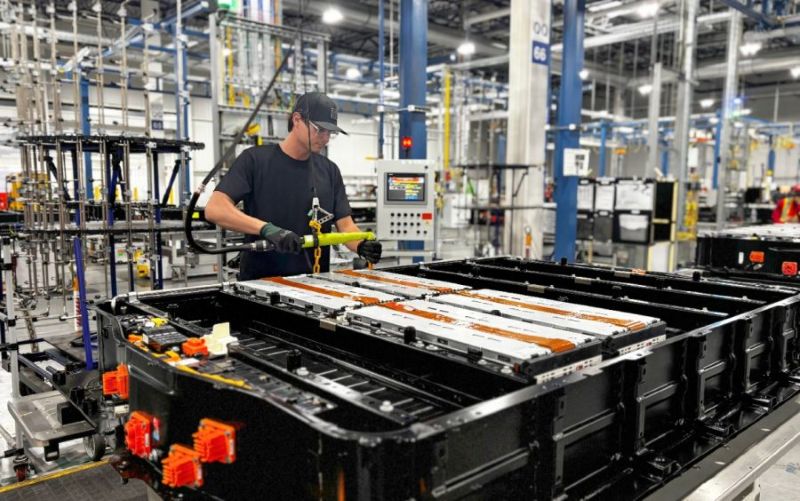
Following cell production at Ultium Cells, General Motors’ manufacturing teams assembled the cells into battery modules and complete battery packs at Factory ZERO and Spring Hill (Spring Hill Assembly). In September 2026, the first customer vehicles powered by GM’s first battery cells containing cathode active material made from these recycled critical minerals rolled off the assembly lines at Spring Hill Assembly and Factory ZERO:
-
Cadillac LYRIQ and Cadillac LYRIQ-V,
-
Cadillac VISTIQ,
-
Cadillac ESCALADE IQ and Cadillac ESCALADE IQL,
-
Chevrolet Silverado EV Trail Boss,
-
GMC Sierra EV AT4.
These vehicles are now headed to customers. Achieving this milestone required years of coordinated engineering, quality assurance, logistics, testing, and manufacturing work across GM and its partner network, including Cirba Solutions, Ultium Cells, LG Energy Solution, and others. According to GM, one of the primary takeaways from the pilot is the extensive level of teamwork and coordination required to execute closed-loop programs. The pilot provides a foundational dataset and operational experience to build upon as a growing wave of EV batteries reaches the end of its useful life over the next decade and beyond.
End-to-End Lifecycle Strategy: Refurbishment and 10,000 Second-Life Batteries
As significant as the closed-loop GM battery recycling pilot is, material recycling is not the second act for GM’s EV batteries—it is typically the final act within the automaker’s broader, end-to-end battery lifecycle strategy.
Before recovering materials for new EV cells, GM prioritizes extending the operational life of its battery packs through multiple avenues:
-
Remanufacturing and Refurbishment: GM’s remanufacturing and refurbishment programs are engineered to reuse more than 70% of pack components, extending the useful life of existing units while reducing the need to manufacture entirely new battery packs.
-
Second-Life Stationary Energy Storage: Because lasting value is engineered into GM’s EV batteries, their energy-storage capability can be extended beyond a vehicle’s first life by deploying them in stationary energy storage applications prior to material recovery and recycling.
-
Deploying 10,000 Packs with Redwood Materials: In partnership with Redwood Materials, GM is deploying roughly 10,000 GM second-life batteries into real-world energy infrastructure. This initiative includes the largest second-life battery microgrid in North America, with additional deployments planned, including installations across GM’s own U.S. manufacturing footprint.
While not every battery will follow an identical trajectory, GM’s circular economy strategy treats batteries as critical assets designed for the entire lifecycle—delivering value to EV drivers today, supporting electrical grid stability tomorrow, and powering the next generation of transportation. The closed-loop pilot demonstrates a viable pathway for utilizing recovered battery materials in new cells while supporting GM’s overarching objective of exploring ways to lower the carbon footprint of battery materials and reduce costs for consumers. GM also announced plans to share further insights on this program and other circularity innovations at Climate Week NYC, where the company serves as a title sponsor of the Nest Campus.
Frequently Asked Questions (FAQ)
What percentage of critical minerals can be recovered from EV batteries using current technology?
Depending on process conditions and battery chemistry, today’s recycling technologies can recover up to 95% of nickel, cobalt, and manganese, and up to 80% of lithium from end-of-life batteries.
How many batteries were recycled in GM’s pilot program and how much material was produced?
Working with partner Cirba Solutions, 80 end-of-life GM EV batteries were recovered and converted into black mass, which was then refined into more than 12 metric tons of new cathode active material made with 100% recycled nickel, cobalt, and manganese.
How do battery cells made with recycled minerals compare to cells made from virgin materials?
Before entering production at Ultium Cells, the recycled cathode active material was validated to the exact same quality, safety, and performance standards required for brand-new materials, and testing confirmed that the recycled cells performed as well as cells made from virgin material.
Which GM vehicles are the first to use battery cells made from these recycled critical minerals?
In September 2026, the first new Cadillac LYRIQ, LYRIQ-V, VISTIQ, ESCALADE IQ and IQL, Chevrolet Silverado EV Trail Boss, and GMC Sierra EV AT4 rolled off the lines at Spring Hill Assembly and Factory ZERO equipped with these battery cells.
How does GM extend battery life before final recycling?
GM’s remanufacturing and refurbishment programs are designed to reuse more than 70% of battery pack components. Additionally, in partnership with Redwood Materials, GM is deploying roughly 10,000 second-life batteries into stationary energy storage infrastructure, including North America’s largest second-life battery microgrid.


