




If you like our site, mark us as a preferred source on Google — so you’ll see our articles more often in search!
★Mark us as a preferred sourceFor decades, the sustainability efforts of the modern packaging industry have been hindered by the hidden ingredients used in paper packaging. Although paper bags, food wrappers, and disposable cups appear ecologically friendly, their secure sealing almost exclusively requires synthetic adhesives or thin plastic films, which significantly complicates the recycling process.
However, the Fraunhofer-led PAPURE project is currently rewriting industry standards with a pioneering laser and heat-sealing technology. This innovation completely eliminates the need for plastics and glues while guaranteeing astonishing physical durability: a tiny seam measuring just 2 centimeters by 3 millimeters can safely hold up to 20 kilograms of weight. Moving from the laboratory phase toward industrial integration, this development is ushering in the era of a truly plastic-free, circular economy.
The End of Synthetic Binders: The Mission of the PAPURE Project
The recycling of current paper-based packaging materials is drastically complicated by the synthetic adhesives used at seams and linings. These foreign materials, which seep between the paper fibers, cause serious technological problems during recycling by introducing multi-material composites into the recovery stream and degrading the quality of extracted cellulose fibers. The PAPURE project, spearheaded by a German research team from Fraunhofer, addresses this global industrial challenge with a clear goal: to revolutionize paper joining by eliminating the need for external, synthetic binders.
This initiative requires unprecedented professional collaboration, involving exactly four different Fraunhofer institutes working together to bring the technology to life. The participating research centers operate within strictly divided focus areas:
-
The first group focuses on Material Analysis, evaluating how different paper grades respond.
-
The second team researches the technology behind Laser Processing and surface modification parameters.
-
The third group develops the Sealing Systems and modular sealing units.
-
The fourth institute specializes specifically in Production Prototyping and industrial integration.
Chemical Transformation: Carbon Monoxide (CO) Laser Technology
The foundation of the technology developed by Fraunhofer lies in the targeted modification of the paper’s surface chemistry. The very first step in the process is selecting a specific type of paper that is capable of bonding well. Following this, experts utilize a specialized carbon monoxide (CO) laser to create a fusible, meltable surface layer on the paper.
During the laser treatment, a highly precise chemical transformation occurs. The process generates what researchers call “re-meltable glycosidic cleavage products” on the fiber surface for bonding. This laser step physically and chemically alters the paper’s surface, preparing it for adhesive-free fusion without scorching or making the material brittle.
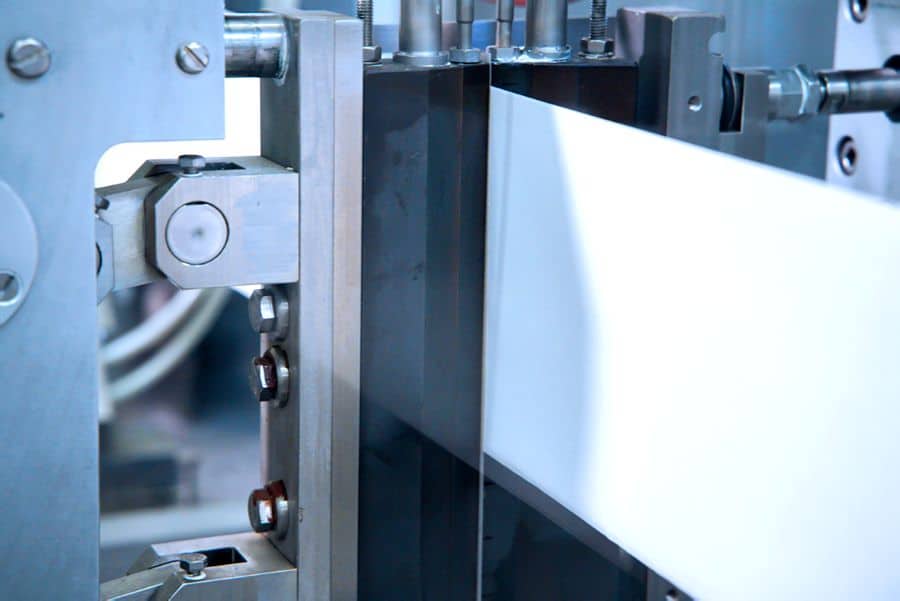
The second half of the process involves traditional heat-sealing. By applying targeted heat and pressure, the layer prepared by the laser is activated. As a result, the natural cellulose fibers form a strong structural bond directly with one another. The major breakthrough is that the entire bonding process remains absolutely free from any added synthetic adhesives or plastic sealing layers.
Impressive Physical Strength and Factory Speed Targets
The most common industry skepticism regarding adhesive-free technology revolves around physical load-bearing capacity and manufacturing speed. However, official test results from Fraunhofer dispel these concerns, proving extreme structural strength. According to the reports, a tiny paper seam—measuring only 2 centimeters long and 3 millimeters wide—can safely support a load of up to 20 kilograms under testing conditions.
Another critical metric for industrial applicability is speed. The goal of the development is to ensure that adhesive-free paper sealing does not merely remain an impressive laboratory stunt, but becomes a viable reality in factories. The pilot target for the PAPURE project is to reach a sealing speed of ten packages per minute (10 packages per minute) by September 2026, thereby demonstrating the technology’s suitability for high-volume industrial mass production.
The Three Primary Pillars of Development
Based on industry analyses, the Fraunhofer development focuses on three primary pillars, each essential for global success:
-
Hardware Engineering: Precisely engineering the specific hardware and modular sealing units required for industrial, roll-to-roll packaging integration.
-
Mastering Surface Chemistry: Fully understanding, controlling, and fine-tuning the surface modification chemistry induced by the carbon monoxide (CO) laser.
-
Validating Volume: Proving on an industrial scale that adhesive-free paper packaging technology can maintain and logistically support global packaging volumes.
This technological breakthrough clearly points toward a plastic-free circular economy where, in the absence of foreign synthetic contaminants, paper packaging can remain as close to 100 percent pure cellulose fiber as possible.
References and Official Sources:
-
This article is based on the April 2026 analysis by Intelligent Living and Fraunhofer research. The original English source is available here: Replacing Synthetic Binders: The Future of Laser-Sealed Paper Packaging in A Plastic-Free Circular Economy
