


If you like our site, mark us as a preferred source on Google — so you’ll see our articles more often in search!
★Mark us as a preferred sourceThe City of Vienna has had enough of the chaotic conditions surrounding clothing collection containers and the worsening public sanitation issues. Under a recent legislative amendment—and an accompanying police decree—the placement of used clothing collection containers in public spaces will be banned in the Austrian capital starting January 1, 2027. The decision was justified by drastically deteriorating statistics, a rapid increase in resident complaints, and continuous negligence by private operators. The briefing published on the official Viennese state portal analyzes in detail the reasons for the ban, the alarming quantitative data, and the alternatives available in the future.
The Situation on the Streets and Sidewalks Has Become Untenable
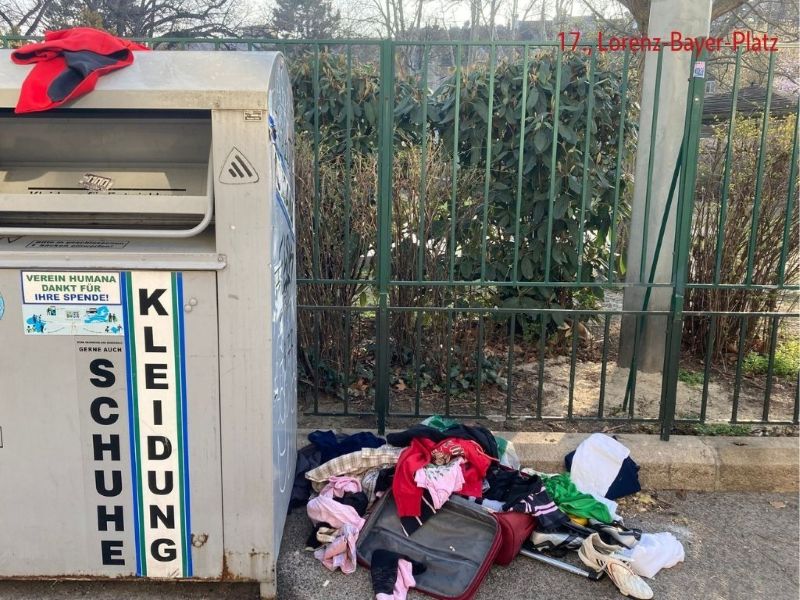
Over the past few years, the sight of trash piles around clothing collection containers has become a well-known, everyday phenomenon in all districts of Vienna. The root of the problem is largely that the containers, operated by private companies, are continuously and illegally forced open or broken into. Intruders sort out the usable pieces that still hold some value for them, and simply throw the less interesting remainder onto the sidewalk, the street, or next to the containers. These scattered textiles, exposed to the weather, quickly deteriorate and are reclassified as mere waste.
Furthermore, the accumulating garbage attracts additional pollution and pests in the affected areas. According to the city administration, this sight greatly demotivates residents who wish to dispose of their unwanted garments in a lawful and environmentally conscious manner.
The severity of the situation is clearly supported by quantitative data. Complaints have been flooding in via the “Sag’s Wien App” citizen reporting system: while nearly 800 official reports were registered last year regarding these chaotic conditions, this year, up to May 20, the number has already exceeded 340. The municipal department responsible for public sanitation in Vienna, MA 48, has to dispatch teams multiple times a day to collect and dispose of barely used or ragged clothes discarded into the environment. A telling statistic is that in March 2026 alone, MA 48 staff documented no fewer than 1,257 separate pollution incidents around these containers. Currently, there is a total of 2,280 used clothing collection containers permitted by MA 46 located in Vienna’s public spaces, the vast majority of which are situated next to selective waste collection islands.
Private Operator Negligence and the Legal Background of the Ban
According to Ulli Sima, the Executive City Councillor responsible for public spaces, the city hall has repeatedly called on the private companies operating the containers to clean up the chaotic conditions and ensure the cleanliness of the immediate surroundings of the bins they installed. “Unfortunately, these efforts have been unsuccessful. The operators are unable to handle the problem, and they pass the costs and the emerging issues onto the public. Our city’s public space is a valuable asset that we must treat with extreme care, which is why further measures are necessary,” the councillor stated.
The legal basis for the tightening of rules is provided by a recent amendment to the Vienna Use of Public Space Act (Gebrauchsabgabegesetz). This is accompanied by a local police (magistrate) decree aimed at permanently eliminating public sanitation deficiencies. The new regulation will enter into force on January 1, 2027. It is important to highlight that textile collection itself will not be generally banned: the measure applies exclusively to containers located in public areas. The placement and operation of collection containers on private property will continue to be permitted. The city administration expects a drastic reduction in pollution from the removal of public space containers.
Alternatives for the Public: Focus on ReUse
Despite the gradual disappearance of public space containers, several alternatives will remain available to the Viennese. Climate Protection Councillor Jürgen Czernohorszky emphasized the importance of local value creation, the circular economy, and reuse (ReUse).
-
Waste Collection Centers: Residents can continue to hand in their used textiles free of charge at Vienna’s waste collection centers (Mistplätze), where closed, secure bins are available.
-
Official Second-Hand Markets: Clothes arriving at the centers are sorted by professionals, and high-quality items are returned to circulation at the official city second-hand markets called “48er-Tandler” operating in the Margareten and Donaustadt districts.
-
Charities and Platforms: Surplus garments can also be dropped off at designated collection points of charitable organizations, such as Volkshilfe or Caritas. Furthermore, an increasing number of clothing exchange platforms are available online, and even some fashion chains take back no-longer-used items in their stores.
The Dark Side of Fast Fashion and the Global Textile Waste Crisis
The main prerequisite for the successful local reuse of textiles is appropriate quality. However, with the rapid spread of “fast fashion” and “ultra-fast fashion,” this basic quality is often lacking. A direct consequence is that a significant portion of the clothing collected in Austria and Europe is inherently unsuitable for further local use.
According to Jürgen Czernohorszky, the primary rule everyone should follow is: “Only pass on garments that our friends or family members would genuinely be happy to receive.” Soiled, ragged, or textiles in need of repair should not be placed in used clothing bins, but rather in the residual mixed household waste (Restmüll).
A recent Greenpeace study also shed light on the global dimensions of the situation. The data revealed that collected clothes undergo long journeys, often spanning half the globe, and their actual rate of reuse is extremely low. Many clothes eventually end up in African or Asian landfills instead of finding their way into someone else’s wardrobe. Due to the massive volume of low-quality, cheap clothing, the European market is also experiencing a massive price drop. Wholesalers and European sorting plants are continuously losing their markets, which has recently led to the bankruptcy of several previously stable European sorting companies. According to experts, the entire current business model based on second-hand clothes is on the verge of collapse.
Stricter European Union Directives from 2028
In response to the worsening textile crisis, structural changes are expected across Europe. The new provisions of the European Union’s Waste Framework Directive (Abfallrahmenrichtlinie) will soon transform the continent’s entire textile management. Based on the principle of extended producer responsibility, the collection and processing of all textile waste—including discarded clothes that can no longer be reused—must be placed on a new foundation and financed starting no later than 2028. As part of this, adequate infrastructural and treatment capacities must be built within the European Union in the future to ensure that all old textiles can be subjected to actual reuse or genuine material recycling.
Source:
Consistent structure, quick answers: every article is built so that both readers and AI search tools can find the key points easily. Our content is produced with the help of AI tools and reviewed by our editor.


