


If you like our site, mark us as a preferred source on Google — so you’ll see our articles more often in search!
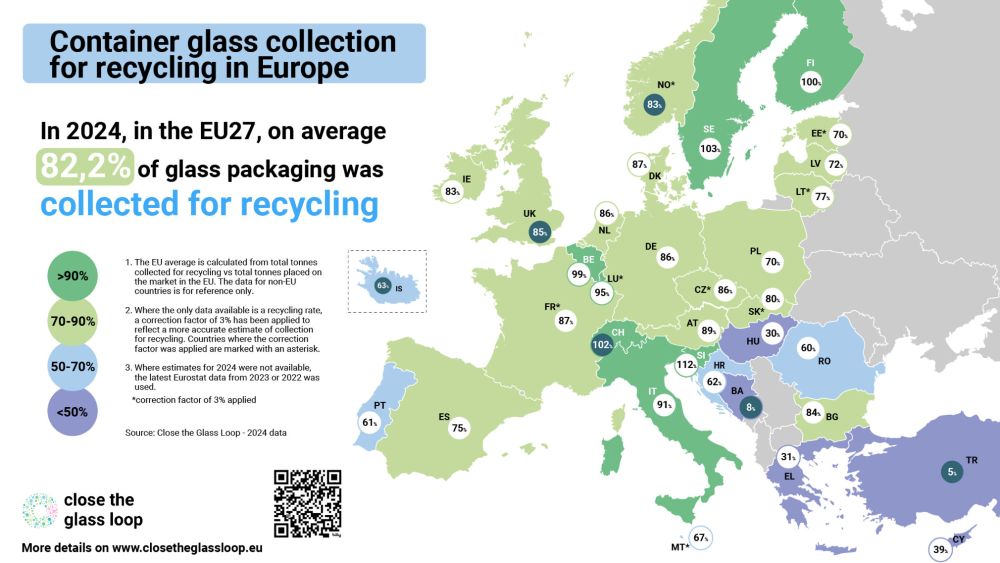
★Mark us as a preferred sourceAccording to the latest report by the Close the Glass Loop platform, the collection rate of glass packaging for recycling in the European Union reached an unprecedented high of 82.2% in 2024. The results highlight the effectiveness of separate glass waste collection systems across Europe and the importance of close cooperation between municipalities and the industry.
Outstanding Performance in Municipal Waste Management
According to the latest published data, a staggering 87% of all collected glass packaging comes directly from municipal waste management systems. This fact clearly demonstrates the success of local separate waste collection methods.
Françoise Bonnet, Secretary General of ACR+ (Association of Cities and Regions for Sustainable Resource Management), highlighted the outstanding results: “Local authorities are not only responsible for municipal waste management, they are securing the supply of secondary raw materials into the circular economy and glass packaging is a strong example of this.” Bonnet pointed out that to close the collection gap, it is essential to reinforce the partnership between municipalities and industrial value chains, which ultimately delivers tangible environmental and economic benefits to citizens.
Disparities in Performance and the 2030 Objectives
While the overall growth of the EU collection rate is highly encouraging, there are still significant disparities between the performances of Member States that must be addressed with targeted measures. The ambitious, long-term goal of the Close the Glass Loop platform is for the European collection rate to reach 90% by 2030.
Carlo Pirrone, Secretary General of FEVE (European Container Glass Federation), highlighted the critical role of national platforms. “Glass can be reused and is endlessly recyclable, no matter where it is consumed. The next phase of our work should focus on strengthening capacity on the ground, targeting investment where it can deliver the greatest impact and accelerating progress in countries that still have the largest collection gaps,” stated Pirrone.
The Essence of Quality Recycling and the Closed Loop
Increasing collection volumes alone is not enough; continuous improvement of recycling quality is also essential to ensure that waste can be transformed back into full-fledged glass containers. According to industry estimates, 85% of collected glass packaging is already effectively recycled in a closed loop.
Rene Schroeder, Secretary General of FERVER (European Glass Recyclers’ Federation), pointed out the significance of modernization investments in glass cullet recycling facilities. “While increasing collection volumes is key, it must be accompanied by a strong focus on collection quality and recyclability of the glass packaging, to maximise the amount of glass that can be recycled back into new containers,” the expert warned. Quality improvement efforts are based on the design-for-recycling criteria developed by the European Committee for Standardization (CEN), in line with the EU Packaging & Packaging Waste Regulation (PPWR).
Methodological Refinements in Data Collection
The 2024 data provides the most accurate estimate of Europe’s collection performance to date. For the first time, Close the Glass Loop applied a 3% correction factor for Member States where only a general national recycling rate was available. This correction is based on the finding in sectoral reports that approximately 3% of glass waste entering facilities remains unaccounted for, or is sent to landfills or energy recovery. This new, refined methodology was applied to eight countries—Czechia, Estonia, France, Lithuania, Luxembourg, Malta, Norway, and Slovakia—to present a realistic picture.
Hungary’s Position in Light of the 2024 Results
Based on the 2024 data collection by Close the Glass Loop, Hungary ranks at the bottom of the EU27 in collecting glass packaging waste for recycling. The collection rate of 29.8% not only falls dramatically short of the 82.2% EU average, but is even lower than that of the second-weakest performer, Greece (31.1%). Meanwhile, the frontrunners—Belgium (99.0%), Italy (91.0%), and Germany (85.9%)—perform in the 85–100% range.
Out of the 175,577 tons of glass packaging placed on the market, only 52,333 tons were collected for recycling. This means approximately 123,000 tons of glass are lost from the circular economy annually. Ending up in landfills or incinerators, this quantity represents not only an environmental loss but also a significant loss of secondary raw materials, since glass cullet can theoretically be recycled infinitely without any degradation in quality.
Furthermore, time-series data show a stagnation: from 28.7% in 2020, following a peak of 37.8% in 2021–2022, the rate fell back below the 30% mark. In contrast, the EU average has continuously risen from 79.4% to 82.2%—meaning the gap is growing rather than shrinking.
Methodological Context and Future Outlook
It is an important methodological note, however, that the source for the Hungarian data is the 2022 Eurostat report (due to the lack of recent national data provision). Therefore, the impact of the mandatory Deposit Return System (DRS) operating since January 2024 and the MOHU concession is not yet reflected in the numbers.
A meaningful improvement can realistically be expected in the next data collection cycle. Nevertheless, since the DRS only covers a specific segment of beverage packaging, the collection of the entire glass stream (mason jars, food jars, cosmetic bottles, and non-returnable bottles) will continue to depend on the effectiveness of the residential selective collection system.
Reference to the original source:


