


If you like our site, mark us as a preferred source on Google — so you’ll see our articles more often in search!
★Mark us as a preferred sourceThe RecyClass testing campaign has, for the first time, examined whether one of the most complex plastic blends in the automotive industry – the impact-modified polypropylene (PP) compound used in bumpers – can withstand mechanical recycling. The answer is yes, within two clearly defined thresholds. The Automotive and Electrical & Electronic Equipment (A&EEE) Technical Committee of RecyClass, the European non-profit recyclability initiative, published its technical review at the end of October 2026, covering nine industrial formulations and seven different elastomer technologies. It is the organisation’s first testing campaign dedicated specifically to the automotive and electronics sector.
In short: According to the RecyClass testing campaign, elastomer-modified PP compounds used in automotive bumpers are compatible with mechanical recycling. Within a PP matrix, POE and non-cross-linked EPDM are fully compatible up to 30%, and SEBS and SEPS up to 12.5%; above these levels, recyclability must be confirmed through dedicated testing.
Why bumpers?
A bumper has to be light, stiff and impact-resistant at the same time – including at sub-zero temperatures. Polypropylene on its own is cheap and easy to process, but it turns brittle in the cold, so manufacturers blend in rubber-like elastomers (impact modifiers) and adjust stiffness and dimensional stability with talc filler.
The result is one of the most elastomer-rich PP blends in use today. Exactly the kind of material the waste industry rightly asks about: does all that additive content spoil the quality of the recyclate? The RecyClass committee therefore deliberately chose bumpers as its starting case. If the formulations with the highest elastomer content pass the test, that is a strong signal for less demanding PP parts too.
Nine samples, seven elastomers: what was tested?
All compounds shared the same basis: a PP copolymer matrix, at least 10% talc filler and no more than two elastomeric impact modifiers. The elastomer panel consisted of four polyolefin elastomer (POE) grades, one non-cross-linked ethylene-propylene-diene monomer (EPDM) and two styrenic block copolymers – one SEBS and one SEPS.
Three industry supporters supplied the samples as pellets. Samples 1 to 7 were custom formulations made for the study with commercially available impact modifiers, so that the effect of each additive could be seen separately. Samples 8 and 9 were commercial black bumper compounds already on the market, containing a black masterbatch and some application-specific additives – which, according to the technical review, do not affect recyclability.
| Sample | Supporter | PP copolymer | Elastomer 1 | Elastomer 2 | Talc | Other additives |
|---|---|---|---|---|---|---|
| 1 | Dow | 65% | POE 1 – 20% | – | 15% | 0% |
| 2 | Dow | 55% | POE 1 – 30% | – | 15% | 0% |
| 3 | Dow | 65% | POE 2 – 20% | – | 15% | 0% |
| 4 | Dow | 55% | POE 2 – 30% | – | 15% | 0% |
| 5 | Dow | 55% | Non-cross-linked EPDM – 30% | – | 15% | 0% |
| 6 | Kraton | 60% | POE 3 – 12.5% | SEBS – 12.5% | 15% | 0% |
| 7 | Kraton | 60% | POE 3 – 12.5% | SEPS – 12.5% | 15% | 0% |
| 8 | Borouge | 85% | – | – | 10% | 5% |
| 9 | Borouge | 60% | POE 4 – 15–20% | – | 15% | 5–10% |
It is worth noting that no separately added elastomer is listed for sample 8: this formulation relies on its 85% PP copolymer matrix, which makes it a useful reference point for the deliberately elastomer-enriched blends.
How was the RecyClass testing campaign carried out?
The tests were performed by Interzero Slovenia, a RecyClass recognised testing facility, following the organisation’s Recyclability Evaluation Protocol for A&EEE resins (REP-RESINS-A&EEE-01 v1.0).
In essence, the pellets are pre-treated and then extruded twice: the second extrusion simulates a recycling cycle. The laboratory then assessed the pellets and injection-moulded the samples into tensile bars – without any dilution with virgin material. This is one of the most important details of the study: in practice, recyclate is often blended with fresh resin, which can mask a loss of quality. Here, the 100% reprocessed material had to stand on its own. Mechanical properties were measured both before and after the second extrusion, allowing a direct comparison of the two states.
This methodological rigour is nothing new for RecyClass: the organisation also bases its packaging guidelines on extensive testing campaigns, as we reported in our article on the RecyClass packaging recommendations update.
The results: stable processing, barely changing properties
All nine samples showed good reprocessability. The key findings of the technical review:
- pressure variations during extrusion stayed below the threshold throughout;
- no abnormal fumes or odours were observed;
- after the second extrusion, the pellets were clean and homogeneous;
- pellet properties before and after the second extrusion were very similar, all within the benchmark recommendations;
- mechanical properties varied only very slightly, and all results stayed within the protocol’s acceptance criteria.
The committee’s overall conclusion is that the tested elastomers hindered neither the recycling process nor the performance of the recovered material.
Two thresholds: 30 and 12.5 per cent
Based on the results, the RecyClass A&EEE Technical Committee issued two recommendations:
- POE or non-cross-linked EPDM within a PP matrix is fully compatible with recycling at contents of up to 30%;
- SEBS or SEPS within a PP matrix is fully compatible with recycling at contents of up to 12.5%.
These numbers need careful reading. The thresholds match the highest concentrations tested: 30% is the upper value of the POE and EPDM samples, and 12.5% is the level at which the styrenic block copolymers were tested, in combination with POE. So the threshold is not a technical limit that was found, but the edge of the available evidence. Above it, RecyClass says compatibility with recycling streams should be assessed through testing.
For product designers this means clear room to manoeuvre: typical current bumper formulations sit comfortably within the “fully compatible” range.
Not just cars: fridges and small appliances are covered too
Although the campaign focused on bumpers, the same elastomers are used in other automotive parts and in electrical and electronic equipment. Because RecyClass assesses recyclability based on material composition rather than the final application, the findings have been fed into three Design for Recycling Guidelines:
- the guidelines for plastics in vehicles;
- the guidelines for plastics in fridges and temperature exchange equipment;
- the guidelines for plastics in small appliances and information & communication technologies (ICT).
This matters because the plastic fraction of e-waste has long been a weak point in recovery. Recyclability only becomes reality, however, if small electronics actually reach a collection point – a topic we covered in detail in our analysis of the fast tech phenomenon.
What the test doesn’t tell us – a practitioner’s view
The campaign’s result is important and reassuring, but from a waste-management perspective it is worth seeing its limits as well. These are not flaws in the study but the next steps towards real-world recycling.
Factory-fresh material, not parts from end-of-life vehicles. The samples were supplied as new pellets, so the study shows whether the formulation itself can be reprocessed. A bumper that has spent 10–15 years on the road, however, has undergone UV and thermal ageing and may be damaged or contaminated. The technical review does not address this.
Paint and coatings. Most bumpers are painted. Paint residue is a known issue for recyclate quality, and the document does not deal with it.
One cycle, not several. The second extrusion simulates a single recycling loop. The campaign provides no data on how the material behaves after repeated reprocessing.
Sorting and separation. Talc (density around 2.7 g/cm³) raises the density of the blend while elastomers lower it – formulations with 15% talc can therefore end up close to the 1.0 g/cm³ density of water. That can be a borderline case in sink-float separation, which is used to separate polyolefins from heavier plastics. Black, carbon-coloured grades have also traditionally been hard for near-infrared (NIR) sorters to identify. These factors matter most when a bumper is recovered from a mixed fraction after shredding rather than through dismantling. The campaign assessed reprocessability, not sortability.
Which stream? The assessment applies to the automotive and EEE PP stream. Its findings cannot automatically be transferred to packaging PP recycling.
Why it matters now: the ELV Regulation’s targets
The timing is no coincidence. The EU’s new End-of-Life Vehicles Regulation entered into force on 13 August 2026 and, for the first time, sets mandatory recycled plastic content for new vehicles: at least 15% from 2032, rising to 25% by 2036. The regulation also expects part of that recycled plastic to come from end-of-life vehicles themselves – we summarised the details in our article on the new ELV regulation.
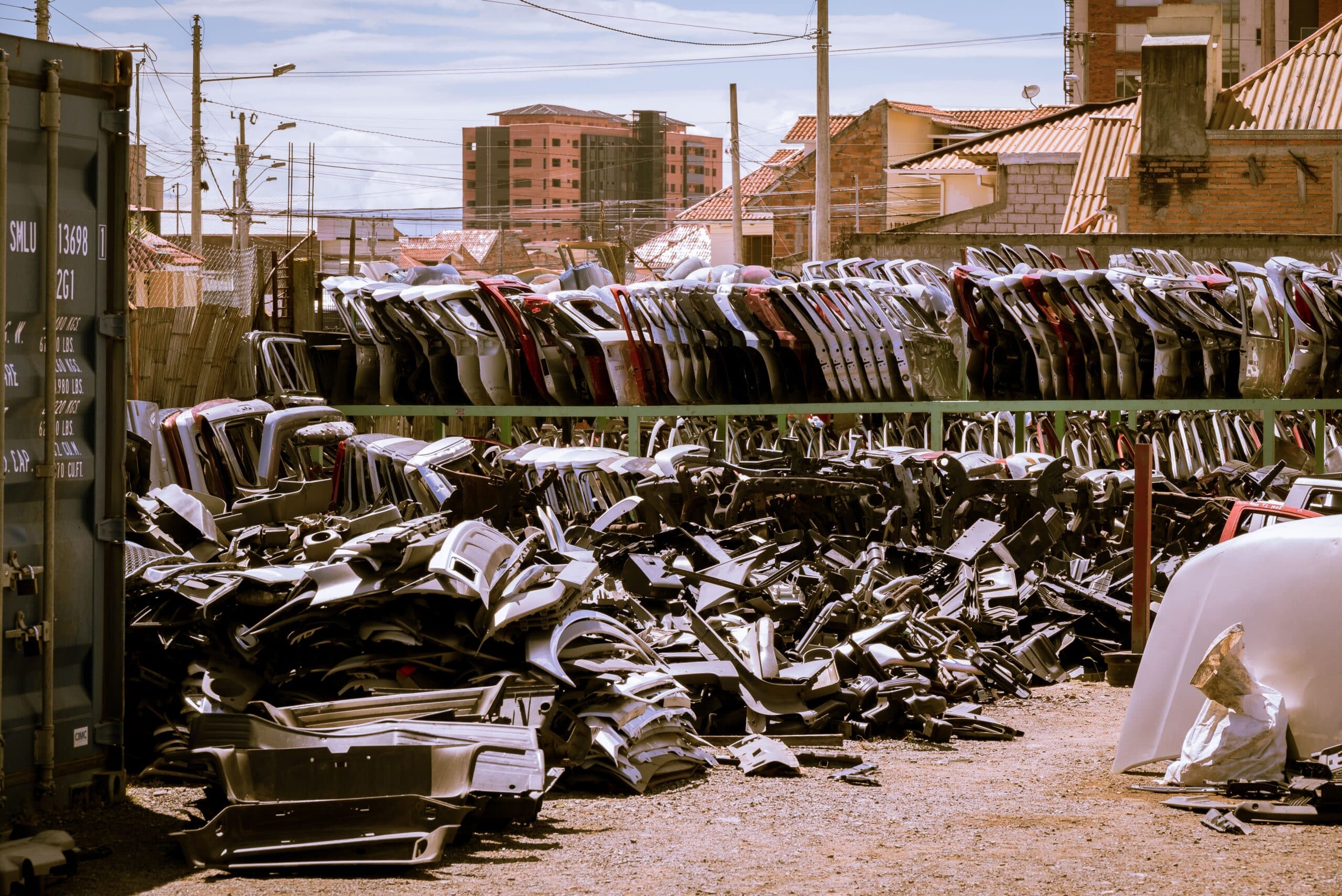
The bumper is one of the largest PP parts in a passenger car with a relatively uniform composition, making it an obvious candidate for closed-loop, car-to-car recycling. RecyClass itself says that science-based recyclability assessments help the industry anticipate the requirements of the ELV Regulation. The new result means that, at least in terms of material composition, nothing stands in the way of today’s bumpers becoming tomorrow’s.
What does this mean for industry players?
For vehicle manufacturers and their suppliers, the thresholds offer a concrete design reference: staying within 30% and 12.5% elastomer content means using a formulation with proven recyclability. For dismantlers and plastics recyclers, the campaign signals that removing bumpers separately and handling them as a clean fraction can create real value, as the quality of the end product is stable.
Technical proof alone, however, does not solve two things. The first is traceability: to meet the ELV targets, manufacturers will have to prove recycled content, and not all certification schemes are equally reliable – as we wrote in our article on the German UBA’s certification study. The second is economics: Europe’s plastics recycling capacity has shrunk significantly in recent years, and according to the sector, demand alone cannot keep plants running without regulatory support. The industry’s demands are set out in our analysis of the European plastics industry’s letter to Brussels.
Recyclability has now been proven on paper. Whether bumpers actually become recyclate will depend on dismantling, sorting and the market in the years ahead.
RecyClass testing campaign – frequently asked questions
What did the RecyClass testing campaign examine?
The campaign examined whether elastomer-modified PP compounds used in car bumpers are compatible with mechanical recycling. Nine formulations were tested, each with a PP copolymer matrix, at least 10% talc and no more than two elastomers. The panel included four POE grades, one non-cross-linked EPDM, one SEBS and one SEPS, with samples supplied by Dow, Kraton and Borouge.
Up to what elastomer content is a PP compound fully compatible with recycling?
Within a PP matrix, POE and non-cross-linked EPDM are fully compatible at contents of up to 30%, and SEBS and SEPS at up to 12.5%. These values reflect the highest concentrations tested rather than a technical limit that was identified. According to RecyClass, formulations with higher elastomer content must be assessed through dedicated testing.
How was recycling simulated during the tests?
Following the RecyClass protocol for A&EEE resins, the pellets were extruded twice, with the second extrusion simulating the recycling process. The samples were then injection-moulded into tensile bars without dilution with virgin material, and mechanical properties were compared before and after the second extrusion. The work was carried out by Interzero Slovenia, a RecyClass recognised testing facility.
Which products do the results apply to beyond bumpers?
The results apply to any automotive or electrical and electronic application using a PP compound of the same composition, because RecyClass assesses material composition rather than the final product. The findings were therefore integrated into three Design for Recycling Guidelines: for vehicles, for fridges and temperature exchange equipment, and for small appliances and ICT devices.
What did the RecyClass testing campaign not examine?
The campaign used factory-fresh pellets, so it did not model the condition of real end-of-life bumpers. The technical review does not address paint residues, years of UV and thermal ageing, repeated reprocessing, or sorting and density-based separation. These are the next steps towards real-world recycling rather than a challenge to the current results.
🔗 Official sources and references: 👉
- RecyClass: RecyClass’ Landmark Testing Campaign Confirms Recyclability of PP Compounds Used in Automotive Bumpers
- RecyClass Technical Review – Impact-modified PP compounds (Brussels, 27 October 2026), available via the RecyClass testing campaigns page
- RecyClass: Recyclability Evaluation Protocols (REP-RESINS-A&EEE-01 v1.0)
- RecyClass: Design for Recycling Guidelines – Automotive & EEE
- European Commission: End-of-Life Vehicles Regulation
Consistent structure, quick answers: every article is built so that both readers and AI search tools can find the key points easily. Our content is produced with the help of AI tools and reviewed by our editor.


