If you like our site, mark us as a preferred source on Google — so you’ll see our articles more often in search!
★Mark us as a preferred sourceOn the mist-shrouded, steep trails of Mount Tai in East China’s Shandong Province, an innovative solution is unfolding to address logistics and waste management challenges. Traditional human porters are now being supplemented by artificial intelligence-driven robotic dogs, which haul supplies uphill and transport waste downhill. This development not only reduces physical exertion but also elevates environmental conservation and mountain waste management to a new level.
The 24,000-Tonne Challenge and the “New Porter”
Renowned for its grueling terrain, Mount Tai is one of China’s most iconic peaks. For centuries, the arduous task of transporting supplies up the mountain and removing waste relied entirely on human porters. The mountain generates approximately 24,000 tonnes of waste annually, making garbage removal a backbreaking physical endeavor due to the rugged topography.
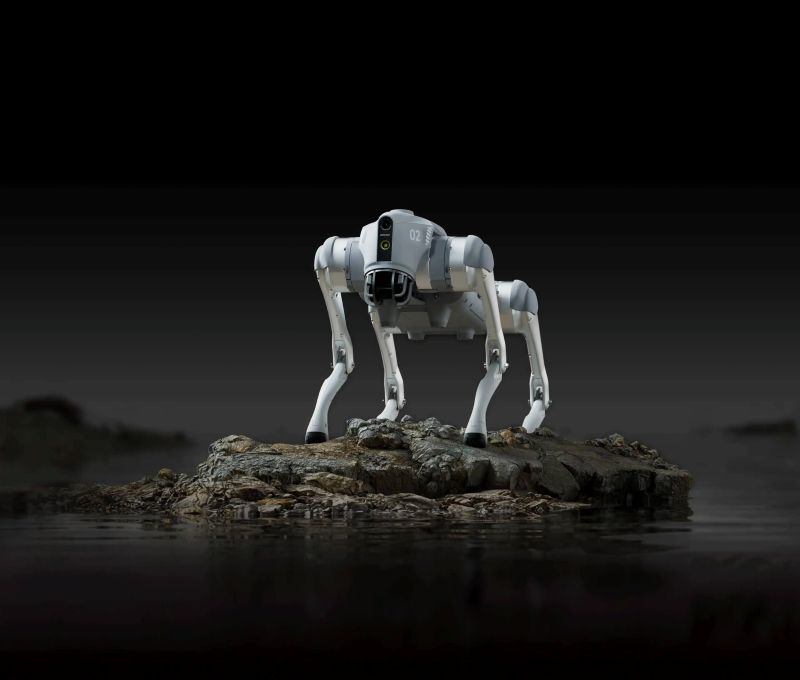
To address this, a silver-gray machine, roughly a meter long, has emerged as the mountain’s “new porter.” Moving at a constant pace alongside tourists with a bulging nylon canvas bag strapped to its back, this four-legged machine is a new member of the workforce, not a sci-fi prop. According to Wang Yunpeng, a local manager at the scenic area, the arrival of the robotic dog is expected to significantly reduce manual labor and improve overall efficiency.
Technical Specifications and Payload Capacity
Despite its compact size, the machine possesses impressive technical capabilities, navigating steep stone steps with steady precision:
-
Static Load: It can bear a static load of up to 120 kilograms.
-
Transport Capacity: It carries 30 to 45 kilograms per trip, which is comparable to the load of a human porter.
-
Operating Time: The robot operates for four to six hours on a single charge. As long as its battery is swapped, the mechanical porter can work tirelessly.
-
Navigation: Equipped with high-resolution cameras, LiDAR, and various sensors, it effortlessly identifies obstacles.
-
Terrain Capability: The machine can safely navigate slopes as steep as 45 degrees.
The “Smart Mount Tai” and AI Plus Initiatives
The deployment of the robotic dog is just one facet of the broader “Smart Mount Tai” initiative. The scenic area is undergoing a comprehensive digital transformation, incorporating artificial intelligence (AI), the Internet of Things (IoT), cloud computing, and VR/AR to build an intelligent management system. This system covers fire dispatch, crowd control, and smart tourism services.
As part of this digital transition, the scenic area introduced climbing-assist exoskeletons last year, marking one of the first large-scale deployments of such technology in the tourism sector. Weighing just 1.8 kilograms, these wearable devices use AI algorithms to reduce a climber’s physical exertion by over 30 percent.
This localized evolution aligns with China’s broader “AI Plus Initiative,” a strategy outlined in national guidelines last year. The initiative targets extensive AI adoption across six key areas by 2027: technology, industry, consumption, social services, governance, and global cooperation.
Expanding Robotics to Ecological Conservation: Drones and Biomimetic Fish
Scenic spots across the country are actively driving this cross-regional technological adoption, moving AI from research laboratories into practical daily applications:
-
At Mount Huangshan in East China’s Anhui Province, local authorities have developed AI travel assistants, deployed drones for cargo transport, and introduced climbing exoskeletons.
-
In Hangzhou, East China’s Zhejiang Province, tourism departments have introduced biomimetic robotic fish to the iconic West Lake. These autonomous devices patrol the water to monitor temperature and pH levels, detect invasive species, and transmit real-time ecological data to command centers.
Reference Links:
-
Original Source (Xinhua): english.news.cn
-
State News Agency (Xinhua) report on the project and waste management: news.cn – 泰山有望用“机器狗”清运垃圾
-
Shandong Provincial Government site mentioning the implemented technologies: sdxc.gov.cn