


If you like our site, mark us as a preferred source on Google — so you’ll see our articles more often in search!
★Mark us as a preferred sourceTurkey’s new deposit return system for beverage containers (DOA) is scheduled to launch nationwide on July 1, 2026, including the Alanya region. Implemented as part of the country’s “Zero Waste” initiative, the project is expected to contribute approximately 30 billion Turkish liras ($645.44 million) annually to the economy, while significantly reducing waste and greenhouse gas emissions. The head of the Turkish Environmental Agency stated that the program is not merely a recycling application, but a comprehensive strategic transformation.
Strategic Transformation and Digital Tracking
Nurullah Ozturk, President of the Turkish Environment Agency, highlighted in a statement to the state-run Anadolu Agency that the new deposit system is far more than a traditional recycling initiative. The program represents a strategic transformation project encompassing environmental, technological, industrial, and economic dimensions. According to Ozturk, the system ranks among the world’s most comprehensive digital deposit-return programs.
The system relies entirely on digital tracking: the entire supply chain—from producers to consumers, and from return points to recycling facilities—is monitored digitally. This infrastructure establishes a transparent and reliable structure for the logistics process.
How the DOA System Works in Practice
The deposit return system—known by its Turkish acronym DOA (Deposit Return System for Beverage Packaging)—features a straightforward and accessible framework for the public. Consumers will be able to return plastic, glass, and aluminum beverage containers that bear the official DOA logo.
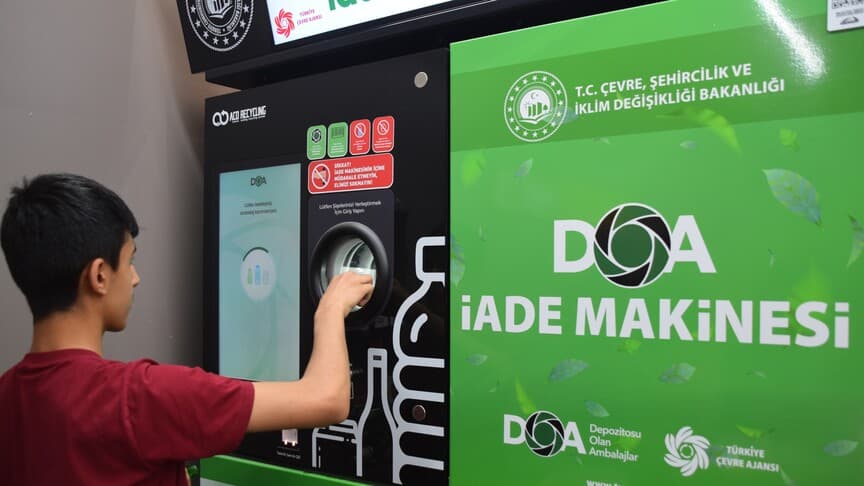
The return process will be conducted through designated return points or automated reverse vending machines. For every container returned, users will receive a refund of 1 Turkish lira, disbursed via a dedicated mobile application.
Pilot Success and Infrastructure Deployment
The nationwide rollout on July 1, 2026, which covers Alanya and all other regions, follows an extensive preparation phase. According to the Turkish Environment Agency, the pilot program originally launched in the Sakarya province has expanded to 72 provinces. This preparatory phase has already recovered more than 38 million beverage containers, including plastic, glass, and aluminum packaging.
Significant infrastructure has been deployed to support the initiative:
-
A total of 1,148 reverse vending machines have already been installed across the country.
-
The system utilizes equipment produced by six domestic manufacturers, contributing to the local economy.
-
The hospitality sector is actively participating, with 853 businesses—including hotels, restaurants, and cafes—already registered.
-
Additionally, 304 manual return points are currently operating, and 23 operators have been authorized to manage the collection, transportation, and verification processes.
Economic and Environmental Impact: Quantitative Data
Statistical data underlines the necessity of the system’s introduction. Turkey consumes approximately 25 billion single-use beverage containers annually. The Environment Agency aims for the DOA system to inject around 30 billion liras annually into the Turkish economy, establishing a model that balances environmental preservation with economic gain.
The projected environmental savings are also substantial. The agency estimates that the system will:
-
Reduce annual greenhouse gas emissions by approximately 37,000 tons.
-
Save 1.3 billion kilowatt-hours of energy annually.
-
Prevent the consumption of 3.6 million barrels of oil.
-
Lower raw material imports for beverage packaging by 35% to 40% due to increased recycling rates.
Official Sources Used:
-
StayProperty (Information regarding the launch date and Alanya coverage): Link to the original article
-
Anadolu Ajansı / AA (Turkey’s official state news agency – primary source for statistical data): Link to the state media website


