




If you like our site, mark us as a preferred source on Google — so you’ll see our articles more often in search!
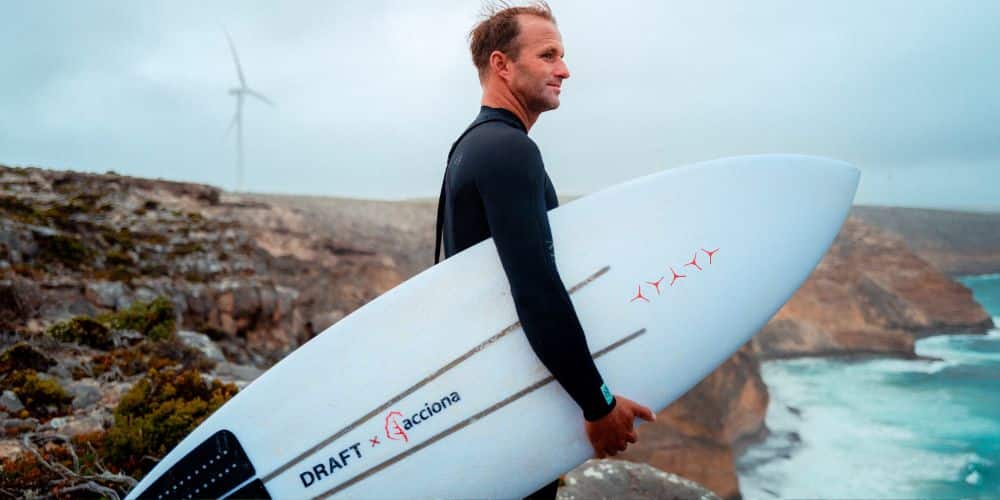
★Mark us as a preferred sourceThe sustainable recycling of decommissioned wind turbine blades is one of the most significant future challenges for the renewable energy sector. ACCIONA has proven with an innovative solution that obsolete infrastructure does not necessarily equate to waste: they have created the world’s first premium surfboards from retired turbine blades. Developed in collaboration with professional surfer Josh Kerr and the Draft Surf brand, the project not only strengthens the circular economy but also repurposes the highly resistant physical properties of industrial materials for high-performance sports equipment.
Globally, ACCIONA is working on numerous initiatives to ensure the responsible management of materials sourced from wind farms. The latest milestone in this strategy is an Australian project that represents a creative intersection between the wind energy sector and local sports culture.
The “Turbine Made” Initiative and the First 10 Prototypes
For this project, ACCIONA utilized a decommissioned turbine blade from the Waubra wind farm in Victoria, Australia. Launched in February, the Turbine Made program is Australia’s first initiative specifically aimed at the innovative transformation of retired wind energy infrastructure. So far, the project has resulted in exactly 10 prototype surfboards.
Industrial Materials on the Gold Coast: Strength and Flexibility
The surfboards were handcrafted on Australia’s famous Gold Coast. Engineers and shapers directly utilized the highly resistant physical properties of the turbine blades to enhance the boards’ performance in three distinct ways:
-
The Deck: Strips cut from the blades were built into the deck of the surfboard, providing essential strength and precise control over the board’s flex.
-
The Fins: The fins, which provide stability, drive, and speed, were manufactured using recycled fiberglass from the blades.
-
The Outer Shell: The exterior shell of the board was made more resilient by integrating particulate ground down from the turbine blades directly into the fiberglassing process.
Circular Economy in Renewables: A 10-15 Year Window
Mariola Domenech, Global Sustainability Director at ACCIONA Energía, outlined a specific timeframe regarding the impending waste crisis when discussing the industry-wide significance of the project:
“We know that over the next 10-15 years, countries like Australia are going to have huge amounts of decommissioned wind turbine blades, so we’re acting now to explore new ways to recycle and reuse their building materials.”
The director added that the locally developed surfboard prototype serves as a perfect example of how to reimagine retired materials and push the boundaries of innovation within the circular economy.
Not the First Instance: Turbine Soles for Sneakers
For ACCIONA, the Turbine Made project is part of a longer-term, cross-industry strategy. The company has previously worked on recycling decommissioned blades: in a past collaboration with the European fashion brand El Ganso, they created sneakers that integrated recycled blade material directly into the soles of the shoes.
Official Source and Reference:
-
ACCIONA Official Press Release: ACCIONA creates world-first surfboards made from decommissioned wind turbine blades
