
'/%3E%3C/svg%3E)



If you like our site, mark us as a preferred source on Google — so you’ll see our articles more often in search!
★Mark us as a preferred sourcePublic cleanliness maintenance and measurement are entering a new era on the streets of Brussels. Through the Swiss-developed Cortexia technology, which combines artificial intelligence with cameras mounted on cleanliness vehicles, the city management can now map the waste situation based on objective data. Following the initial pilot phase in 2024, the project is expanding significantly this year: technical equipment has been quadrupled, and the intervention perimeter has increased fivefold, covering more than 703 kilometers of roads in the Belgian capital.
Project Scale-Up: Quadrupled Capacity and Extended Scope
The Cortexia project, coordinated by Bruxelles-Propreté and supported by Fost Plus, has been relaunched in Brussels. Developed in Switzerland, this technology pairs artificial intelligence with cameras embedded on cleanliness vehicles to detect and quantify waste on public roads. Following an initial pilot phase conducted in 2024 with four trucks equipped with as many cameras covering 144 kilometers of roads to objectively evaluate cleanliness conditions, the project is now scaling up: its technical resources have been quadrupled, and its intervention perimeter is five times vaster.
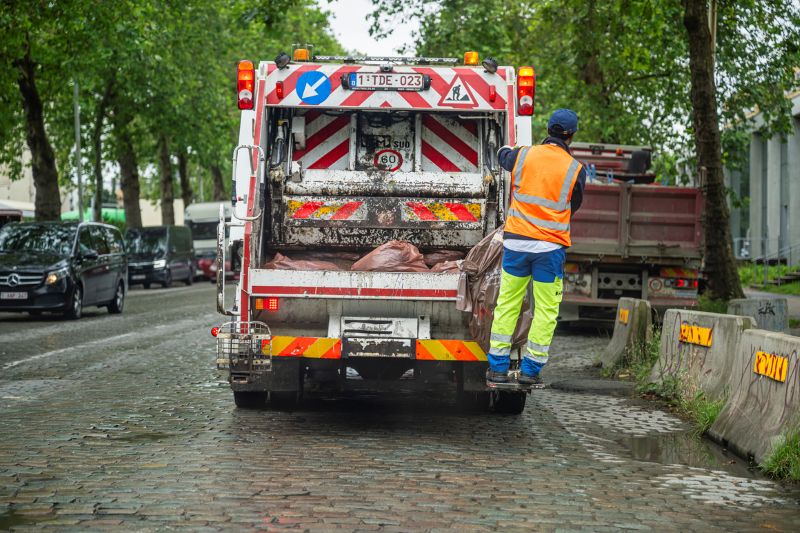
This new phase, coordinated by Bruxelles-Propreté, is deployed with the cooperation of the City of Brussels, as well as the municipalities of Anderlecht and Ixelles. Since May 19, around fifteen trucks—primarily household waste collection vehicles mobilized almost daily for emptying public bins—have been equipped with onboard computers and cameras. Objective: to measure the cleanliness status across more than 703 kilometers of roadways.
Thanks to this regional-municipal collaboration, the perimeter is not only five times larger than during the first pilot experience, but it also offers a measurement field that is much more representative of Brussels’ realities, covering local municipal streets and alleys as well as major regional arteries such as the chaussée de Waterloo, the boulevard du Midi, the chaussée de Mons, or the boulevard Lambermont.
Swiss Technology on Brussels Streets: How the Measurement Works in Practice
The system mounted on these vehicles was developed by a Swiss start-up that has already provided this solution to several European cities. Concretely, the tool uses artificial intelligence to detect and count waste littering the roads, including sidewalks.
During the one-year project, the cameras will identify the most frequently encountered types of waste in the targeted area (cigarette butts, paper and plastics, cans, dog droppings, small packaging, etc.) and link them to mapped locations and time periods. In practice, the camera automatically captures images every three meters along the roadway. These images are analyzed locally by the onboard computer; they are not transmitted to the Cortexia company and, for the vast majority, are immediately deleted after processing. This operational method guarantees a high level of personal data protection.
Based on the data, a Clean City Index (CCI) is established on the map of the covered zones, featuring a scale ranging from 0 to 5. The CCI highlights color codes based on the cleanliness status of the axes traveled by the 16 trucks:
-
Green: For a very clean artery.
-
Orange: For a satisfactory cleanliness status.
-
Red: For a roadway categorized as insufficiently clean.
Dual Objective: Better Measurement for Better Action
Bruxelles-Propreté believes that, from an information-sharing and transparency perspective, the solution potentially represents a solid basis for objectifying street cleanliness and building a new approach to cleanliness management in the Brussels region. Two objectives are particularly targeted by this new experience:
-
Optimizing the Allocation of Cleaning Teams: The objective is to redeploy human resources and the fleet from sufficiently clean areas to those that are less clean. Thanks to its automated analysis of the cleanliness status, the tool helps identify whether the cleaning frequencies, which have been standardized until now, are insufficient, adapted, or excessive.
-
Measuring the Impact of Public Urban Cleanliness Actions: The goal is also to determine, thanks to this technological tool, to what extent structural cleanliness actions (awareness, rationalization of public bins, fines) and punctual interventions actually improve public cleanliness. Operational optimization measures, such as adapting sweeping frequencies, evening rounds, or team reallocations, will also be subject to analysis.
Financial Background and Future of the Program
More generally, the project, financed by Fost Plus to the tune of 218,000 euros, aims to further strengthen coordination between the Agency and the municipalities. Via Fost Plus, packaging producers commit to the fight against litter alongside the municipalities and the Brussels Region. In 2026, they are providing 1 million euros to finance an action plan, under which Fost Plus supports this initiative. For Fost Plus, waste littering the road is packaging that escapes collection and recycling—and, therefore, a lost valuable material.
The final evaluation of the project will take place in the spring of 2027 and will determine whether or not it is relevant to deploy the solution across the entire Brussels Fővárosi Régió (Brussels-Capital Region). The measurement indicator (CCI) could potentially become a common tool for evaluation and management.
Decision-Maker Reactions: A Data-Driven Future and Shared Responsibility
The involved leaders welcomed the initiative. Audrey Henry, Secretary of State for Public Cleanliness, highlighted: “Public cleanliness enters the era of artificial intelligence. Thanks to Cortexia, we no longer clean the city based on habits, but according to the reality of the terrain. Each data point will allow for a targeted action. We are moving from a management based on fixed rounds to a Region that constantly adapts to its needs. This is the future of urban cleanliness, and it begins today thanks to a solid partnership between municipalities and the Region.”
For the Alderman for Public Cleanliness of the City of Brussels, Anas Ben Abdelmoumen: “With our participation in this pilot project, we reaffirm our ambition to base cleanliness policy more on objective and reliable data to fundamentally improve the cleanliness of our City. In addition to the expertise and experience of our field agents and reports from our residents, this AI system will allow us to obtain a precise and detailed view of cleanliness at the street level. We will thus be able to deploy our teams and material in an even more targeted manner.”
Achille Vandyck, Alderman for Public Cleanliness of Anderlecht, noted: “The use of cameras and artificial intelligence constitutes one of the major axes of my action plan for public cleanliness. It was therefore natural for Anderlecht to take part in this innovative project. Pooling resources and data among all actors committed to a sustainable improvement of cleanliness is indispensable.”
Geoffroy Kensier, Alderman for Public Cleanliness of Ixelles, added: “With the implementation of evening teams since April, we will be able to obtain data across almost the entire territory of Ixelles from 7:00 AM to 10:00 PM. These new tools will allow us to objectively measure the impact of actions carried out under our new Local Cleanliness Plan and, if necessary, adjust our human resources (e.g., reorganizing sweeping teams) and material resources (rationalizing the number and location of public bins) while guaranteeing employment.”
Cécile Fries-Martinez, Director France-Benelux for Cortexia, summarized the core idea: “For ten years, we have defended a simple idea: cleanliness is not managed by the means deployed, but by the results observed on the terrain. Zurich, Hamburg, and now Brussels are choosing to objectively measure the actual state of their streets to guide their actions where they have the most impact.”
Original Reference and Source:
Bruxelles-Propreté – L’IA pour objectiver la propreté des rues bruxelloises
Consistent structure, quick answers: every article is built so that both readers and AI search tools can find the key points easily. Our content is produced with the help of AI tools and reviewed by our editor.
