If you like our site, mark us as a preferred source on Google — so you’ll see our articles more often in search!
★Mark us as a preferred sourceFires caused by lithium-ion batteries represent a massive challenge and a constant threat to the waste management industry today. However, a recent joint study by the Münster University of Applied Sciences (FH Münster) and BRT HARTNER GmbH reveals that utilizing gentle bag opener equipment in lightweight packaging sorting plants can drastically reduce incidents involving dangerous heat generation—by up to a factor of twenty compared to traditional pre-shredding.
Growing Fire Risk in the Waste Management Sector
In recent years, the number of fires within the recycling sector has skyrocketed globally. This alarming trend is driven by the steadily increasing volume of lithium-ion batteries and accumulators on the market, coupled with a corresponding rise in incorrect disposal practices. The severity of the situation is highlighted by official statistics: according to a status report by the Federal Association for Secondary Raw Materials and Waste Management (bvse) and the Federation of the German Waste, Water and Circular Economy (BDE), the industry faces around 30 fires per day in Germany alone.
Beyond the acute danger posed to facility personnel, this development places an enormous economic burden on the industry. Following a fire, disposal yards and sorting plants face severe operational downtime, entire material batches are destroyed, and supply chain disruptions make planning nearly impossible. Furthermore, transport companies are increasingly refusing to accept certain risk-prone goods. For many operators, however, the most daunting economic challenge remains the continuously rising insurance premiums.
University Research Focusing on Sorting Plant Safety
To explore viable fire prevention strategies, a comprehensive study was conducted through a joint initiative between the Münster University of Applied Sciences (FH Münster) and BRT HARTNER GmbH. The scientific research was carried out by Finn-Luca Röll for his bachelor’s thesis, supervised by Prof. Dr.-Ing. Sören Weinrich as the primary examiner. Röll collected the necessary data during an internship at BRT HARTNER.
The research was initiated by the machine manufacturer after being approached by a German facility operator from the Dual System Germany (DSD) network. The operator noted a massive discrepancy in fire data between plants utilizing bag openers and those using pre-shredders following the introduction of automatic temperature detection and systematic incident documentation. Steffen Simonsen, Area Sales Manager at BRT HARTNER, emphasized the societal relevance of the issue, as fires directly threaten waste disposal security and, by extension, essential public infrastructure.
Staggering Figures: A Twenty-Fold Difference in Heat Generation
The study analyzed operational data from eleven DSD lightweight packaging (LVP) sorting plants. The results demonstrated a clear and compelling contrast depending on the material feeding technology applied:
-
Four of the facilities utilized bag openers at the beginning of the sorting process. Operating on a three-shift basis, these plants recorded a maximum of 3 to 4 heat detections per month.
-
In contrast, six other facilities that relied on traditional pre-shredding at the material intake registered an average of 3 detections per day.
This equates to a twenty-fold increase in fire-risk incidents for pre-shredding systems compared to the monthly average of bag openers. (The eleventh plant was excluded from the final comparison due to its specific household and residual waste collection system, making it not directly comparable to the pure lightweight packaging plants.)
The data clearly indicates that bag openers cause virtually no damage to mistakenly discarded lithium-ion batteries, resulting in far fewer cases of dangerous heat generation. Simonsen highlighted that out of more than 800 BO bag openers sold worldwide, the company is not aware of a single case where the machine itself triggered a facility fire.
Operating Principle and Preventive Role of Bag Opener Technology
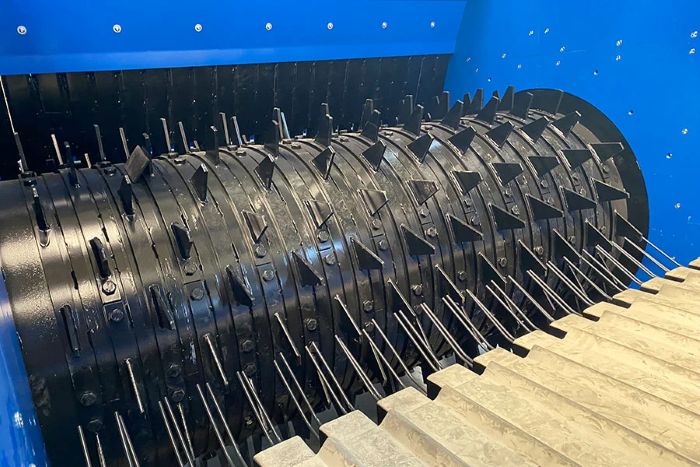
“Our BRT HARTNER BO bag openers are designed for the gentle tearing and emptying of bags,” explained Simonsen, who also co-supervised the thesis. “The material itself is deliberately treated in such a way that it is passed on to the subsequent sorting processes largely intact.”
The efficiency and gentleness of the technology lie in its mechanical design. The relative movement of separately driven drum halves and the use of clamping arms enable a near 100-percent opening rate and homogeneous dosing without damaging the material. This ensures that the contents of the bags—including hazardous lithium-ion batteries—avoid physical trauma, preventing short circuits on the conveyor belts.
Maximum Investment Protection and Future Efficiency
Gentle material feeding is vital not only for direct fire prevention but also for the protection of highly valuable downstream sorting infrastructure. Facility operators who have invested millions in advanced X-ray systems or optical sorters for the targeted extraction of batteries see a clear added value in this technology.
As Simonsen pointed out: “These systems are located after the material feed—meaning that without gentle bag opening, a significant fire potential already exists before the batteries can even be sorted out by the machines. Only the upstream integration of a bag opener enables true efficiency and maximum safety.”
In addition to the drastic improvement in fire safety metrics, the objective university analysis also provided important insights into the exceptional throughput and opening rates of the new generation of bag openers, far exceeding the manufacturer’s initial expectations.
References & Sources:
-
Original press release: Eggersmann Recycling Technology – Sacköffnung reduziert Brandgefahr erheblich
-
Official industry report (bvse Statusbericht 2026): https://www.bvse.de/recycling/recycling-nachrichten/12795-statusbericht-der-deutschen-kreislaufwirtschaft-2026-veroeffentlicht.html
Consistent structure, quick answers: every article is built so that both readers and AI search tools can find the key points easily. Our content is produced with the help of AI tools and reviewed by our editor.