
'/%3E%3C/svg%3E)



If you like our site, mark us as a preferred source on Google — so you’ll see our articles more often in search!
★Mark us as a preferred sourceThe processing and recycling of disposable baby diapers has been a decades-long challenge in global waste management. For these typical products of the linear economy, a unique, industrial-scale solution has now been demonstrated in Europe by the Belgian company Woosh, the global Borouge International, and BlueAlp, a pioneer in chemical recycling. Within the framework of this closed-loop project, the plastic content of used diapers is recovered and chemically transformed into a feedstock suitable for the production of new polymers—including potentially new diapers—proving the hygiene sector’s integrability into the circular economy.
The Problem of the Linear Economy and the European Waste Situation
Disposable baby diapers are single-use products and thus one of the most striking examples of the linear economic model. They typically end up in incinerators or landfills after a single use without any possibility of material recovery. This situation persists despite the fact that these products contain valuable, polyolefin-based non-woven fabrics and films.
The severity and scale of the problem are supported by concrete data: based on a 2019 analysis by Cabrera and Garcia, approximately 6.73 million metric tons of disposable baby diaper waste were generated in the 28 Member States of the European Union (EU-28) in 2017. This European-scale statistic highlights the massive volume of largely unrecovered waste on the continent that requires a systemic and scalable industrial intervention.
Woosh’s Closed-Loop Ecosystem and Innovative Collection
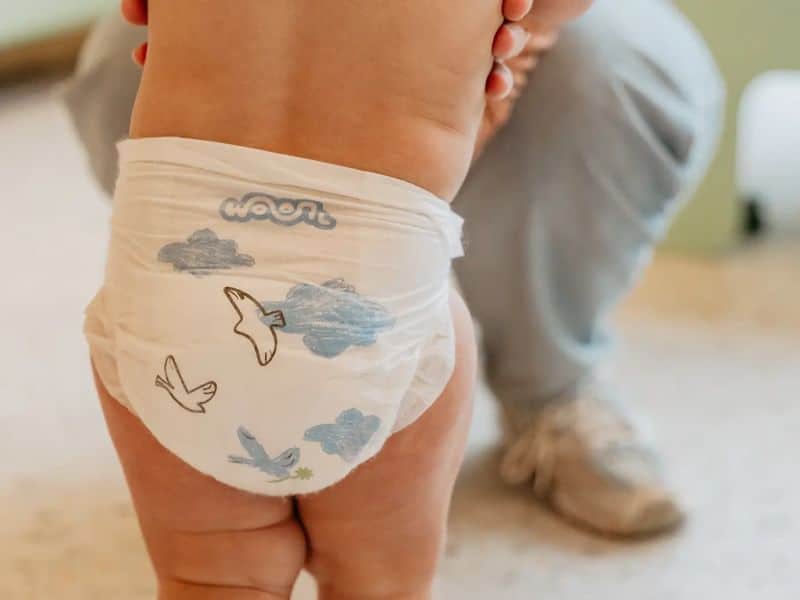
The foundation for realizing this recycling was laid by Woosh, a Belgian company based in Ghent, founded in 2021. The explicit mission of this circular diaper brand is the total elimination of diaper waste. To this end, the Woosh “give-back” diaper itself was designed to be optimal for subsequent recycling processes. The company delivers these products to childcare facilities and households, and then collects them after use, creating a strictly separated, traceable flow of used diapers.
The quantitative metrics of the system are remarkable: more than 30,000 children use Woosh diapers daily across Belgium. The company’s own diaper recycling plant, commissioned in 2025, is already capable of processing thousands of metric tons of waste annually.
Near-future expansion plans include entering the French and Dutch markets, as well as opening up to the retail sector. Regarding the results achieved, Jeff Stubbe, CEO of Woosh, emphasized: “We spent years building the collection network and technology to make this possible. Seeing the plastic recovered from used diapers certified as feedstock for the production of new polymers—and potentially new diapers in the future—is exactly the goal we wanted to achieve. This is what closing the loop looks like in reality.”
Engineering Challenges, Mechanical Separation, and Pyrolysis at BlueAlp
The separated, dedicated waste stream forms the starting point for processing. To prepare for chemical recycling, experts from Borouge International and BlueAlp worked closely with Woosh engineers to define the strict quality requirements that the recovered plastic must meet. Based on these requirements, Woosh optimized its patented mechanical separation process, ensuring the perfect input material.
The first industrial-scale recycling runs were carried out at BlueAlp’s commercial plant in Ostend, Belgium. The facility—which was built licensing BlueAlp’s technology and currently operates as an upscaled 21-kiloton (21kt) plant under the name BlueAlp Ostend—has proven the industrial applicability of the process. At the plant, the recovered plastic fractions were converted into a liquid hydrocarbon, known as pyrolysis oil, using BlueAlp’s pyrolysis technology. This product is ISCC PLUS certified and fully meets the quality specifications required for the production of new polymers—and even new diapers.
Peter Voortmans, Vice President of Consumer Products Marketing at Borealis, highlighted that chemical recycling in this case is a highly complex engineering task requiring careful pre-processing due to the unique specifications. Valentijn de Neve, CEO of BlueAlp, confirmed: the project demonstrates that even difficult-to-manage waste streams, which were previously impossible to treat effectively via mechanical recycling, can be processed chemically.
Project Background: The Profiles of BlueAlp and Borouge International
BlueAlp, a technology company headquartered in Eindhoven, the Netherlands, employs approximately 130 people. Its operations are built on three main business models: developing and licensing its proprietary technology; detailed engineering and manufacturing of chemical recycling plants; and owning and operating such facilities.
Following the initial 3-kiloton plant in Switzerland, they are now expanding on a global scale: together with the Italian waste management company RES, for example, they are building Italy’s largest pyrolysis plant with a capacity of 20 kilotons (20kta). The company enjoys the backing of major global partners and shareholders such as Borouge International, Shell, Rumali, Den Hartog, and Mourik.
The integrated material technology background for the project is provided by Borouge Group International AG. This international corporate group was formed in 2026 through the merger of Borouge Plc, Borealis, and NOVA Chemicals, with the long-term support of XRG (the international investment arm of ADNOC) and OMV. The entity, which has its global headquarters in Austria, a regional headquarters in Abu Dhabi, and corporate hubs in North America and the Asia-Pacific region, offers the world’s leading polyolefin solutions.
This cross-sectoral collaboration is tangible proof of concept that, through careful, purposeful system design, even Europe’s most problematic waste streams can be successfully reintegrated into the production value chain.
Sources and Reference Links:
-
Primary reference: BlueAlp Newsroom (Official press release and project description) – https://www.bluealp.nl/newsroom/
-
Supplementary global corporate and data information: Global platform of Borouge International / Borealis – https://www.borealisgroup.com/
Consistent structure, quick answers: every article is built so that both readers and AI search tools can find the key points easily. Our content is produced with the help of AI tools and reviewed by our editor.
