


If you like our site, mark us as a preferred source on Google — so you’ll see our articles more often in search!
★Mark us as a preferred sourceThe success of packaging recycling largely depends on correct waste sorting, an area where there is still room for improvement in Germany. To address this, the dual systems, municipal waste management advisors, waste disposal companies, and major retail chains are joining forces for the nationwide campaign “Deutschland trennt.” (Germany sorts), representing the largest partner awareness initiative to date, running from June 6 to 21, 2026.
The Root of the Problem: Myths and Misplaced Waste
Although the German population actively participates in waste collection, around 30 percent of the waste disposed of in Yellow Bins (Gelbe Tonne) and Yellow Bags (Gelber Sack) does not belong there. Items such as diapers, vacuum cleaner bags, batteries, or food scraps frequently land in these recycling containers. These “misplaced items” (Fehlwürfe) significantly slow down and disrupt the efficiency of a working circular economy, leading to the loss of valuable raw materials.
The root cause of this phenomenon is often a lack of knowledge or long-disproved myths. For instance, many people mistakenly assume that separated packaging is not actually recycled but is instead mostly incinerated or exported abroad. The primary goal of the “Deutschland trennt.” campaign is to dispel these widespread misconceptions. In this nationwide educational offensive, the dual systems are working alongside municipal advisors, waste management companies, and leading retailers in the food, DIY, drugstore, and organic sectors to campaign for more and better waste sorting.
Recycling in Numbers: The Importance of the Circular Economy
Quantitative data clearly demonstrates the environmental and economic importance of recycling: in Germany, approximately four million tons of secondary raw materials are generated annually from recycled packaging (according to a 2022 study by the Öko-Institut examining the performance of the dual systems). These raw materials represent a crucial source for manufacturing new packaging and products.
Axel Subklew, spokesperson for the “Mülltrennung wirkt” (Waste sorting works) initiative, highlighted regarding the campaign: “Germany is already sorting, but the potential is not yet fully exhausted. Against the backdrop of the growing importance of the circular economy and resource protection, we want to reach, inform, and motivate as many people as possible with the ‘Deutschland trennt.’ campaign to sort their waste correctly.” The scale and relevance of this task are underscored by official 2023 data showing that private end-consumers in Germany generated a total of approximately 8.4 million tons of packaging waste nationwide.
Nationwide Educational Tour: 500 Live Events and Personal Dialogue with the Public
Direct, local-level personal communication forms the cornerstone of this awareness drive. During the 16-day campaign, a total of 500 live events will take place, and 20 dedicated educational “showtrucks” will be deployed across Germany. During the nationwide tour running from June 6 to 21, 2026, the public can directly ask their questions regarding everyday waste management: How do you properly sort a yogurt cup? Does it need to be washed out before being thrown away? Where should dead batteries and accumulators be disposed of?
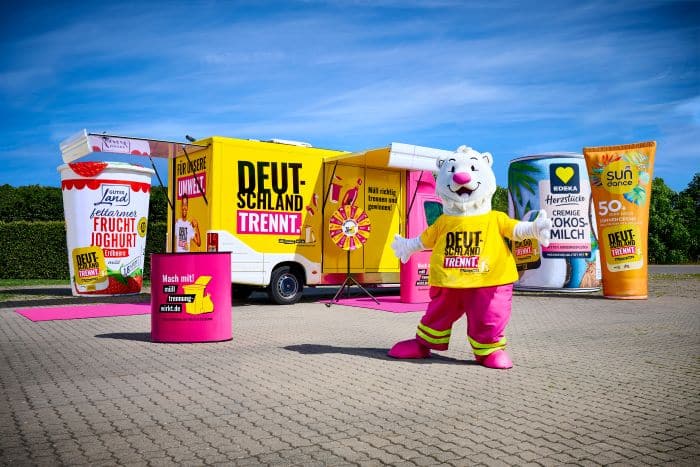
On-site, dedicated action teams composed of specialists from municipal waste management advisory boards and the dual systems will answer both local and fundamental questions from citizens. Around the showtrucks and eye-catching XXL-sized packaging, visitors are invited to engage in dialogue and interactive activities on central squares with the campaign’s official mascot, the TRENN-BÄR (Sorting Bear). Furthermore, the experts are heavily focused on education, visiting kindergartens, schools, and companies with tailored educational materials provided by the dual systems. Local waste management companies also offer direct insights into practical processes, for example, through public visits to their local sorting facilities.
Broad Alliance and Retail Responsibility at the Point of Sale
Informing and encouraging shoppers begins right inside the stores. Thirteen major retail partners have joined the campaign, raising awareness among their customers about the correct separation of used packaging directly at the point of sale in approximately 13,700 (precisely 13,698) stores nationwide.
The participating partners include major retail chains:
-
Drugstores: BUDNI, Rossmann, dm
-
Food Retail: dennree, EDEKA (including its Minden-Hannover, Südbayern, and Südwest foundation and regional networks), GLOBUS, Netto Deutschland, Netto Marken-Discount
-
DIY Stores: Hornbach, OBI, toom
Customers are educated comprehensively through multiple channels: via in-store posters, their own social media channels, specific shopping information, and promotional activities in parking lots. The oversized XXL packagings display products from their own store brands, visually reinforcing the campaign’s core message.
Comprehensive Action Alliance for the Circular Economy and Climate Protection
Consumers play an entirely central role in running an efficient circular economy: the more and the better they sort waste, the more effective the final recycling of packaging becomes. The exact goal of the “Deutschland trennt.” campaign is to promote sustainability by clearly increasing the collection volumes and qualities of used packaging, which actively and directly contributes to climate and resource protection.
Initiated and centrally organized by the “Mülltrennung wirkt” initiative of the dual systems, this educational project was first launched in 2024, and its professional success is evidenced by winning the prestigious German Brand Award 2025. This successful program is being continued now in June 2026. As the largest German partner alliance to date, it aims to reach the widest possible segment of the population through dialogue-oriented, local awareness campaigns, factually eliminating existing information gaps.
Sources and References:
-
Original press release (Mülltrennung wirkt): Deutschland trennt – aber es geht noch besser
-
State / Federal statistical data source (Umweltbundesamt report from April 2026 on packaging waste): Aufkommen und Verwertung von Verpackungsabfällen in Deutschland im Jahr 2023


