


If you like our site, mark us as a preferred source on Google — so you’ll see our articles more often in search!
★Mark us as a preferred sourceFor the sixth consecutive year, Dubai has retained its title as the cleanest city in the world, according to the latest Global Power City Index (GPCI) published by Japan’s Mori Memorial Foundation. The city achieved a flawless 100 percent satisfaction score in the cleanliness indicator of the environment pillar, outpacing the world’s largest metropolises. The driving force behind this success is a massive, 24/7 infrastructural machine and an integrated waste management strategy that places the circular economy front and center.
The Global Power City Index (GPCI), compiled by the Japanese Institute for Urban Strategies, evaluates the world’s leading cities based on economy, livability, cultural interaction, and environment, among other factors. Within the environmental category, Dubai secured a maximum 100 percent satisfaction score in the public cleanliness indicator. The official report highlights that maintaining cleanliness in the emirate is not merely an operational task, but a fundamental pillar of a long-term vision aimed at creating a sustainable and healthy urban environment.
A 24/7 Cleanliness Machine in Numbers
The Dubai Municipality operates an extensive and technologically advanced system 24 hours a day to ensure the city remains in pristine condition. According to official data, the public sanitation network operates with the following capacities:
-
The fleet consists of 785 specialized cleaning vehicles and modern equipment.
-
More than 23,300 waste collection and storage bins are distributed across residential and public areas.
-
Fieldwork and supervision are carried out by a total of 2,876 public cleanliness engineers and workers, alongside a 280-member supervisory staff (totaling a workforce of nearly 3,200 people).
This massive institutional system covers an astonishingly vast network on a daily basis: continuous cleaning operations span 2,400 kilometers of main roads, 1,419 square kilometers of investment zones, and 33.4 kilometers of water canals.
The Role of the Circular Economy: Zero Waste to Landfills
Dubai’s concept of cleanliness is closely intertwined with its sustainability and circular economy objectives. The city’s leadership recognized that merely clearing away waste is not enough; interventions must happen at the source, and collected materials must be recycled as valuable resources.
The cornerstone of this strategy is the Dubai Integrated Waste Management Strategy 2041. The primary goal of this program is to achieve a 100 percent diversion of waste from traditional landfills.
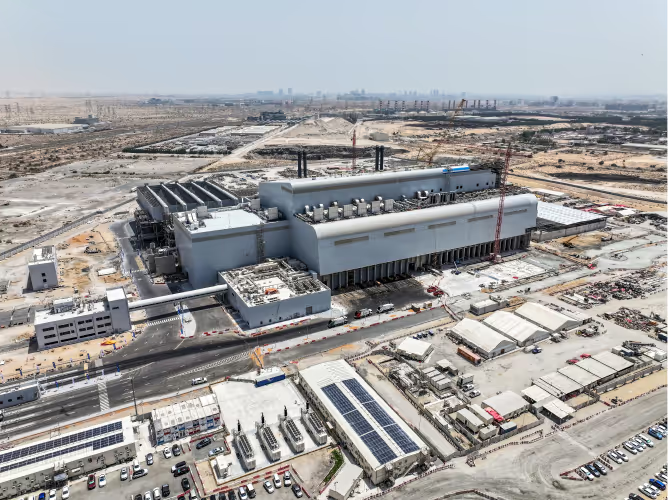
One of the most crucial infrastructural elements of this circular transition and energy production is the municipality-operated Warsan Waste-to-Energy Centre, which stands as one of the largest waste-to-energy facilities in the world. Alongside physical infrastructure, the municipality also employs advanced digital monitoring systems and targeted recycling programs to maximize the efficiency of waste collection and environmental management.
Community and Institutional Collaboration
Reflecting on the achievement, Marwan Ahmed bin Ghalita, Director General of Dubai Municipality, emphasized that cleanliness in Dubai is a deeply rooted urban culture that reflects the society’s sense of responsibility and values. According to the Director General, maintaining the top spot for the sixth consecutive year is a direct result of the strong partnership between government entities, the private sector, and the general public.
Official Sources and References:
-
Original News Source (Gulf Today): Dubai retains title of the world’s cleanest city for sixth consecutive year
-
Dubai Government Media Office (Official State Source): Dubai retains title of the world’s cleanest city for sixth consecutive year


