


If you like our site, mark us as a preferred source on Google — so you’ll see our articles more often in search!
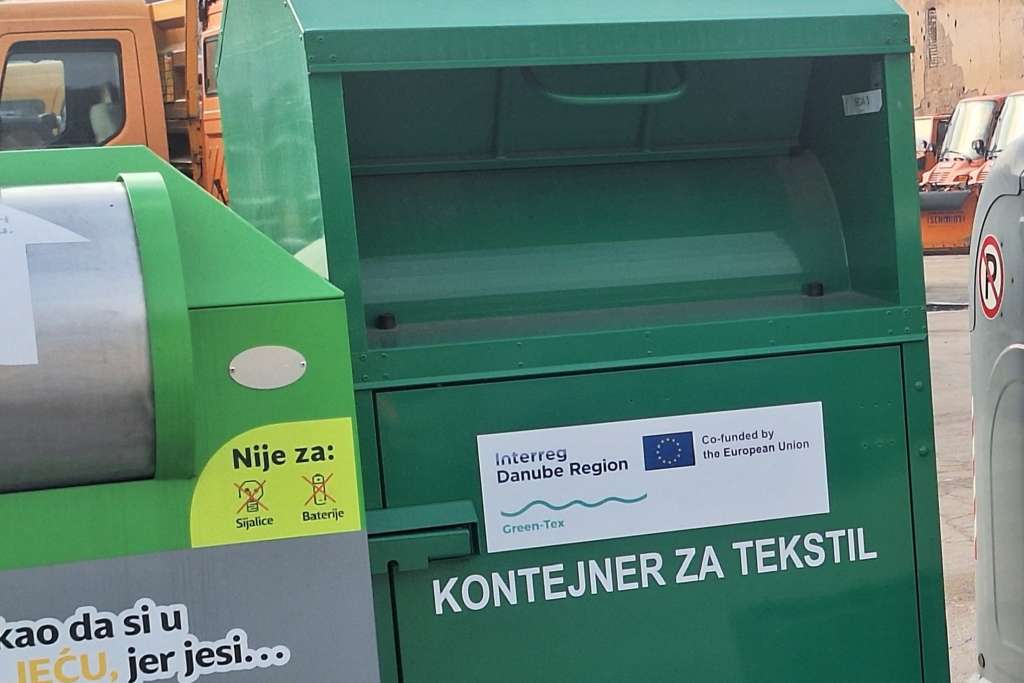
★Mark us as a preferred sourceThe textile industry, as one of the sectors with the largest environmental footprints globally, faces urgent challenges regarding waste management and carbon emissions. Latest statistics show that 86 percent of used clothing ends up in landfills or incinerators, while only 1 percent is recycled to create new garments. In response to this crisis, the “Green-Tex – From Textile Waste to Resource” project has been launched under the leadership of the Sarajevo Regional Development Agency (SERDA). Part of the EU’s INTERREG Danube Region Programme, the initiative is reforming collection processes in Sarajevo Canton using containers equipped with digital sensors.
The ecological burden of the textile industry has moved into the spotlight in recent years, particularly due to the rise of “fast fashion,” which accelerates consumption cycles and drastically shortens the lifespan of clothing. Amela Ikić Suljagić, project manager at SERDA, emphasized in a statement to the FENA news agency that the data shows a massive waste of raw materials, putting direct pressure on the environment and increasing global $CO_2$ emissions.
Statistical Alert: Why the Green-Tex Project is Essential
The figures providing the background for the project speak for themselves. Global textile production has doubled in the last decade, but waste management technologies have not kept pace with this growth.
-
86% ends up as waste: The vast majority of used textiles leave the economic cycle and enter landfills in an environmentally damaging way.
-
1% recycling: Due to technological limitations and deficiencies in collection systems, the recycling rate remains negligible.
-
Loss of Resources: According to SERDA’s analysis, a significant portion of discarded clothes could be valuable secondary raw materials if sorting and collection were more efficient.
The goal of the Green-Tex project is precisely this: to treat textile waste not as trash, but as a valuable resource, laying the foundation for a more sustainable future.
Digital Logistics: Sensors and Cloud-Based Data Analysis
The most visible element of the project is the pilot initiative implemented in Sarajevo Canton. In close cooperation with the Sarajevo Canton Ministry of Communal Economy and the KJKP “Rad” utility company, SERDA has placed 10 special textile collection containers at strategic points. These containers, however, are far from ordinary storage units.
The core of the innovation lies in the integrated smart solutions:
-
Fill-Level Sensors: Every container features digital sensors that measure the saturation level in real-time.
-
Telecommunication Data Transfer: The sensors send information via mobile networks to a central cloud-based portal.
-
Optimized Dispatch Service: Dispatchers use the portal data to see exactly which container is full. Collection vehicles are only sent to the site when it is actually justified.
This technology provides direct environmental and economic benefits: saving significant amounts of fuel and time, while reducing the unnecessary mileage of heavy machinery and the burden on urban traffic.
International Cooperation Along the Danube
Although the pilot activity is located in Sarajevo, Green-Tex is part of a broader, transnational cooperation. The project brings together partners from 9 Danube region countries, ranging from research institutes and small-to-medium enterprises to waste management experts.
The project does not just test technology; it also collects data. According to Amela Ikić Suljagić, the goal of the pilot phase is to gain an accurate picture of the quantity and composition of the collected textiles. This data is essential for developing future strategies and legislative frameworks. Additionally, they are investigating how the sensor-based solutions applied here can be adapted to collect other types of waste streams, such as plastic or paper.
April: A Milestone in the Project’s Life
The Sarajevo pilot initiative is scheduled to conclude in April 2026. By then, the aggregated results will be available to form the basis for recommendations on expanding the system. The success of the project is important not only for Sarajevo but can also serve as a model for the entire Balkan region and the countries along the Danube.
The Green-Tex project proves that by combining modern technology and municipal will, the transition to a circular economy can be initiated even in the most difficult segments of waste management.
Official Sources and References:
-
Original News Source (FENA): SERDA i partneri u projektu Green-Tex – Od brze mode do održive budućnosti
-
Project Page: INTERREG Danube Region Programme – Green-Tex Project
-
Executing Partner: Sarajevo Regional Development Agency (SERDA)


