


If you like our site, mark us as a preferred source on Google — so you’ll see our articles more often in search!
★Mark us as a preferred sourceAs of today, June 24, the Hungarian population has officially consumed its sustainable budget of natural resources for the entire year. From the Overshoot Day for the remaining 190 days of 2026, we are liquidating the capital of future generations. At a global level, the situation is slightly more favorable, yet the trajectory remains critical: humanity as a whole will reach its tipping point on July 30.
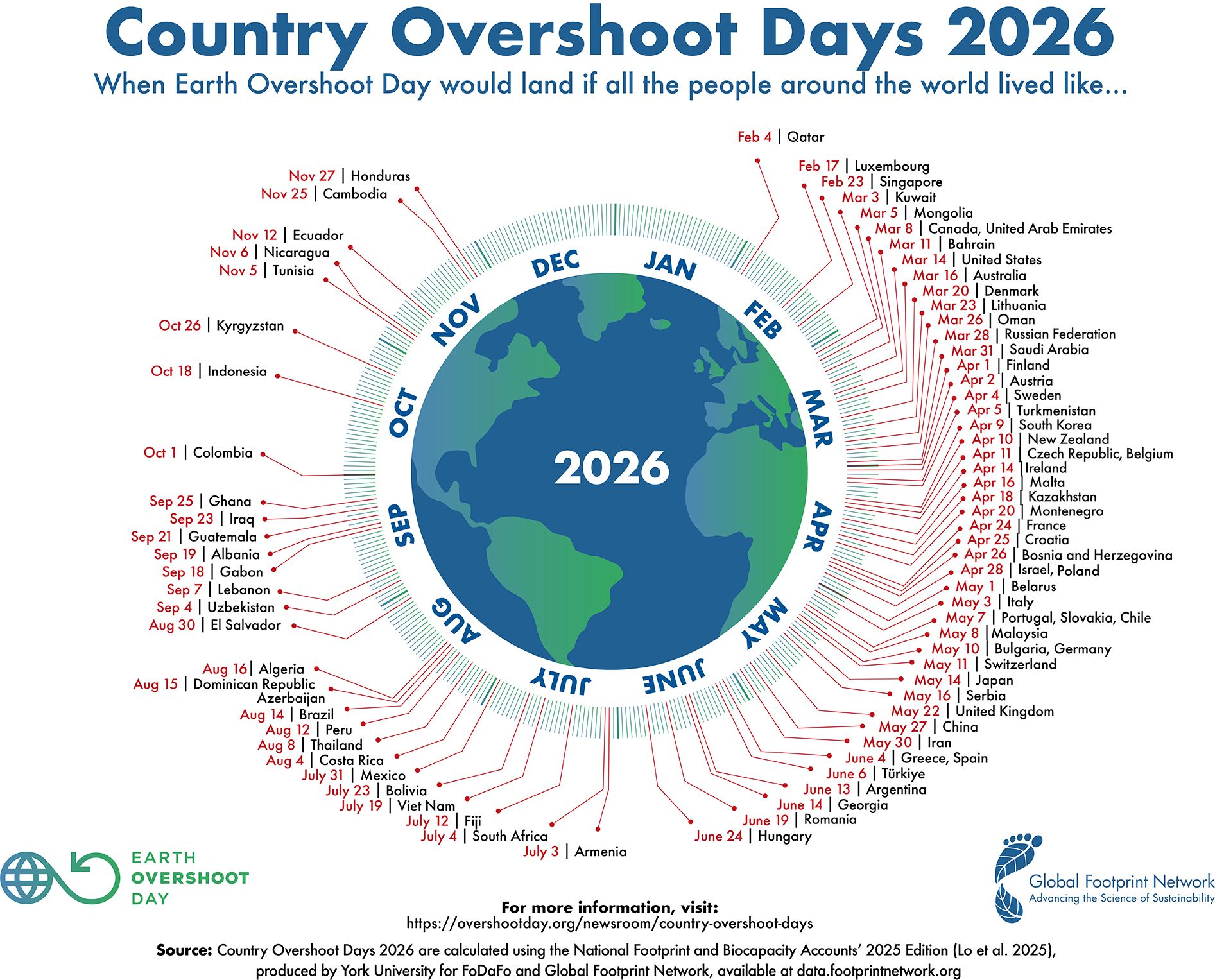
Budapest, June 24, 2026 – Today, Hungary has crossed the ecological threshold designated by researchers as the Country Overshoot Day. According to recent data compiled by the Global Footprint Network, an international research organization tracking sustainability metrics, if every person on Earth mirrored the consumption patterns and lifestyle of the average Hungarian citizen, the planet’s ecosystems could only regenerate the resources consumed and absorb the waste generated—specifically carbon dioxide—up until today, June 24.
According to objective quantitative and statistical records, this indicates that the operations of the Hungarian economy and society currently far exceed sustainable boundaries. Maintaining our current way of life would require nearly two full Earth planets.
The Global and Domestic Balance: Exhausting the Budget Months Before Year-End
The foundation of this international methodology relies on the latest figures from the National Footprint and Biocapacity Accounts. Computations show that while Earth Overshoot Day falls on July 30 this year, Hungary’s consumption outpaces the global average by more than a month. Furthermore, this negative trend has been structurally locked in for decades; in the early 1970s, global resource depletion occurred in December, whereas it has now permanently advanced to mid-summer.
Ecological overshoot carries direct, measurable consequences. Data from the Global Footprint Network underscores that since the phenomenon of global overshoot became systemic in 1972, atmospheric greenhouse gas concentrations have climbed from a historical 367 ppm (parts per million) to 547 ppm today, based on measurements from the National Oceanic and Atmospheric Administration (NOAA). This accumulating ecological debt directly drives climate change, biodiversity loss, and extreme weather events.

How is the Overshoot Day Calculated?
To establish this critical threshold, researchers contrast two primary metrics: biocapacity and the ecological footprint.
-
Biocapacity: The capacity of ecosystems (forests, pastures, fishing grounds, built-up land) to regenerate biological materials demanded by humans and to absorb the resulting waste.
-
Ecological Footprint: The total area required to sustain human consumption and to sequester the emitted carbon dioxide.
The mathematical formula is straightforward and rigorous: a country’s biocapacity for the given year is divided by its ecological footprint, and the quotient is then multiplied by the number of days in a year (365). Whenever the footprint exceeds biocapacity—which is the case for Hungary and most developed nations—the resulting calendar date falls prior to December 31.
International Overview: Qatar Leads, Developing Nations Remain in Balance
Country breakdowns illustrate massive disparities in global resource distribution and consumption habits. Highly affluent nations with substantial per capita energy and material consumption exhaust their budgets earliest.
-
Qatar continues to lead the absolute ranking, reaching its overshoot day as early as February 4.
-
Luxemburg and South Korea crossed the threshold in February (February 11), while the United States reached its critical limit on March 14.
-
Within Europe, Denmark marked its day on March 16, Germany on May 10, and neighboring Romania joined the list on June 19.
-
Positioned just ahead of Hungary are Spain and Greece (June 4), while Turkey crossed the boundary on June 6.
Conversely, numerous lower-income nations (such as Nigeria or Bangladesh) do not have a designated overshoot day, as their per capita consumption does not exceed globally sustainable limits.
Ecological Deficits Constitute Economic Risks
Expert analyses emphasize that maintaining a persistent ecological deficit is no longer solely an environmental issue, but represents a severe macroeconomic risk. Nations that extend far beyond their domestic and global biological capacities face long-term vulnerabilities, including supply chain disruptions, escalating resource costs, and dependency on food or raw material imports.
Overshoot Day serves as an explicit, calendar-based warning: current growth and consumption models fundamentally destabilize future economic and social security.
Official Sources and References:
-
Official country breakdown database and calendar by the international research organization: Global Footprint Network – Country Overshoot Days 2026
-
Context on ecological footprints and domestic environmental data: Association of Environmental Service Providers and Manufacturers (KSZGYSZ) Knowledge Base


