




If you like our site, mark us as a preferred source on Google — so you’ll see our articles more often in search!
★Mark us as a preferred sourceOn April 10, 2026, Portugal reached a significant milestone in environmental sustainability and recycling by officially launching its long-anticipated deposit return scheme (DRS) for single-use drink containers. With this move, Portugal becomes the 19th European country—and the first major market in Southern Europe—to implement this circular economy model. The initiative is designed to significantly reduce waste, improve material recovery, and decrease the nation’s reliance on virgin resources.
System Mechanics and the “Volta” Trademark
Managed and operated by SDR Portugal, the new national system is branded under the name “volta”. Under this scheme, consumers will pay a €0.10 deposit when purchasing eligible drink containers. They will receive a full refund of this deposit as soon as they return the empty packaging to one of the designated collection points.
Strict rules have been established for the return network: retail stores larger than 400 square meters are legally required to accept packaging covered by the DRS. These retailers have the flexibility to choose between implementing automatic reverse vending machines or utilizing manual collection methods.
Which Containers Are Covered?
The program specifically covers drink containers marked with the official “volta” DRS symbol. These include:
-
PET plastic bottles.
-
Aluminum and steel cans.
-
A key criterion is that the system accepts these packaging materials up to a maximum volume of 3 liters.
To ensure the system is highly accessible across both urban and rural areas—including the autonomous regions of the Azores and Madeira islands—a massive network featuring over 2,500 automated reverse vending solutions has been deployed.
Technological Backbone and TOMRA’s Role
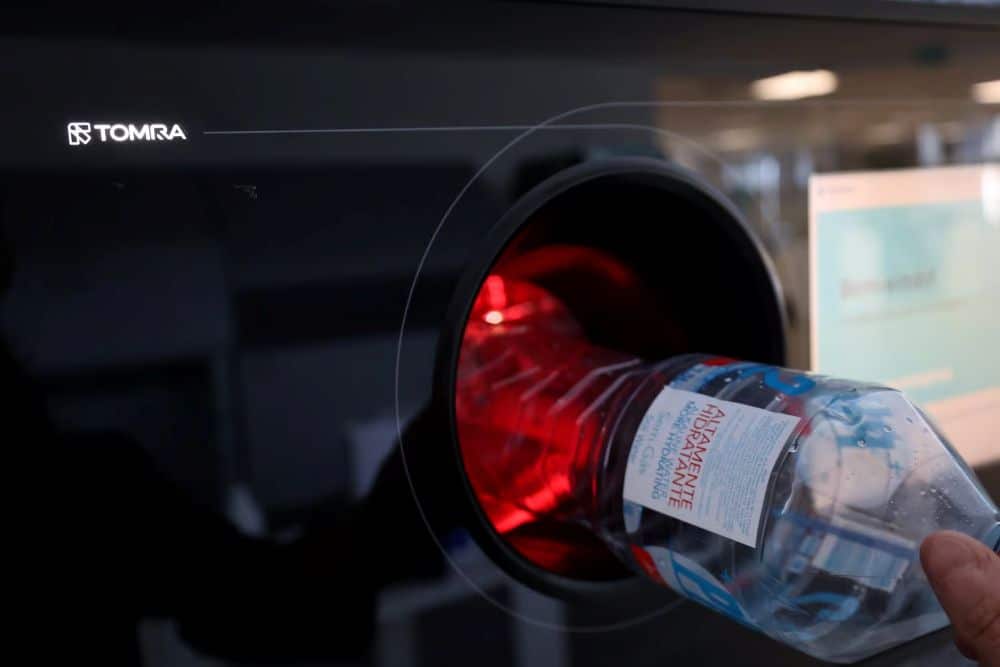
The technological infrastructure powering Portugal’s new system is provided by TOMRA Collection, a global leader in the sector. With over 50 years of experience, operating more than 91,000 reverse vending machines internationally and collecting over 53 billion containers annually, the Norway-based company’s proven solutions are central to the Portuguese transition.
Paulo Borges, Managing Director at TOMRA Collection Portugal, emphasized that the system is a transformative step toward a cleaner environment. He noted that TOMRA’s technology provides fast, convenient, and reliable solutions for consumers, retailers, and system operators alike.
Transition Period for a Smooth Market Launch
Legislators have carefully prepared for the logistical challenges of this market transition. Stores designated as return locations are granted a 120-day transition period to meet the new operational requirements and fully prepare their return infrastructure.
Furthermore, pre-DRS products (those without the deposit marking) can still be sold for a limited time to clear existing inventory:
-
Producers have up to 60 days to sell these products.
-
Wholesalers and distributors have up to 90 days. After the 120-day mark, only fully DRS-compliant, branded products will be permitted on the market.
A Lighthouse Model for Southern Europe
According to Thomas Morgenstern, Vice President of Public Affairs – Head of Europe and Central Asia at TOMRA, the launch of Portugal’s DRS sends a powerful message across the Iberian Peninsula. He underscored that this move proves circular economy solutions for drink containers are shifting from policy ambitions to operational realities. Portugal is poised to serve as a “lighthouse model” for the entire region, demonstrating how to achieve high-performing collection and recycling rates at scale while significantly reducing both terrestrial and marine litter.
The reviews have arrived
The environmental association “Zero” (Associação Sistema Terrestre Sustentável) welcomed the introduction of the scheme for plastic and metal drink containers but sharply criticized the exclusion of glass. While the NGO views this omission as a missed opportunity, the Portuguese government points to underlying technological and economic challenges behind the decision.
The Stance of the Zero Association: “A Major Flaw in the System”
Susana Fonseca, a leader at the Zero association, emphasized in a statement to the Lusa news agency that the organization has been fighting for the system’s implementation since the parliamentary debates of 2018 (noting it was originally slated to launch in 2022). Although they consider the current launch an important and successful step, Fonseca argues that the system’s main shortcoming is that it applies exclusively to single-use products rather than reusable ones, and completely omits glass.
“We had every reason to include glass in the system. Unfortunately, a political decision was made that did not follow what had previously been approved,” Fonseca explained, adding that the original legal framework had accounted for glass packaging. According to the environmental expert, the government’s subsequent decision to alter the law previously passed by the Assembly of the Republic (the Portuguese parliament) is distinctly detrimental to the country.
Recycling Targets at Risk: Why Glass is Critical
Glass is a highly durable material that is 100% and infinitely recyclable. Environmentalists have pointed out a stark paradox: while Portugal is currently failing to meet its mandatory glass recycling targets, the domestic industry is forced to rely on raw material imports for glass production.
According to Zero, integrating glass into the deposit return system would have been a logical and essential step. Since a significant portion of bottled beverages (such as beer and wine) is sold in glass packaging, the motivational power of the DRS—namely, the financial incentive of a refundable deposit—could have radically increased the collection rate. Susana Fonseca warned that by omitting glass from the scheme, it is highly likely that Portugal will continue to fall short of the European recycling quotas assigned to this specific material in the future.
The Ministry’s Response: Economic Analysis and Technical Considerations Required
In response to the criticism, Maria da Graça Carvalho, Portugal’s Minister of Environment and Energy, addressed the issue publicly. The government remains open to the future integration of glass, but the minister stressed that such a decision must be preceded by a rigorous cost-benefit analysis.
“It may make sense to have a deposit and return system for glass, but from an economic standpoint, we need to calculate very precisely what advantages this would bring compared to the system currently in use,” the minister stated.
Maria da Graça Carvalho also highlighted the significant technological constraints associated with glass handling. While the reverse vending machines deployed in April (which collect plastic bottles and metal cans) are capable of immediately compacting or crushing the deposited packaging to save space, this mechanism cannot be easily applied to glass. The mechanical processing and storage of glass require a specialized, entirely different system and logistics network to handle weight and breakage safely.
The government’s current position is that it is not yet clear whether automated reverse vending for glass would offer a substantial, quantifiable advantage over the traditional selective glass collection containers already in place. Before the state drastically alters its infrastructure to improve poor recycling metrics, it asserts that it must thoroughly understand the economic and operational mechanics of the process.
References and Sources:
