


If you like our site, mark us as a preferred source on Google — so you’ll see our articles more often in search!
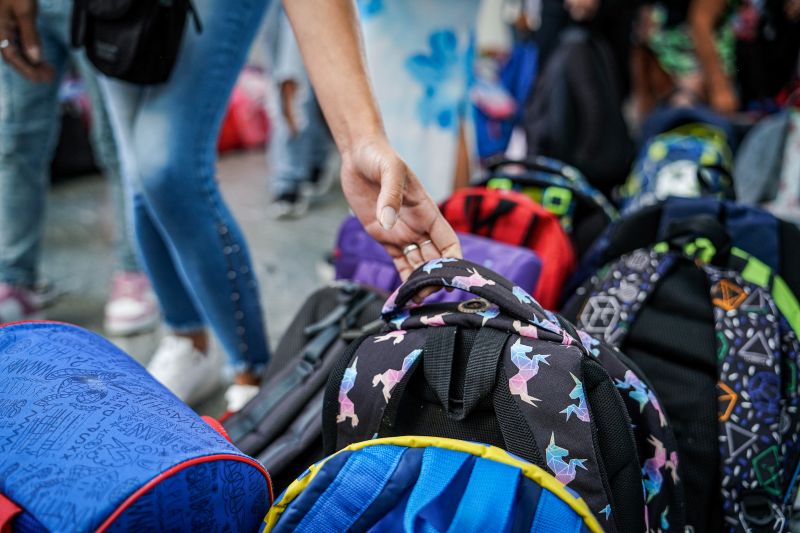
★Mark us as a preferred sourceThis year’s school bag collection broke every previous record: MiReHu Nonprofit Kft. organised its school bag and stationery drive for the sixth time, and a total of 349 school bags were donated – the highest figure in the programme’s history. The first children received their packages in person at a press conference held shortly before the start of the school year: cleaned, filled with stationery and ready to use.
The initiative runs on two tracks at once. It is a social programme, giving tangible help to families for whom a new backpack and a full set of school supplies represents a serious financial burden at the beginning of September. But it is equally a waste prevention and reuse programme, because donated bags in good condition do not end up in a household waste bin – they go back into service for the purpose they were made for.
A record number of donations arrived through this year’s school bag collection
The 349 bags did not come from a single large donor. The total is the sum of many smaller contributions and a few notably large ones. The Mayor’s Office, municipal companies, local businesses and organisations all contributed to the result.
This year’s largest single donor was Bükk TISZA Sziget, while the permanent implementation partner of the programme is the Supersum Public Benefit Foundation. That partnership matters more than it might appear: a drive like this is not just a collection point. It involves logistics, storage, sorting and targeted distribution – and that requires a predictable partner structure that returns year after year.
Cleaning, filling, delivering
Donated bags do not travel directly from donor to child. MiReHu staff cleaned every item and then filled each one with stationery, so the packages would reach families genuinely ready for use. This step is what turns a collection into a usable donation: a cleaned, restocked backpack is not a hand-me-down, it is a complete back-to-school kit.
Distribution runs through two channels. In Miskolc the packages are handed out with the involvement of MESZEGYI, the city’s social and child welfare institution, while in the surrounding rural settlements local municipalities coordinate the delivery. This matters because identifying genuine need requires local knowledge – municipalities and social institutions know exactly where the support will make a difference.
The first packages were handed over at the press conference
The press conference was not only about presenting results. It was also the first stop of this year’s donation programme, where the first children personally received their backpacks filled with school supplies.
Speakers at the event included József Tóth-Szántai, Mayor of Miskolc; Roland Ladányi, Managing Director of MiReHu Nonprofit Kft.; Péter Attila Gúr, Director of MESZEGYI; Katalin Bernasconi-Bús, President of the Supersum Public Benefit Foundation; and Dr Péter Gecse, representative of Bükk TISZA Sziget. All of them highlighted the importance of joint action and corporate social responsibility, and the fact that the programme delivers real, measurable help before the school year begins.
Why is the start of the school year so expensive?
Back-to-school season is one of the hardest points in a family budget. A good-quality, ergonomic backpack that lasts several years is a significant expense on its own, and on top of it comes the list of notebooks, pens, drawing materials, PE kit and other compulsory supplies. In households with more than one school-age child, the September cost multiplies.
That is exactly why the logic of this programme works. It does not distribute money; it delivers the specific product a family needs, at the precise moment when the need is greatest.
Reuse sits at the top of the waste hierarchy
The order of the waste hierarchy is well known: prevention, preparing for reuse, recycling, other recovery and – as a last resort – disposal. Material recycling, which receives most of the public attention, ranks only third.
For a backpack in good condition, recycling is in fact the least effective option. Most bags are a combination of several materials: a polyester or nylon shell, foam padding, plastic buckles, a metal zip, sometimes PVC-coated surfaces. This multi-material, glued and woven construction is highly unfavourable from a separation point of view – there is essentially no established, economically viable technology for turning a worn-out school bag back into valuable secondary raw material. Anything that does not go into reuse is therefore likely to head towards energy recovery or landfill.
By contrast, if the same bag serves another child for two or three more school years, it is not only the moment of becoming waste that is postponed. The production of a new product is avoided altogether. The environmental burden avoided appears not at the waste treatment stage but much earlier – in raw materials, energy, water, transport and packaging.
A product still in use is worth more than well-sorted waste
This is one of the central messages of the MiReHu programme: sustainability is not only about what we put in the bin and which bin we choose. It is at least as much about what we prevent from becoming waste in the first place.
An object that has finished its job in one household but remains physically fit for its function for years to come is in the worst possible place if it is thrown away. Good practice is what happened here: collection, sorting by condition, cleaning, preparation, then targeted handover to someone who needs it. This is a textbook case of preparing for reuse – quite literally.
MiReHu Nonprofit Kft. operates as a waste management service provider, so the programme does not sit outside its everyday activity – rather the opposite. Social responsibility and sustainability point in the same direction here: what has become surplus for one household becomes real help and real joy for another at the start of a new school year.
This year’s record volume also shows that there is genuine willingness to take part. In Miskolc and the wider region, many again considered it important to make the start of the school year easier for children in need through collective effort – and, at the same time, to make sure a still-usable object does not end its life as waste.
The practice built up over six years, together with this year’s 349 bags, points to a clear conclusion: initiatives like this work when there is organised backing, a stable partner network and a clear distribution system behind them. All three elements were in place this time.
Frequently asked questions about this year’s school bag collection
How many school bags were donated this year?
A total of 349 school bags were donated, the highest figure in the programme’s history. MiReHu Nonprofit Kft. organised the drive for the sixth time this year. Contributions came from the Mayor’s Office, municipal companies, local businesses and organisations, so the record is the sum of many smaller donations plus a few particularly large ones.
Who was this year’s largest donor?
Bükk TISZA Sziget was the largest single donor this year. The permanent implementation partner of the programme is the Supersum Public Benefit Foundation, which supports organisation, storage and the distribution process. Alongside them, the Mayor’s Office, municipal companies and numerous local businesses and organisations contributed to the record volume of donations.
How do the donations reach children in need?
Distribution runs through two channels: in Miskolc with the involvement of MESZEGYI, and in rural settlements through local municipalities. This matters because identifying genuine need requires local knowledge. MiReHu staff clean each bag beforehand and fill it with stationery, so families receive a complete, ready-to-use back-to-school package rather than a bare item.
Why is recycling a worn-out school bag not an effective solution?
Because bags are multi-material products: a polyester or nylon shell, foam padding, plastic buckles, a metal zip and sometimes PVC-coated surfaces. This glued and woven construction is highly unfavourable for separation, and there is no established, economically viable technology for producing valuable secondary raw material from it. Reuse is therefore considerably more effective than material recycling.
What does preparing for reuse mean in practice?
It means collection, sorting by condition, cleaning, preparation and targeted handover. In the MiReHu programme, donated bags are cleaned and then filled with stationery before being handed over, so they return to service as full-value products. In the waste hierarchy this step comes directly after prevention, ranking above recycling.
Who spoke at the press conference?
Speakers included József Tóth-Szántai, Mayor of Miskolc; Roland Ladányi, Managing Director of MiReHu; Péter Attila Gúr, Director of MESZEGYI; Katalin Bernasconi-Bús, President of the Supersum Public Benefit Foundation; and Dr Péter Gecse, representative of Bükk TISZA Sziget. The event was also the first stop of this year’s donation programme, where the first children received their packages.
Source:


