


If you like our site, mark us as a preferred source on Google — so you’ll see our articles more often in search!
★Mark us as a preferred sourceThe SustainaCycle project sets out to answer a simple question: how can more plastic, textile and electronic waste be brought back into the loop – not through giant new plants, but through smart collection solutions designed around people’s everyday habits? With support from the Interreg Central Baltic programme, partners from Estonia, Finland, Latvia and Sweden have been working together since May 2025, and by autumn 2026 the first pilot collection points are up and running. We looked at what the project is about, which smart technologies it uses, and what Hungary can learn from it.
In short: The SustainaCycle project is a €2.64 million EU cooperation that uses smart and mobile collection points to increase the reuse and recycling of plastic, textile and electronic waste in Estonia, Finland and Latvia. The demo sites can collect up to 40 tonnes of waste a year, at least 60 per cent of which is to be sent for reuse or material recycling.
What is the SustainaCycle project trying to achieve?
The project falls under the “Joint circular economy solutions” objective of the Interreg Central Baltic 2021–2027 programme. Its reference number is CB0700374, it runs from 1 May 2025 to 30 April 2028, and its total budget is €2,644,194.50. The lead partner is the Viimsi Rural Municipality Government in Estonia.
The partnership is deliberately mixed:
- Latvia: Valmiera Development Agency and the waste management company ZAAO,
- Estonia: Viimsi Municipality and the Estonian Circular Economy Industries Association,
- Finland: LAB University of Applied Sciences,
- Sweden: Sustainability InnoCenter.
The project focuses on three waste streams: plastics, textiles and electronic waste. That choice is no accident. All three contain valuable materials, all three often end up in mixed waste, and for all three the quality of collection decides whether they become raw material again.
The work rests on three pillars: piloting smart and mobile collection, mapping waste chains and connecting them with companies that can recycle or reuse the material, and awareness campaigns explaining how and why to sort better.
Three countries, three collection models
One of the most interesting features of the project is that it does not try to install a single “smart bin” everywhere. Each country tests a model adapted to local conditions:
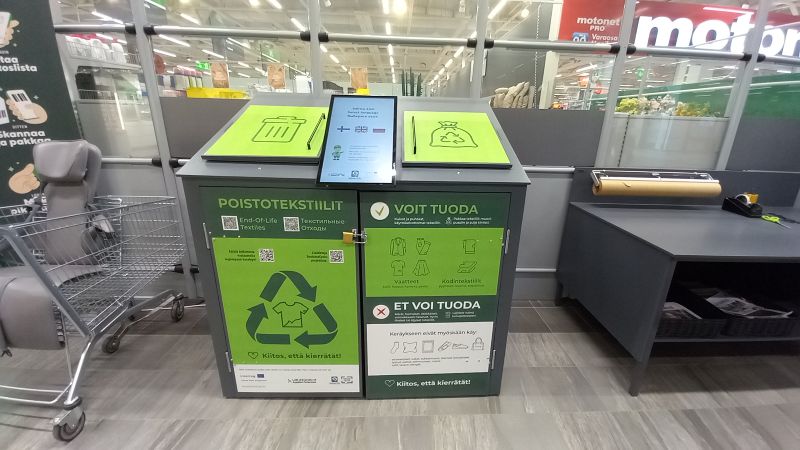
- Finland, Imatra: a digitally guided textile sorting station in the entrance hall of the Prisma hypermarket, from 15 September 2026 to 30 April 2027. The station was built by LAB University of Applied Sciences.
- Estonia, Viimsi: three self-service recycling points, called Ringpunkt, are being set up.
- Latvia, Vidzeme region: ZAAO is introducing five mobile collection points that travel between communities on a set schedule.
The three models answer three different situations. The hypermarket collects where people already go. The self-service points are available continuously in one place. The mobile points target sparsely populated areas where a permanent facility would not pay off.
Smart solutions up close: how the Imatra textile station works
The best-documented element of the project so far is the textile sorting station in Imatra. Using it takes a few steps:
- Residents bring clean textiles that are no longer in use, such as worn-out items.
- A touch screen asks a few questions about the condition of the textiles.
- Based on the answers, the system decides whether the material is suitable for textile recycling or belongs in the residual waste compartment.
- Only the selected compartment opens: both are secured with electronic locks, and a light indicator marks the right one.
- After depositing, users can rate their experience and leave feedback on the screen.
The service is free. The station is emptied by SaimaanVirta ry, a non-profit employment and circular economy organisation that helps people into work through training, coaching and recycling activities, and that also collects, sorts and recycles textiles at its own premises. Fill-level sensors built into the station automatically notify its staff when a container is approaching capacity.
What actually makes it smart?
The Imatra station is not smart because it has a screen, but because it tackles three old problems at once:
- The decision is made at the moment of deposit. At most textile containers, residents decide alone what goes in, and mistakes only surface later during sorting. Here the system asks exactly where the mistake would happen.
- The lock prevents misuse. Because only the selected compartment opens, it is harder to throw in the wrong material, and the collection point teaches while it collects.
- Emptying follows actual need. Thanks to the sensors, crews do not have to visit a half-empty container on a fixed schedule, and the risk of an overflowing, unusable station drops.
The pilot tests whether digital guidance helps people separate recyclable textiles from residual waste more accurately, and also assesses user experience, station operation and collection efficiency.
We have covered similar thinking on dontwasteit.hu before: smart bins in Hangzhou give residents instant feedback, and AI-supported textile sorting aims to fix quality problems further down the chain. SustainaCycle is more modest, but it builds on the same insight: good sorting is not a matter of discipline, but of well-designed systems.
Data, a game and a campaign: smart is not just hardware
The project’s “soft” tools are at least as interesting as the collection points.
- Data mapping: in April 2026 the project published the Report of Current Data Collection Tools for Waste Flows, an overview of the mapping, analysis and modelling tools used to collect waste flow data around the Baltic Sea. The aim is to strengthen regional cooperation and data alignment.
- The SampoSort game: LAB developed an educational textile sorting game in which players decide whether each item can be repaired, donated or sent for textile recycling. It is available in English, Estonian, Finnish, Latvian and Swedish, and its message is simple: not every unwanted textile is waste.
- Workshops and business programmes: in February 2026 a hybrid workshop in Lappeenranta brought together participants from four countries to discuss communication that boosts recycling, and businesses in Valmiera learned about reducing waste in production. University students also contributed ideas to the Imatra pilot.
- Campaign: in October 2026 the project launched its “Less, but Better” campaign, encouraging smarter everyday choices.
What do 40 tonnes and 60 per cent really mean?
The project aims for its demo sites to collect up to 40,000 kilograms of plastic, textile and electronic waste a year together, with at least 60 per cent of it going to reuse or recycling.
To be honest, 40 tonnes is a small amount. Spread across the nine planned collection points (one Imatra station, three Ringpunkts, five mobile points), it comes to four or five tonnes per point per year. So the project is not really about tonnes; it is about giving the region’s municipalities and waste operators a tested, data-backed model that can be adopted elsewhere.
The 60 per cent target, however, carries real weight. Collection is not the same as recycling – a point we explored in our analysis of the ReSTRAND Vintage Market and the textile waste hierarchy. That is why the project links collection with companies that can actually process the material.
For electronic waste, separate collection is also a safety issue. Lithium batteries hidden in small devices can start fires in mixed waste, as we recently explained in our piece on hidden lithium battery fire hazards. Every collection point that brings collection closer to residents helps reduce that risk.
What can Hungary learn from this?
SustainaCycle is not a Hungarian project, but its lessons apply directly.
- Textile collection quality is decided at the container. MOHU operates around 3,500 textile containers and is now offering free containers for closed sites, partly because littering and rummaging remain recurring problems at street containers. Guided sorting, locks that open only the right compartment and fill-level sensors could help here too.
- Mobile collection suits small settlements. The Vidzeme model, in which the collection point comes to residents, would fit Hungary’s areas of small villages, where the nearest recycling centre is far away. Municipal collection events are one existing tool: they have recently returned under MOHU’s new system.
- E-waste collection lags behind. According to Eurostat’s estimate, Hungary collected only 8.2 kilograms of e-waste per person in 2024, well below the EU average – as covered in our guide to Eurostat’s e-waste figures.
- Reuse first, then recycling. SampoSort’s message that repair and passing items on come before recycling matches the waste hierarchy.
- Cooperation is key. In Imatra a university, a retail chain and a social enterprise work together. The same set-up could work in Hungary, especially while preparing for the textile EPR scheme due by 2028.
What comes next?
The Imatra pilot runs until April 2027, and the project as a whole ends in April 2028. The most interesting results are still ahead: whether digital guidance really improves sorting accuracy, what it costs to operate a smart collection point, and how residents respond. If the answers are positive, SustainaCycle’s models could serve as a blueprint beyond the Baltic Sea region – including for Hungarian waste management.
FAQ: the SustainaCycle project
What is the SustainaCycle project?
The SustainaCycle project is an Interreg Central Baltic cooperation running from 2025 to 2028 that aims to increase the reuse and recycling of plastic, textile and electronic waste. Estonian, Finnish, Latvian and Swedish partners are piloting smart and mobile collection points, mapping waste chains and running awareness campaigns. Its total budget is €2.64 million.
Where are the SustainaCycle pilot collection points?
The pilot collection points are in Finland, Estonia and Latvia. Imatra has a digitally guided textile sorting station in a hypermarket entrance hall, Viimsi municipality is setting up three self-service Ringpunkt recycling points, and in the Vidzeme region ZAAO runs five mobile collection points on a fixed schedule. The Swedish partner, Sustainability InnoCenter, has no pilot site.
How does the smart textile sorting station in Imatra work?
A touch screen asks users a few questions to decide whether their textiles are suitable for material recycling or belong in the residual waste compartment. Only the selected compartment, secured by an electronic lock, opens, and a light marks its edge. Fill-level sensors alert SaimaanVirta, which empties the station, and the service is free to use.
How much waste can the project collect, and what recovery rate does it target?
Together, the demo sites can collect up to 40,000 kilograms, or 40 tonnes, of plastic, textile and electronic waste a year. The goal is to send at least 60 per cent of it to reuse or recycling, reducing demand for virgin materials. The volume is small; the project’s real value is a collection model others can adopt.
What is the SampoSort game?
SampoSort is an educational textile sorting game developed by LAB University of Applied Sciences. Players decide whether each textile item can be repaired, donated for reuse or sent for textile recycling. The game is available in English, Estonian, Finnish, Latvian and Swedish, and it teaches that not every unwanted textile is waste.
What can Hungary learn from the SustainaCycle project?
Above all, that collection quality is decided at the moment of deposit. Guided sorting, locks that open only the right compartment and fill-level sensors could improve the cleanliness of Hungarian textile containers too. Mobile collection points running on a schedule could help with e-waste collection where the nearest recycling centre is far away.
🔗 Official sources and references: 👉
- Interreg Central Baltic: SustainaCycle project page
- LAB University of Applied Sciences: SustainaCycle
- Central Baltic: Test your textile sorting skills with the new SampoSort game (31 August 2026)
- LAB: Report of Current Data Collection Tools for Waste Flows (PDF)
Consistent structure, quick answers: every article is built so that both readers and AI search tools can find the key points easily. Our content is produced with the help of AI tools and reviewed by our editor.


