
'/%3E%3C/svg%3E)



If you like our site, mark us as a preferred source on Google — so you’ll see our articles more often in search!
★Mark us as a preferred sourceOn June 12, 2025, a large-scale pilot project was launched across four major regions in western France, marking the return of reusable packaging to retail store shelves. Coordinated by Citeo, the “ReUse” initiative is the result of a collaborative effort driven by social and environmental goals to reduce waste volumes and preserve natural resources. Currently in its active experimental phase, this optimized and centralized system makes environmentally conscious shopping accessible to sixteen million consumers while purposefully simplifying user habits and daily routines.
Regional Rollout and Scope of the ReUse Initiative
The implementation of the reusable packaging system is based on a highly structured regional strategy. Geographically, the pilot program focuses on the French “Grand Nord-Ouest” (Great North-West) territory, which encompasses four distinct regions: Brittany, Normandy, Pays-de-la-Loire, and Hauts-de-France. These specific areas were selected based on the 2025 assessment of the “EncoRE plus” call for reuse projects, primarily due to their previously demonstrated proactive dynamism and high commitment in this environmental sector.
The extensive reach of the network is demonstrated by the fact that today, more than 360 retail stores offer products in reusable packaging. Through the ReUse initiative, Citeo has successfully integrated around one hundred different industry and civil stakeholders into a unified platform—including brands, distributors, glassmakers, operators, and industry federations. Currently, around fifty brands and distributors are actively participating in the experimental phase, collectively making nearly 170 different product references available to consumers on the shelves. The ultimate objective is to establish a national, shared reuse system for supermarket food packaging, built upon the foundation of two years of collective planning and industry-wide reflection.
Quantitative Results from the First Twelve Months of the Trial
During the first twelve months of the pilot program, exact and quantifiable data was collected, providing a clear and precise picture of the project’s efficiency and its reception among consumers. According to the official statistics, the operation of the system yielded the following results:
-
A total of 518,000 deposit-based (reusable) products were sold. This indicates that within the participating categories, reusable alternatives accounted for an outstanding 80% of the total products sold.
-
Consumers successfully returned 108,000 pieces of packaging to the designated collection points.
-
The average return rate stood at 24% during this period. However, in the most highly engaged retail locations, this metric surged to an impressive 60%.
-
Regarding the overall user experience, participating consumers awarded the initiative a rating of 8.6 out of a maximum of 10 points, indicating an exceptionally high level of satisfaction with the new sustainable shopping procedure.
Standardized “R-Cœur” Packaging and Innovative Product Range
To optimize the complex logistical processes, Citeo developed a standardized family of reusable packaging called “R-Cœur” (R-Heart), which is openly accessible to all participating actors on an open-source basis. The primary goal of this standardization is to create an unprecedentedly large, shared packaging pool among market players. This strategic move significantly facilitates and optimizes every critical step of the cycle: collection, transportation, sorting, and industrial washing.
The standardized product range currently includes 7 different packaging references. During 2025, the first items to appear in stores were the 1-liter wide-neck glass bottles (specifically designed for storing milk, fruit juices, and soups), alongside 75-centiliter amber glass bottles primarily used for beer. In the second wave of the rollout, scheduled for 2026, the product lineup will be further expanded to include narrow-neck bottles, various types of jars, and standard wine bottles.
Collection Infrastructure: Automated and Semi-Manual Return Systems
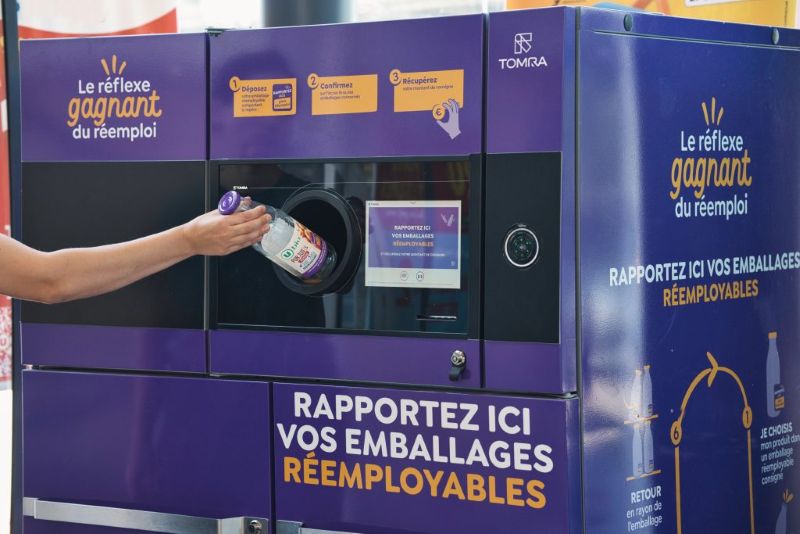
The fundamental prerequisite for the project’s operational success is the establishment of a highly accessible collection infrastructure. Six large-scale distributor networks are participating in the pilot program: Carrefour, Coopérative U, Intermarché, Monoprix, E. Leclerc, and La Brasserie du Bout du Monde. Within these retail networks, specialized collection equipment has been installed, provided by five selected suppliers following a rigorous tender process: Bocoloco, Lemon Tri, Noww, The Keepers, and Tomra.
The return process is executed through two main technological solutions within the stores:
-
Automated equipment: Customers can return their empty packaging through a self-service system using reverse vending machines, which immediately scan and safely store the items for the subsequent logistical phases.
-
Semi-manual option: In this scenario, the return process is assisted by a store employee who registers the packaging using a handheld barcode scanner.
Upon completion of the return process, customers receive their pre-paid deposit back. The deposit amount is set at 10 euro cents for smaller format packaging and 20 euro cents for larger capacity bottles. To support consumer education, Citeo actively assists industrial players and distributors in creating a uniform and easily understandable customer journey for the 16 million citizens involved.
Logistics, Washing, and Central Coordination
The most critical element of the reuse chain (the “ReUse by Citeo” loop) is centralized logistics combined with industrial washing that meets stringent quality and hygiene standards. To minimize the operational costs and risks associated with launching the system, the collected packaging is transported to centralized consolidation sites and dedicated washing facilities. The cleaning process receives prioritized attention regarding its technical, sanitary, environmental, and economic performance. Currently, two modern washing centers handle this task: the “Bout’ à Bout'” facility near Carquefou, and the “Haut la consigne” center in the Lille region.
A single centralized service provider, “GO! Réemploi,” is responsible for the daily operation of the entire regional system. The company won the mandate through Citeo’s tender process for a two-year cycle spanning from February 2025 to February 2027. The central provider’s responsibilities are structured in three main pillars:
-
Managing the entire packaging pool inventory across all types (standard “R-Cœur,” custom “iconic” designs, and bulk network packaging).
-
Organizing the complete operational chain, from collection, transportation, and sorting, through to post-cleaning redistribution back to market players.
-
Operating a dedicated and secure Information System to ensure complete data-driven tracking of the process and maintain the financial stability of the closed-loop loop.
References and Sources:
-
Original source article and data: Citeo Le Mag – Le réemploi se déploie dans 4 régions françaises
-
Official government regulatory framework (Circular economy and waste reduction): Loi anti-gaspillage économie circulaire – Ministère de la Transition écologique (gouvernement.fr)
Consistent structure, quick answers: every article is built so that both readers and AI search tools can find the key points easily. Our content is produced with the help of AI tools and reviewed by our editor.
