





If you like our site, mark us as a preferred source on Google — so you’ll see our articles more often in search!
★Mark us as a preferred sourceIn August 2026, Nestlé and Viva Energy announced the successful completion of a large-scale proof-of-concept project that could revolutionize sustainable food packaging in Australia. The initiative focused on processing soft plastics pyrolysis oil and transforming it into food-grade packaging materials.
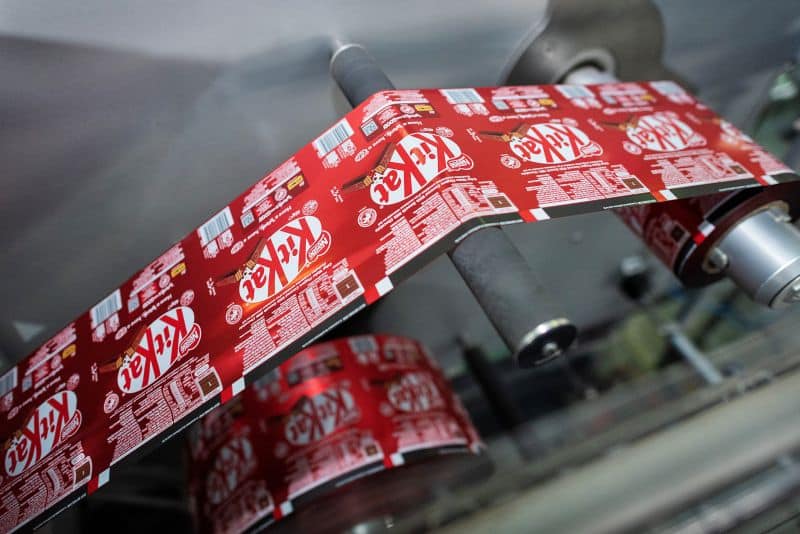
The implementation of recycled plastic packaging represents a significant step forward, building on a previous 2022 collaboration between the two companies that pioneered the use of sustainable wrappers for the 4 Finger KitKat bars. This latest trial, however, elevated the initiative to an industrial scale using a mass-balance approach, proving that existing industrial infrastructure can be successfully adapted for chemical recycling.
The Technological Background of recycled plastic packaging
The core of the initiative was the Viva Energy Hub in Geelong, Victoria. The Geelong Refinery is currently the only facility in Australia with the necessary refining, processing, and polymer manufacturing capabilities to produce polypropylene locally. As part of the proof-of-concept, the refinery processed more than 9.5 tonnes of soft plastics pyrolysis oil during 2025.
This advanced technological process resulted in the production of 5 tonnes of food-grade recycled polypropylene (rPP). This raw material was then processed through a completely localized Victorian downstream supply chain. In partnership with Taghleef Industries and Amcor, Nestlé manufactured exactly 7 million custom wrappers in March 2026, which were used for a limited retail run of KitKat 4 Finger chocolate bars across the nation.
International Certifications and the Supply Chain
A major achievement of the project was that the manufactured recycled plastic packaging successfully demonstrated compliance with the ISCC PLUS (International Sustainability and Carbon Certification Plus) mass-balance standard. This certification guarantees the transparent tracking of sustainable materials throughout the entire production chain. However, because suitable local supply is not yet available at commercial scale in Australia, the plastic pyrolysis oil feedstock used for this specific trial had to be imported from the United States.
Industry Leadership and the Role of Policy
The official launch event, held in Geelong on August 14, 2026, brought together industry leaders, government representatives, and delegates from the Australian Council of Recycling (ACOR) and Soft Plastics Stewardship Australia (SPSA).
Bill Patterson, Executive General Manager of Energy and Infrastructure at Viva Energy, highlighted the importance of domestic capabilities during the panel discussion: “Geelong Refinery is Australia’s last remaining site with this level of refining and processing capability and its only manufacturer of polypropylene. We have proven the use of soft plastics pyrolysis oil as a feedstock and demonstrated how existing industrial infrastructure can be adapted to support a circular plastics economy. With the right policy settings, including for collection and processing of soft plastics, we could take advantage of the refinery’s capacity to process a lot more.”
Andrew Lawrey, General Manager of Confectionery at Nestlé Oceania, added that industry collaboration is vital for the widespread adoption of circular solutions: “This collaboration demonstrates what’s possible when industry works together to tackle packaging challenges and accelerate the transition to a more circular economy. Soft plastic should be treated as a key material, not a waste stream. Building local circular capability will strengthen supply resilience, support manufacturing, and keep valuable materials in the Australian economy.”
Future Prospects and the Circular Economy
The project partners—Nestlé, Viva Energy, Alterra, Amcor, and Taghleef Industries—agreed that scaling this model requires stronger policy support. Establishing a commercial-scale circular economy is highly dependent on developing robust domestic collection and sorting infrastructure, alongside the implementation of an effective Extended Producer Responsibility (EPR) scheme to provide investment certainty.
FAQ
What product used the recycled plastic packaging in this project?
The recycled plastic packaging was used for a limited retail run of Nestlé’s 4 Finger KitKat chocolate bars.
How much pyrolysis oil was processed at the Geelong Refinery?
The refinery processed more than 9.5 tonnes of soft plastics pyrolysis oil during the proof-of-concept in 2025.
How many wrappers were produced during the trial?
A total of 7 million custom KitKat wrappers were produced in March 2026 from the processed materials.
Sources:
