





If you like our site, mark us as a preferred source on Google — so you’ll see our articles more often in search!
★Mark us as a preferred sourcePlastic might be the very last ingredient you would ever consider adding to a dessert recipe, as it is widely known to be inedible. However, a dedicated team of researchers in the United States is utilizing specialized, programmed microbes to transform discarded PET bottles into edible proteins and flavoring molecules. This revolutionary process, which ultimately produces a cookie from plastic waste, could not only mitigate environmental pollution but also sustain human life in disaster-stricken zones on Earth and during long-duration deep-space missions.
As the global community struggles simultaneously with mounting plastic pollution and escalating concerns regarding long-term food security, scientists are actively looking for innovative ways to turn one massive problem into a functional solution for the other. A research team hailing from Southern Illinois University (SIU) Carbondale has taken on this challenge, putting highly specialized microbes to the ultimate test to transform everyday plastic waste into edible, nutritious food for human consumption.
The core of this research revolves around one of the most common forms of plastic on the planet: polyethylene terephthalate, commonly known as PET. This is the exact material predominantly used to manufacture soda and water bottles globally. At a molecular level, PET contains an abundance of carbon atoms that, under the right conditions, can be completely rebuilt into structural proteins. While this molecular rebuilding could theoretically be achieved in a laboratory using harsh chemical reactions and toxic solvents, the researchers opted for a much simpler, significantly more eco-friendly solution: they outsourced the heavy lifting to microbes.
Associate Professor Lahiru Jayakody, a key figure in the project, explained the fundamental logic behind the initiative: since plastic is entirely carbon-based, and food is also carbon-based, bridging the gap between the two makes scientific sense. Jayakody emphasized that “microbes are very clever,” allowing scientists to harness their natural biological traits to solve complex problems that humanity has created.
Using Microbes as Miniature Food Factories
The scientific community has long relied on microbes, particularly various strains of yeast, to act as miniature biological factories capable of producing a wide array of specific molecules. A prime historical example is insulin: while it used to be extracted exclusively from animal pancreases, today, engineered yeast is programmed to synthesize it efficiently.
Following this well-established biochemical path, Jayakody and his graduate student, Sandhya Jayasekara, successfully programmed a variety of yeasts—including common baker’s yeast found in grocery stores—to metabolize the molecules present in broken-down plastic and agricultural waste. By doing so, they convert these base elements into vital dietary components such as proteins, vitamins, and flavorings, providing all the necessary building blocks for a cookie from plastic waste.
The Technology: Oxidative Hydrothermal Dissolution
Before the programmed yeast can work its magic, the raw materials must be made accessible and digestible for the microbes. The researchers take raw PET plastic alongside discarded agricultural biomass—specifically corn plant stalks and leaves—and process them through a proprietary technique known as oxidative hydrothermal dissolution. This innovative method was developed by SIU Carbondale Geology Professor Ken Anderson.
The dissolution process utilizes a precise combination of water and oxygen subjected to extremely high temperatures and immense pressure. This harsh environment effectively breaks down the incredibly tough structural bonds of the plastic and plant matter into smaller, microbe-accessible pieces.
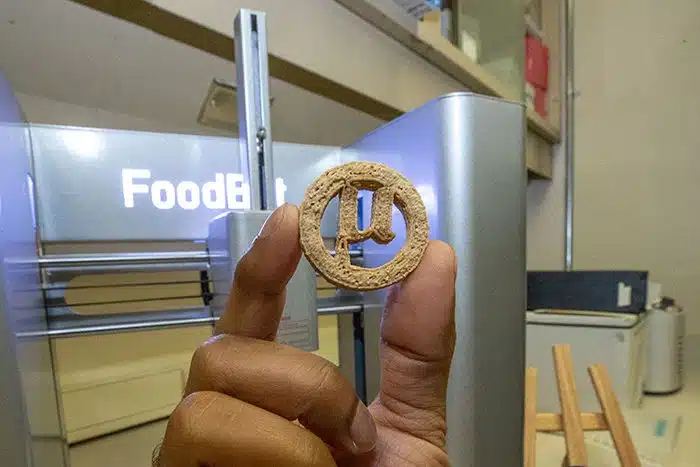
These resulting fragmented molecules are then introduced as a food source to the engineered yeasts, which biologically reform the pieces into an entirely new set of food ingredients, including essential proteins, fats, and organic acids. In the final step of the production line, the researchers introduce fiber, starch, and a sweetener into the biological mixture. This dough-like substance is then precisely extruded through a 3D printer. The final protein-rich treats are shaped like the Greek letter mu and have been appropriately dubbed µBites (pronounced “microbites”).
Safety, Taste, and Future Outlook
The most pressing question for most consumers is whether this product is actually safe to eat. Although empirical data and chemical analyses show that µBites are entirely safe for human consumption, the research team is currently awaiting formal institutional approval before they can conduct official, large-scale taste tests with human subjects. For the time being, the cookies have received exceptionally high marks regarding their aroma, with the majority of preliminary participants agreeing that they would be more than willing to eat the cookies in emergency or resource-limited situations.
To elevate µBites into a product that general consumers might actively choose under normal circumstances, Jayasekara engineered specific yeast strains capable of producing highly desirable food additives. For instance, the modified baker’s yeast can now synthesize natural vanilla flavoring directly from plant biomass. Furthermore, a different specialized strain possesses the ability to convert ethylene glycol—a direct byproduct of PET plastic—into beta-carotene, a vital nutrient that the human body naturally converts into Vitamin A.
This groundbreaking research—which is slated to be presented at the fall meeting of the American Chemical Society (ACS) in Chicago between August 23-27, 2026—was heavily funded by the NASA Deep Space Food Challenge and a National Science Foundation (NSF) Faculty Early Career Development Program (CAREER) grant.
While the technology was initially aimed at sustaining deep-space exploration, such as prolonged missions on submarines or establishing human colonies on the Moon and Mars, the implications for Earth are critical. Global food demand is projected to skyrocket by 35 to 56 percent by the year 2050, potentially placing up to 30 percent of the global population at risk of severe hunger. Professor Jayakody firmly believes that the strategic application of microbes is the ultimate answer to this impending crisis, hoping that µBites will be ready for widespread public consumption within just a few years.
Frequently Asked Questions
What exactly is a cookie from plastic waste made of?
The cookies, officially known as µBites, are primarily formulated from broken-down PET plastic bottles and discarded agricultural biomass, such as corn stalks, which are processed and then biologically converted by specialized, engineered yeast.
Are these plastic-derived cookies genuinely safe to eat?
Current chemical analyses and laboratory data indicate that µBites are entirely safe for human consumption. However, the research team is currently pending formal institutional approval to begin official public taste tests.
Why are scientists investing resources into making food from plastic?
Supported by the NASA Deep Space Food Challenge, this research serves a dual purpose: it aims to create a viable, sustainable food generation system for deep-space missions while simultaneously offering a practical solution to the global food shortages predicted to affect Earth by 2050.
Sources and References:
-
Original source: American Chemical Society (ACS) – This cookie started its life as a plastic bottle
-
Government reference: NASA Deep Space Food Challenge
Consistent structure, quick answers: every article is built so that both readers and AI search tools can find the key points easily. Our content is produced with the help of AI tools and reviewed by our editor.
